Plant care
Green algae on houseplant soil: identification, cleanup, and prevention
· Updated
A thin, damp green film on the surface of a houseplant’s potting mix is most often green algae, a photosynthetic organism that establishes where the top of the mix stays consistently moist and gets enough light. It is rarely the cause of a plant’s problems, but it is a useful signal that surface moisture, drainage, and light at the top of the pot are out of balance. Cleanup is gentle and mechanical: scrape off the top layer, replace it with a dryable material, and let the surface dry between waterings. Prevention follows from the same conditions in reverse — drier surface, better airflow, and light managed so it does not hit the soil directly all day.
What the green layer on houseplant soil usually is
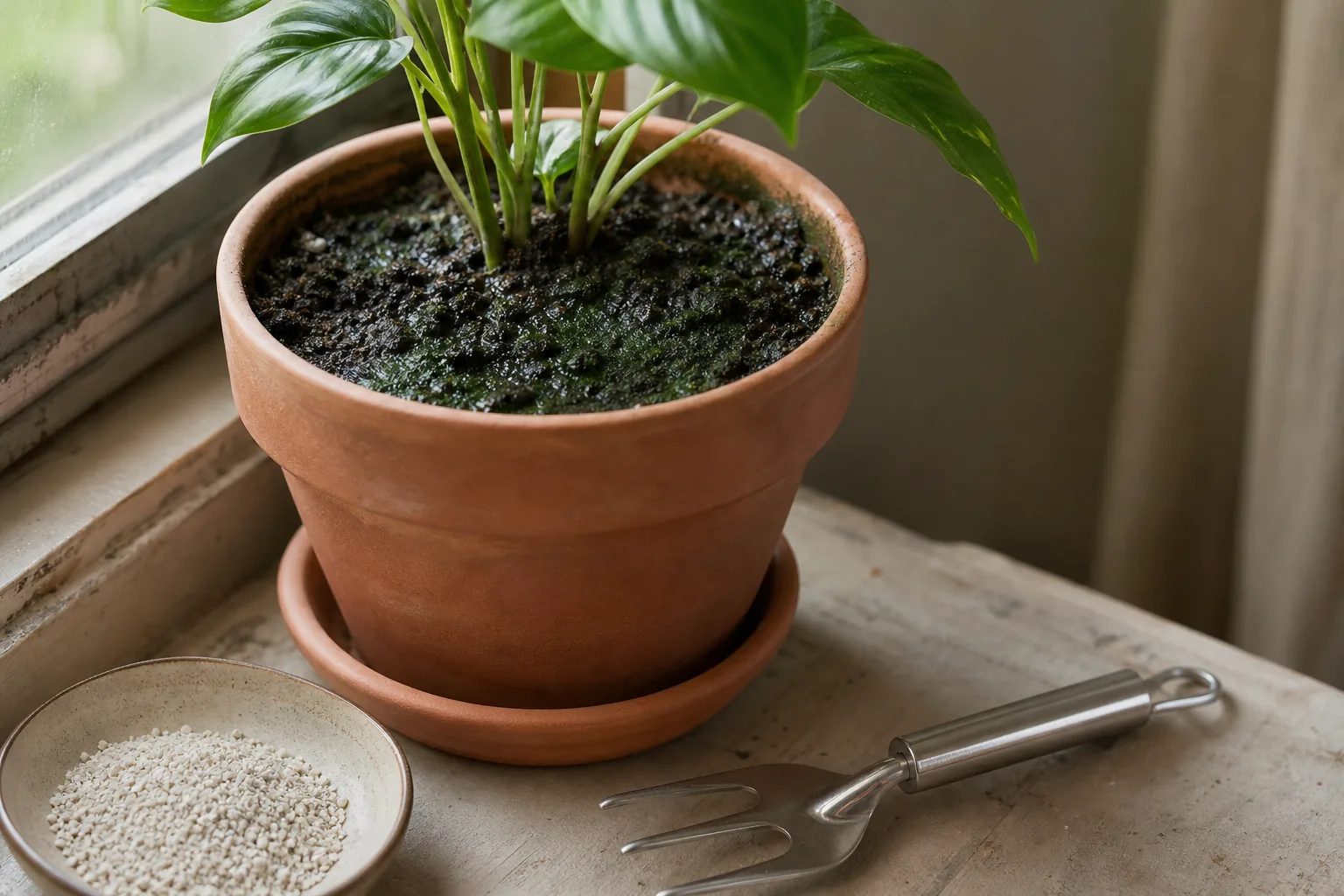
The most common cause of a green layer on the surface of a houseplant’s potting mix is green algae, which university extension services describe as single- to multi-celled photosynthetic organisms that grow under moist conditions and form a greenish film on the surface of growing media. The appearance is usually a thin, slightly damp film, often most visible on the side of the pot that faces a window.
Green algae on houseplant soil is not a fungus and not a mold. It is a living, photosynthetic organism. That distinction matters because it tells you what is allowing it to grow: light and moisture at the top of the pot, not a fungal infection in the deeper root zone.
Green algae versus moss, surface mold, and mineral look-alikes
Because the surface of a pot can collect several different things, it helps to identify what you are seeing before deciding how to respond.
Green algae is a thin, moist, often glossy green film. It tends to spread across the surface as a coat rather than stand up as discrete structures.
Moss is denser. It has visible leaf-like structures and forms a low cushion rather than a film. Moss usually indicates a more consistently moist environment over a longer period, and it tends to be more common in terrariums and shaded outdoor pots than on actively watered houseplant soil.
Surface mold or saprophytic fungi in potting mix are usually whitish, thread-like growths rather than a green film. They feed on organic debris in the mix and can coexist with algae because both like a damp surface, but they are visually different.
White mineral or salt crust is not alive. It is a chemical residue from hard water or fertilizer that builds up on the surface and the pot rim. It looks chalky or crusty and does not smear green when rubbed. If you are not sure which you have, our guide on how to read the white mineral crust on houseplant soil walks through that side of the comparison.
A fourth, less common possibility is cyanobacteria, sometimes called blue-green algae. They are a different group of photosynthetic organisms and can appear greenish, blue-green, or dark and slimy. Most green films on houseplant soil are not cyanobacteria, but if the growth is unusually dark, slimy, and blue-tinted, it is reasonable to treat it with a little more caution.
The three conditions that let green algae take hold
Algae need three things to establish on a houseplant surface, and all three are usually present in an algae-prone pot.
Persistent surface moisture is the main driver. The top of the mix stays damp for days at a time, usually because the plant is being watered before the top of the mix has dried out, or because drainage is slow.
Light reaching the top of the pot is the second requirement. Algae are photosynthetic, so they cannot establish on a surface that is dark. Pots that sit directly in a bright window, or pots whose top is exposed while the plant itself is in bright light, are the most common algae sites.
A stable, undisturbed surface is the third. Algae grow slowly across a compacted top layer that gives them something to grip onto. In practice, regularly disturbing the surface seems to slow algae from establishing in the first place, although the strongest lever is still letting the surface dry between waterings.
Airflow is a useful fourth variable. Still air keeps the surface wet longer, while a little air movement across the pot helps the top dry between waterings.
Is green algae harmful to a houseplant? An honest risk assessment
The clearest statement from extension sources is that algae growth on houseplant soil is not usually detrimental to plants. The risk is indirect rather than direct.
The two indirect effects worth knowing about are these. First, an algae-laden surface can crust over as it dries, and a crusty surface interferes with water absorption the next time you water. Second, algae growth on the surface is associated with fungus gnats, which are attracted to the damp, organic-rich top layer and then become a separate nuisance indoors.
There is no extension-supported evidence that green algae meaningfully competes with a houseplant for nutrients in a pot, or that it directly causes root rot. The conditions that allow algae are also the conditions that allow root problems, which is why algae is a useful prompt to check watering rhythm and drainage, not a verdict that the roots are in trouble.
For people and pets, the default is also that green algae on houseplant soil is not a hazard. Some green algae can be allergenic for sensitive individuals in certain built-environment contexts, and cyanobacteria, which are uncommon on houseplant soil, include some toxin-producing species. Harmful algal blooms that affect people and animals are primarily a water-borne phenomenon, not a soil-surface one. If you have a specific concern about a film that looks unusual, or a pet or child who has disturbed or ingested soil, contact a local nursery, your extension office, or your veterinarian or pediatrician for guidance.
How to clean green algae off the soil surface without hurting the plant
Cleanup is mechanical, proportionate, and quick. A recommended approach from a university extension source is to scrape off about a quarter inch (roughly six millimeters) of the affected surface and replace it with an equal amount of sand, vermiculite, or perlite. That step removes the bulk of the growth, refreshes the surface with a material that dries out faster than organic mix, and breaks the chain of conditions that allowed it to establish.
A few practical notes on doing this safely:
Use a fork or small trowel to loosen the top layer and lift it out. Try to keep the scraping shallow so you are not disturbing the main root mass underneath.
Dispose of the scraped-off material in the trash or outdoors, not in your compost, since you are removing a living culture.
Replace with sand, vermiculite, or perlite. A thin layer — about a quarter inch — is enough. Coarse material on top dries faster than the mix underneath, which makes the surface a less hospitable place for algae.
Avoid the temptation to apply a chemical home remedy. Hydrogen peroxide, cinnamon, baking soda, neem oil, and insecticidal soap are not endorsed by extension sources for algae on houseplant soil and are not the proportionate response to a surface-dwelling photosynthetic organism. The proportionate response is mechanical removal plus adjusting the conditions.
Preventing green algae from coming back
Once the surface is cleaned, the next move is to adjust the conditions that allowed the algae to grow in the first place. The levers, in roughly this order, are:
Let the top of the potting mix dry between waterings. The dry-down rhythm is the same one described in our guide to watering by observation rather than by schedule. If the top of the mix is still visibly damp, wait. If it is dry to the touch and the pot feels lighter than usual, it is time to water.
Improve airflow around the pot. A small fan in the room, or simply moving the pot a few inches away from a wall or a dense grouping of other plants, lets the surface dry faster.
Manage light at the surface. A coarse top-dressing of sand, grit, or decorative stones helps block light from reaching the mix, which removes one of the three conditions algae need. If you are unsure how much direct light your pot is actually receiving, our guide on how to read the natural light in your room gives an honest way to judge that for yourself.
Check drainage. A pot that holds water at the bottom keeps the surface wet longer than a pot that drains freely. If the algae keeps returning on a particular plant, it is worth confirming that water is actually leaving the pot rather than sitting in a saucer or cachepot underneath. Our guide on whether a pot needs drainage holes walks through how pot setup affects the wetness of the surface above.
These are not big interventions. Together they remove the moisture-and-light pairing that algae need, and in most cases that is enough to stop the green film from coming back.
When the green surface is pointing to a bigger root-zone issue
Surface algae is not itself a root problem. But the same watering rhythm that keeps the top of the pot wet often keeps the deeper root zone wet too, and that is worth checking if algae keeps appearing.
A simple ordered inspection:
Lift the pot. If it feels heavy for its size and the surface stays damp for days, the deeper mix is probably also slow to dry.
Look at the pot’s drainage. Standing water in a cachepot or saucer, or a pot without a drainage hole, is a common reason the root zone stays wet.
Watch the plant, not just the soil. The signs our guide on how to tell if a houseplant is overwatered walks through — yellowing lower leaves, soft stems at the base, a sour smell from the mix — point to a root-zone problem rather than a surface phenomenon.
Surface algae is best read as a canary. It tells you the top of the pot is wet and lit. That is useful information by itself, and it is also a reason to glance at the rest of the watering and drainage picture so any underlying issue is caught early.
Sources
- University of Maryland Extension — Algae and fungal growth on the soil of indoor plants
- University of Alaska Fairbanks Cooperative Extension Service — Houseplant pests and control
- Clemson University HGIC — Houseplant diseases and disorders
- University of Florida IFAS — A basic guide to mushrooms commonly encountered in potting media (PP377)
- Premier Tech Horticulture — Controlling algae on growing media