Plant care
Coco coir vs peat moss for houseplants: how to choose the right base
· Updated
Both coco coir and sphagnum peat moss can anchor a houseplant mix, but they behave differently in the pot. Peat holds more water per volume, runs acidic, and becomes hard to rewet if it dries out completely. Coir holds a bit less water at saturation, drains more freely, sits closer to neutral pH, and rewets quickly, but it can carry sodium, potassium, and chloride that need to be rinsed or buffered before use. Neither is universally better. The right choice depends on the plant, your watering rhythm, your tap water, and your values around peat bog sourcing.
This article is an ingredient-level companion to our broader label-reading framework for houseplant mixes. It zooms in on the two most common base ingredients you will see on a bag or in a DIY recipe, and what each one actually does over a normal six-to-twelve-month cycle in a real room.
What coco coir and peat moss actually are
Sphagnum peat moss is a partially decomposed moss harvested from peat bogs, mostly in northern latitudes. The moss grows slowly in waterlogged, acidic conditions, accumulating as a thick fibrous mat over centuries. When it is dried and bagged for horticulture, it is essentially a sterile, soilless, fibrous material with no meaningful nutrition of its own.
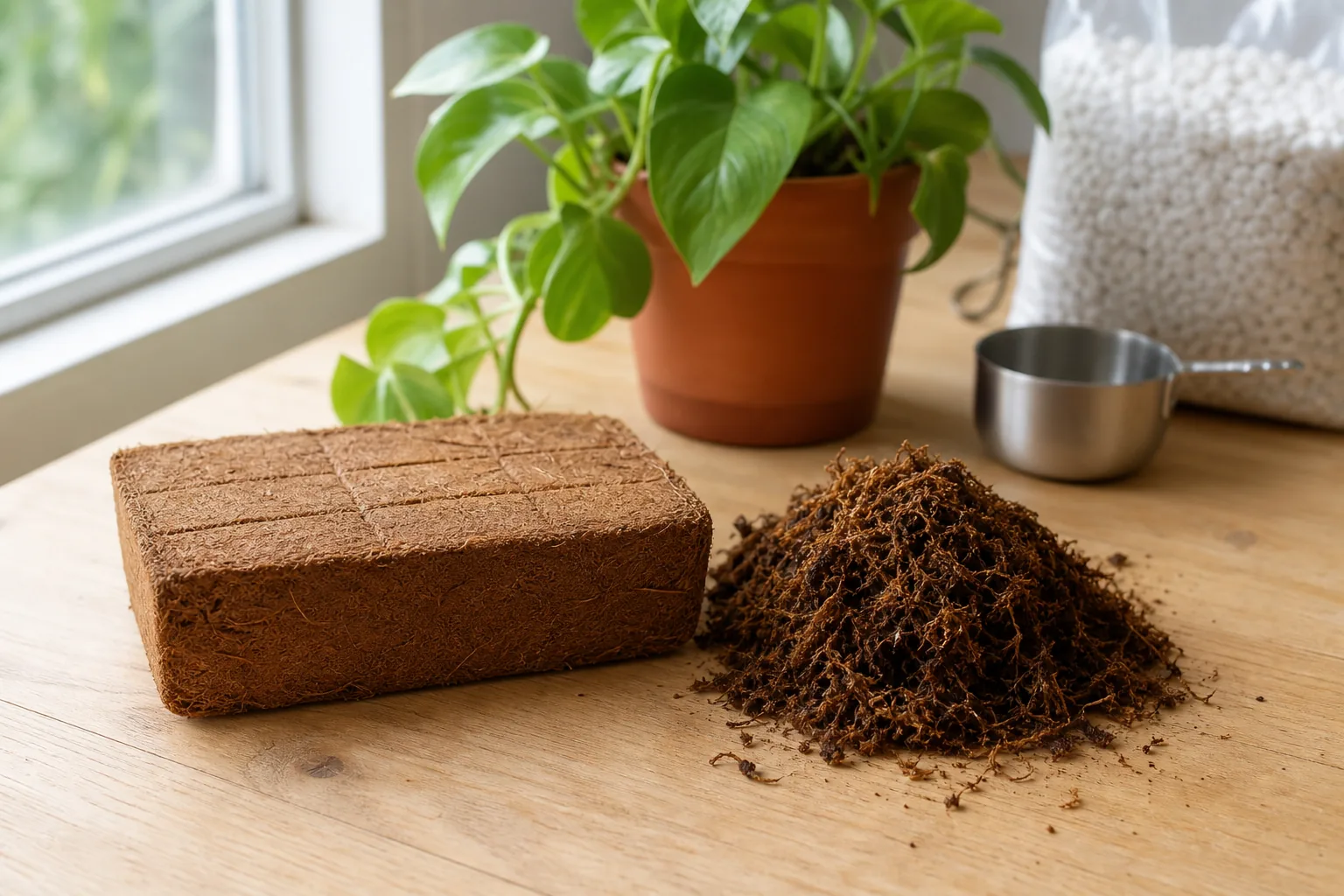
Coco coir, often called coco peat or coir pith, is the short fiber and dust recovered from coconut husks, a byproduct of the coconut industry. It is also essentially sterile and soilless at the bag level, and provides no real nutrition on its own. The husk material is washed, graded, and either pressed into bricks or sold loose. Quality varies widely by origin, washing, and whether it has been buffered, which we will come back to. Research on coir dusts from different sources confirms that bag-to-bag physical properties are not uniform, so two bags labeled “coir” can behave quite differently in the pot.
Both are widely available, both work, and both need a fertilizer program to actually feed the plant. Our houseplant fertilizer basics guide covers how to think about feeding in either base. The choice between the two ingredients is about water behavior, pH, salt risk, and longevity, not about whether the plant can grow in either.
How the two feel in the pot: water holding, aeration, and re-wetting
The single biggest difference is what the pot does the moment you water it.
Peat holds more water per unit volume than coir, and it holds onto that water. A peat-based mix tends to stay moist longer between waterings, which is helpful if you tend to forget, and risky if you tend to overwater. Coir holds a useful amount of moisture but releases it a bit faster and lets air back in sooner, especially in the first weeks after potting.
Aeration follows from that. Because coir resists compaction and microbial breakdown longer than peat, a coir-based mix tends to keep more of its air pockets over months. Peat can compress and mat as it ages, slowly squeezing out the air space roots need. The University of Arkansas extension publication on container growing media specifically notes that coir contains more lignin and less cellulose than peat, which makes it more resistant to microbial breakdown and less prone to shrinking in a container.
The other practical difference is re-wetting. Coir rewets quickly and evenly. Peat, once it has fully dried out, becomes hydrophobic: water beads on the surface, runs down the inside of the pot, and exits the drainage hole without ever reaching the middle of the root ball. Both the same extension source and the extension-affiliated Fairfax Gardening reference flag this as a real and frequent problem with peat. If you have ever watered a peat-based pot, watched the water rush out the bottom almost immediately, and wondered what just happened, hydrophobicity is the usual answer. If the symptoms on the plant look like overwatering even though you just watered, our guide to telling overwatering from underwatering can help you read what is actually happening.
The fix when a peat pot refuses water is to bottom-water it, to soak the whole pot in a sink, or to add a small amount of a surfactant-based wetting agent. Coir rarely needs any of that.
pH, water quality, and what that means for tap-water growers
Raw sphagnum peat moss is strongly acidic, most commonly described in the pH 3.5 to 4.5 range across extension and gardening references. Coco coir, especially when it has been washed and buffered, sits much closer to neutral, with industry sources commonly placing it in the 5.5 to 6.8 band, a slightly acidic tone that suits most general tropical houseplants. (Botanicoir, for example, cites roughly 5.8 to 6.5; other industry and consumer references widen that to about 5.5 to 6.8.)
Because raw peat is so acidic, most commercial peat-based mixes are amended with limestone at the bag to bring pH up into a plant-friendly range. A peat-based bagged mix rarely runs as acidic as raw peat. Coir-based mixes usually need little or no pH adjustment.
For a reader using ordinary tap water and a standard houseplant fertilizer, this means a properly formulated bagged mix of either type will already be in a workable pH range. The pH difference matters more when you start mixing your own from raw ingredients, or when you grow a collection heavy in acid-loving plants (some ferns, African violets, blueberries) rather than a general tropical mix.
If your tap water is very hard or very soft, pH drift is worth watching in either base. It is one reason readers with tricky water sometimes prefer coir: a slightly higher starting pH leaves more headroom before the mix swings too far in either direction.
The salt question with coir, and the mineral question with peat
Coir is grown and processed in coastal regions, and unbuffered coir can carry elevated sodium, potassium, and chloride. The bigger issue is its cation exchange profile: the negatively charged sites on coir fibers tend to be occupied by sodium and potassium rather than calcium and magnesium, so when you fertilize, the plant can run short of Ca and Mg even when those nutrients are in the fertilizer. Industry guidance recommends either rinsing coir thoroughly with low-EC water before use, soaking it in a calcium-magnesium solution to buffer the exchange sites, or buying coir that has been pre-rinsed and buffered by the supplier. If a bag of coir is labeled “buffered” or “low-EC,” that is what the label is trying to communicate.
Peat has the opposite starting salt profile. It is naturally low in soluble salts, but as the months pass and you fertilize, salts from the fertilizer and from hard tap water can accumulate at the surface. The visible sign is the same in both cases: a white or yellowish crust on the soil or pot rim. Our guide to soluble salts and mineral buildup on soil and pots walks through how to read that crust and what to do about it, and the basic fix is the same regardless of which base ingredient is in the pot: flush with plain water, dilute your fertilizer, or refresh the top inch of mix.
The takeaway is that a surface crust is not a sign that the base ingredient is wrong. It is a sign that salts are accumulating faster than water is flushing them. Either base can produce one.
How the mix breaks down over months in a real room
Both ingredients are organic and both eventually degrade, but on different timelines. Peat, with its higher cellulose content, breaks down faster under microbial action, which is part of why an old peat-based mix can compact and lose air porosity within a year. Coir, with its higher lignin content, holds its structure longer and tends to keep its air pockets through a longer stretch of normal indoor use.
The practical effect is that a peat-based pot that has been in the same container for a year or more often needs a refresh sooner than a coir-based pot, especially if the plant has been watered heavily or sits in a low-light corner where the mix stays wet for long stretches. A reader trying to decide whether an existing mix has aged out can use pot weight, drainage speed, and the plant’s growth as the real signals; our piece on how to tell when old potting mix has degraded walks through that judgment. The base ingredient mostly changes the pace of that aging, not whether it happens.
Sustainability and sourcing, without the marketing
Sustainability is the question readers most often raise about this choice, and the right framing is a careful one.
Sphagnum peat is harvested from peat bogs, which accumulate very slowly and are widely recognized as important carbon stores and wildlife habitat. Many extension services and conservation-focused resources have begun encouraging reductions in peat use where alternatives exist, and a reader who wants to minimize their peat footprint has a reasonable case for choosing coir or a peat-free mix. The research base for that recommendation continues to evolve, and specific botanical garden citations on peat bog conservation are outside the scope of this article.
Coir, for its part, is a byproduct of the coconut industry, but rising demand has shifted the supply picture. It is no longer a pure waste stream in every region, and shipping bulky coir from tropical origins carries its own footprint. Treat “coir is a byproduct” as background, not as a settled environmental verdict.
The honest answer is that this is a values-informed choice. Either base, sourced responsibly and used thoughtfully, is a defensible choice for an indoor gardener. What matters more than the label is whether the mix is well drained, refreshed when it has degraded, and matched to the plant and the room.
Matching the ingredient to the plant: a few common houseplant cases
The evidence does not support a hard “use peat for X, coir for Y” map, because most of the published physical-property data comes from container-production research rather than controlled indoor trials across species. That said, common practice groups the choices roughly like this:
- Aroids and many general tropicals (philodendron, pothos, monstera): coir-forward blends with chunky perlite and orchid bark are widely used, because coir rewets easily and resists compaction in a chunky mix.
- Moisture-leaning plants and many ferns: peat-forward blends hold moisture longer and tend to suit plants that prefer a consistently damp root zone, especially in higher humidity rooms.
- Succulents, cacti, and plants that want fast drainage: neither peat nor coir alone is ideal, and the base ingredient matters less than the share of perlite, pumice, or bark in the mix.
- Acid-loving plants: peat-leaning mixes naturally suit them, though most bagged peat mixes are already limed into a more neutral range.
The right ratio of perlite, bark, and base does more for drainage than the choice between peat and coir. The base sets the water-holding tone; the amendments decide how wet the root zone actually stays.
A simple decision framework for choosing or blending
A few questions usually point to a clear default.
- Do you tend to underwater? A peat-forward mix will hold moisture longer and forgive a missed watering.
- Do you tend to overwater, or do most of your plants sit in plastic nursery pots with little airflow? A coir-forward mix with extra perlite or bark will be more forgiving.
- Is your tap water very hard, or do you grow a lot of acid-loving plants? A peat-leaning or peat-based mix, properly limed at the bag, is a reasonable starting point.
- Do you want to minimize peat use for sourcing reasons, or do you want a base that resists compaction over a long-lived pot like a fiddle leaf fig or a large monstera? Coir-forward is the more common choice here.
- Are you mixing your own from raw ingredients? Buffer or rinse coir first, plan to add limestone to peat, and weigh the base against the amendments rather than treating the base as the whole answer.
If you are still on the fence, a blend that mixes some coir with some peat, plus perlite and bark, is one reasonable option for a mixed houseplant collection. It can give you some of the water-holding of peat with the rewetting and structural stability of coir, though the right ratio depends on the plants and the room. Whichever base you pick, the single most important habit is to water by feel and pot weight rather than a schedule; the base ingredient sets the rhythm, and observation is what keeps it on track.
Sources
- University of Arkansas Cooperative Extension Service. Growing media for container production in a greenhouse or nursery (FSA-6097). https://www.uaex.uada.edu/publications/pdf/fsa-6097.pdf
- Purdue University Extension. Commercial Greenhouse and Nursery Production: Growing Media (HO-255-W). https://www.extension.purdue.edu/extmedia/HO/HO-255-W.pdf
- Holman, A. Comparison of Coconut Coir and Sphagnum Peat as Soil. USU Digital Commons, Utah State University (2005). https://digitalcommons.usu.edu/cpl_hydroponics/1/
- Abad, M. et al. Physical Properties of Various Coconut Coir Dusts Compared to Sphagnum Peat. HortScience 40(7):2138–2144 (2005). https://journals.ashs.org/downloadpdf/view/journals/hortsci/40/7/article-p2138.pdf
- Premier Tech Horticulture. Sphagnum Peat Moss Influence on Physical Properties of Growing Media. https://www.pthorticulture.com/en-us/training-center/sphagnum-peat-moss-influence-on-physical-properties-of-growing-media
- Fairfax Gardening (Virginia Cooperative Extension-affiliated public education). Peat v. Coir. https://fairfaxgardening.org/peat-v-coir/
- Botanicare. When to Rinse or Buffer Coco Coir. https://www.botanicare.com/hydro-101/when-to-rinse-or-buffer-coco-coir/
- Botanicoir. A guide to coco coir nutrients and pH levels. https://www.botanicoir.com/a-guide-to-coco-coir-nutrients-and-ph-levels/