Plant care
Is your Alocasia dormant or declining? A calm, observation-first guide
· Updated
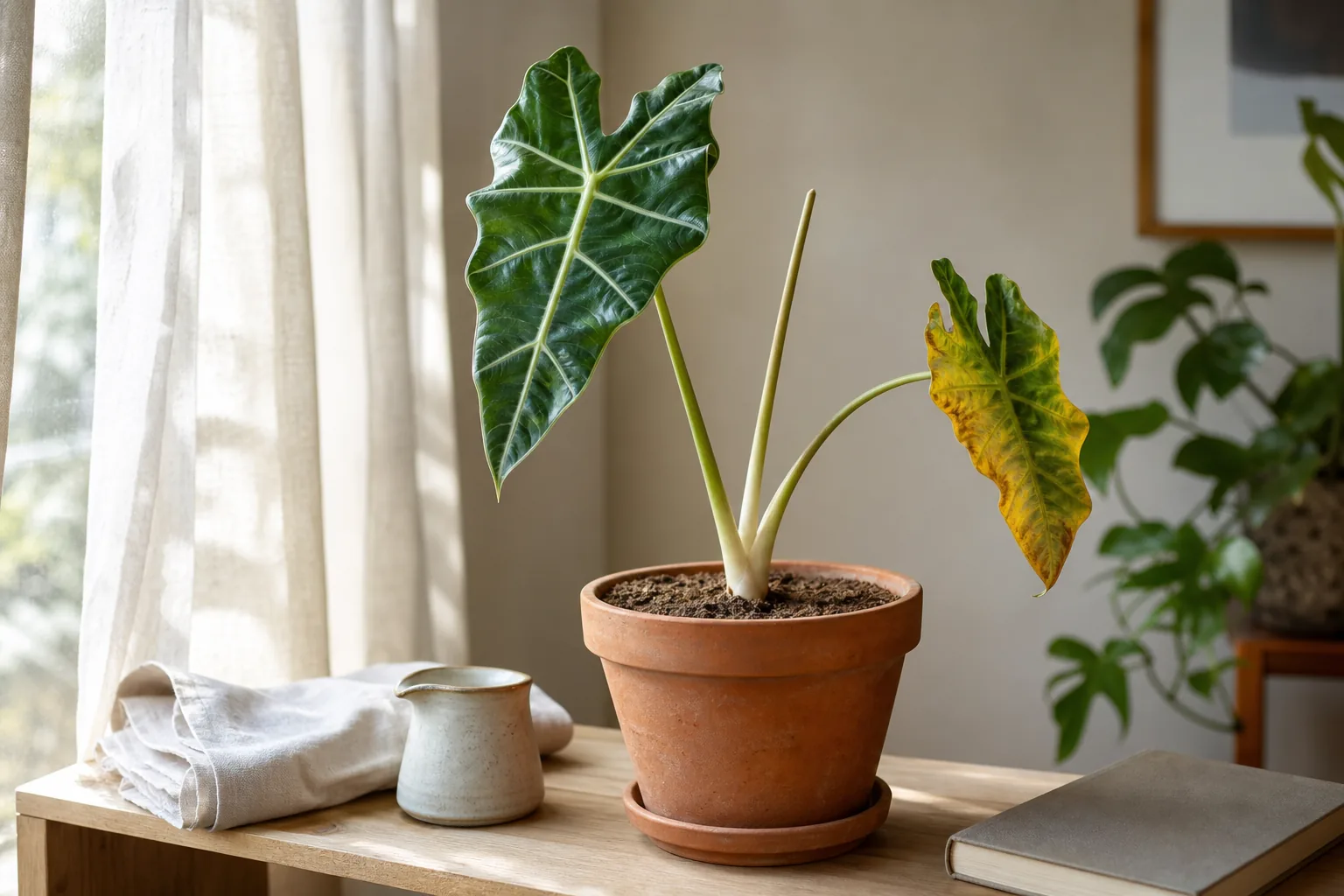
A quiet or leafless Alocasia is one of the more confusing situations in indoor plant care. A natural dormancy pause and a real decline can look almost identical from above the soil line: yellowing leaves, drooping petioles, no new growth. The two states have different causes and call for different responses, so the goal is to separate what you can see without unpotting from what you can only know with a closer look.
The honest answer is that the question cannot be settled by any single observation. It gets settled by combining several: the season, the pattern of leaf loss, what the stem base feels like, and how the soil has been drying. None of those is decisive on its own. Together, they usually point in one direction.
Why Alocasia dormancy and decline are easy to mix up
Alocasia are tropical aroids kept for their dramatic leaves, and indoors in temperate climates they often respond to changes in light, temperature, and humidity by slowing down. A few of the cues that read as decline — older leaves yellowing, petioles softening, no new growth — are also part of how a healthy Alocasia rests. The trouble is that the same surface can also be the early shape of corm rot, chilling damage, or a pot that has quietly broken down.
That overlap is the whole reason this question feels hard. Above the soil line, the information is limited. Most of what you need to know is at the stem base, in the corm, or in the moisture rhythm of the mix over the last few weeks.
What normal Alocasia dormancy usually looks like
Dormancy is a regulated seasonal response. The University of Georgia Extension describes it as a plant slowing or pausing growth in response to environmental cues, not as a sign that the plant is dead.
Indoor Alocasia commonly enter this kind of rest when days shorten, indoor temperatures settle into a cooler range sustained over days or weeks (commercial plant-care sources cite thresholds around 15°C / 60–65°F), the light at the plant’s spot drops, and indoor heating lowers humidity. The visible pattern is usually:
- Older outer leaves yellowing and dropping first, while newer leaves may stay green for a while
- Petioles drooping even before they yellow
- A long pause — often weeks to several months — with no new leaves unfurling
- The stem base where the petioles meet the mix staying firm and pale
Species and individual plants vary. A. amazonica, A. zebrina, A. polly, A. Frydek, A. cuprea, and other commonly kept Alocasia do not behave identically indoors, and two plants of the same species can also differ. A short, mild rest is not the same as a long, deep one. The honest framing is that dormancy is a season shaped by your plant’s species, light, and room temperature, not a fixed number of weeks on a calendar.
This is also why dormancy and stress-driven leaf drop get confused: a move, a draft, or a sudden light change can produce yellowing that looks similar. Our guide to leaf drop after a move or change covers the stress side, and our winter houseplant care post sets the broader seasonal context.
What decline usually looks like instead
Decline has a different texture. The cues that suggest a real problem are usually about tissue quality and pattern, not about whether a leaf or two has yellowed. The signals to watch for are:
- The stem base or corm turning soft, mushy, dark, or hollow
- A sour or rotting smell from the soil or stem base
- Multiple leaves collapsing at once, rather than a gradual loss of older leaves
- Spreading blackening or wet-looking lesions at the petiole or leaf base
- A mix that has stayed wet for many days without drying, especially in a warm room
- Sticky residue, webbing, or visible insects on the undersides of leaves or at the stem
Some of these are rot-type symptoms, often linked to a mix that has stayed wet too long or to chilling damage from a cold window or draft. Some are pest-related. The Royal Horticultural Society treats Alocasia as a tropical aroid kept as a houseplant in cooler climates, which is consistent with the warm, bright, humid conditions most growers aim for, and which is also the same point made in reverse: when those conditions break down, the plant is at risk.
A four-check distinction without unpotting on day one
Before doing anything to the plant, walk through four observations in order. Treat them as a pattern, not a checklist where any one item wins.
Check 1: season and recent change
Did the slowdown start as days shortened, the room cooled, the plant was moved, or watering was changed? If the timing lines up with a cooler, dimmer period, dormancy is a reasonable first guess. If the plant was actively growing and then changed suddenly with no obvious season shift, look harder at decline.
Check 2: pattern of leaf loss
Did the oldest outer leaves yellow and drop gradually, with newer leaves still standing? That pattern fits dormancy. Did several leaves collapse across the plant at once, or did the newest growth die back first? That pattern fits decline. A single yellow leaf does not settle the question. It is the shape of the loss that matters.
Check 3: stem base where the petioles meet the mix
Gently feel the stem base or the top of the corm just below the surface. Firm and pale is encouraging. Soft, dark, squishy, or hollow is concerning. A bad smell from that area is a clear red flag. This is the most informative cue most readers can gather without unpotting.
Check 4: soil moisture rhythm over the last few weeks
A mix that dries slowly in a cool room is expected during dormancy. A mix that has not dried in many days, smells sour, or has standing water at the bottom is not. The watering rhythm is one of the easiest signals to read, and it is also the one most often misread. If you tend to water on a calendar, our guide on watering by observation is a calmer place to reset. If the soil has stayed wet and the plant is limp at the same time, the overwatered-or-underwatered flow is the ordered inspection to run before assuming dormancy.
When a gentle inspection of the corm is worth doing
If checks 1 to 4 leave you unsure, a low-impact inspection is reasonable. Brush some of the surface mix aside with a finger or a chopstick until you can feel the top of the corm. Press it gently. A firm corm with a pale interior when you make a shallow scratch is encouraging. A soft, dark, hollow, or sour-smelling corm is concerning.
It is worth being honest about the limits of this test. A firm corm is a positive sign, not a guarantee that the plant will recover. A soft corm is a reason to slow down and get a second opinion, not an automatic disposal order. Take a photo, note the date, and before cutting anything off or throwing the plant out, contact a local nursery, a master gardener program, or your regional extension office. They can look at your photo and your conditions together, which is something a blog post cannot do.
Care during confirmed dormancy (without overcorrecting)
If the cues point to dormancy, the goal is to support the rest without overcorrecting. Across extension and plant-care sources, the supported pattern is:
- Move the plant to the brightest indirect light you have, while keeping it away from cold windows and heating vents. Checking how much usable light a spot actually gets is worth doing before assuming the plant is in trouble.
- Reduce watering frequency. The mix should still dry somewhat between waterings, and you should still check by weight or finger rather than on a calendar. The goal is less water overall, not bone-dry storage.
- Pause or sharply reduce fertilizer. The University of Florida IFAS Extension notes that fertilizing during drought stress or dormancy tends to stress the plant further, not help it.
- Keep humidity reasonable. A small humidifier, a pebble tray, or grouping with other plants is gentler than frequent misting.
- Do not repot, divide, or move the pot repeatedly. Rest is the goal.
The common overcorrection is to treat dormancy like a dry-storage protocol meant for lifted tubers. Potted indoor Alocasia are not in dry storage. They are in a slow pot with roots and a corm that still need some moisture, just less of it.
If the signs point to decline instead
If your pattern points to decline — soft corm, persistent wet mix with a sour smell, spreading blackening, sudden collapse — the first move is to pause watering and isolate the plant from any healthy neighbors in case the problem is contagious. Photograph the stem base, the corm area, and the soil surface, and use the inspection flow in our guide on wilting in wet soil to cross-check what you are seeing.
Do not cut, soak, or apply any treatment to a rotting corm without checking with a local expert first. None of the plant-care sources in this article’s research support at-home chemical or pesticide treatment for rot-type symptoms in Alocasia. A regional extension office, a master gardener program, or an experienced local nursery can help you tell rot from cold-draft damage, pest pressure, or a pot that has simply broken down, and they can do it with a photo and a few questions.
One more thing worth a sentence. Alocasia contains calcium oxalate and is considered toxic to people and pets. If you live with cats, dogs, or small children, our guide on pet-aware houseplant choices takes a verification-first approach rather than relying on a single list.
A realistic timeline and when to escalate to a local expert
How long dormancy lasts indoors depends on the species, the light, the room temperature, and the plant itself. Sources describe windows of weeks to several months, and none converges on a single number. The supported framing is: a healthy corm in a bright, warm spot will usually resume growth when conditions improve, on its own clock.
The signs that mean it is time to escalate to a local expert — a nursery, a master gardener program, or your regional extension office — are:
- The corm is soft, dark, hollow, or smells sour
- The mix has stayed wet for many days and the pot has no clear drainage
- Blackening is spreading at the petiole or leaf base
- The plant has not produced any new growth well after brighter, warmer conditions have returned, and a root-bound pot has been ruled out
A quiet Alocasia is not automatically a lost Alocasia. It is a plant asking for slower hands, a closer look at the corm, and a calm read of the conditions around it. With a few minutes of observation and a willingness to call a local expert before making big decisions, most owners can give their plant a fair chance to come back on its own.
Sources
- Royal Horticultural Society. How to grow alocasias.
- University of Georgia Extension. Part 1: The Science of Plant Dormancy.
- University of Florida IFAS Extension. Healthy Plants, Watering Restrictions, and Extreme Drought.
- AlocasiaPlant.com. Alocasia dormancy in winter: how to keep your plant alive until spring.
- Foliage Factory. Houseplant dormancy: how to tell rest from stress.