Plant care
Why your indoor succulent is stretching, and what to do about it
· Updated
The short answer
Stretching on an indoor succulent — also called etiolation — is almost always a slow growth response to not enough usable light over weeks or months. The stretched, pale stem will not shrink back on its own. Only new growth produced under better light can become compact again, and severely stretched rosettes are usually beheaded and re-rooted rather than left in place.
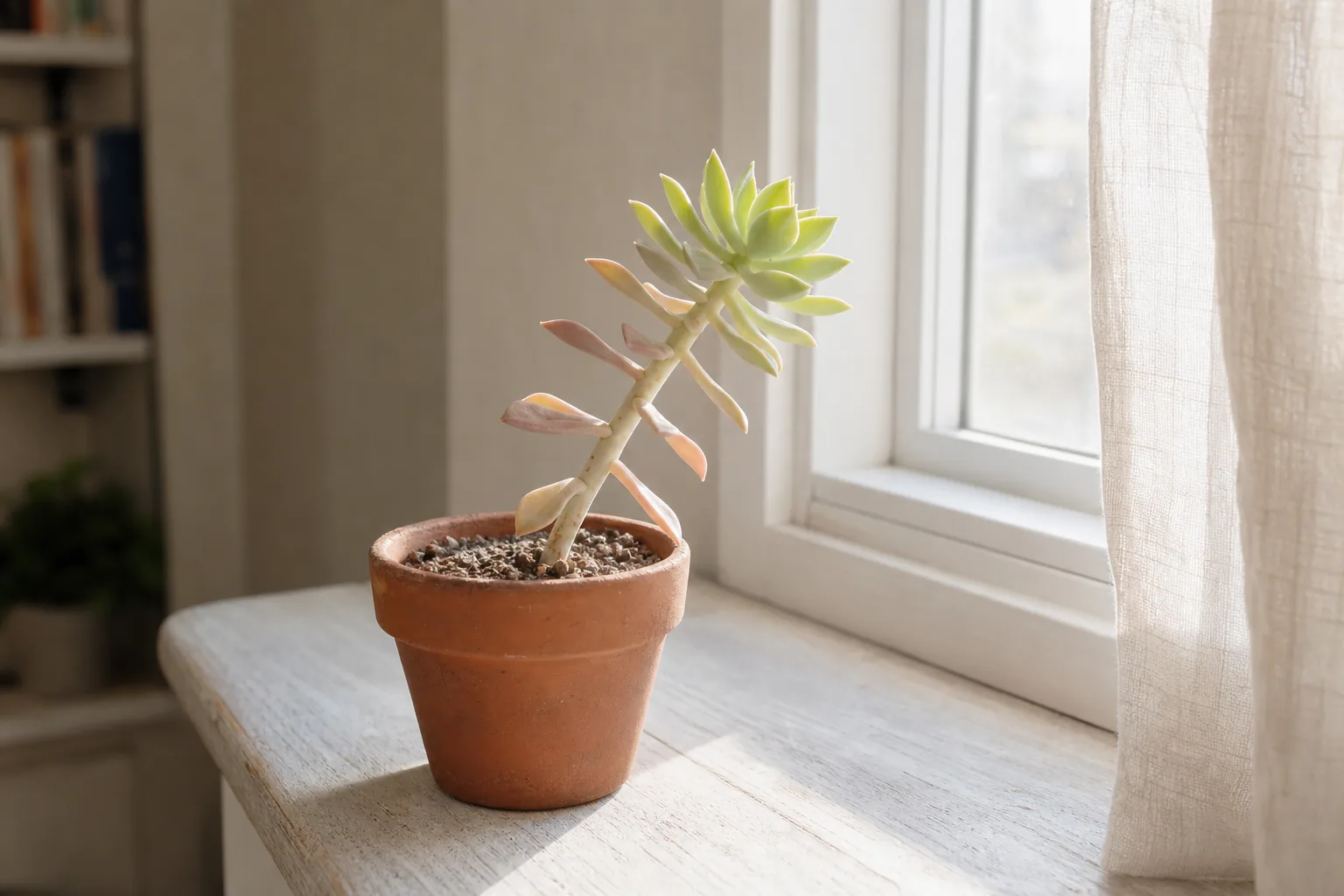
What stretching actually looks like on the plant
Etiolation shows up as a set of small, easy-to-miss signals before it becomes obvious. Reading them early is the difference between catching a mild stretch and inheriting a long, leaning stem.
- Widening gaps between leaves. Look at the newest growth. If the space between leaves is wider than the leaves themselves, that gap is an elongated internode — the clearest single sign.
- Smaller new leaves. New leaves come in noticeably thinner or narrower than the older ones underneath.
- Paler new growth. The newest leaves look washed-out or yellow-green even when the older leaves are still colorful.
- Leaves pointing down. On a rosette, leaves that begin to angle downward or splay outward are reaching for light.
- A leaning stem. The whole plant tilts toward the brightest source, usually the window, and the rosette may also flatten or open up.
These signals tend to appear together, but a reader often notices only one at first. If any of them are present and the plant has not been moved, repotted, or seasonally shifted in the past several months, light is the most likely cause. Stretching in succulents is the same pattern that shows up as leggy growth in other indoor houseplants, and the why houseplants get leggy post covers the cross-species version if you want the broader framework.
Some succulents grow tall by nature. Columnar cacti, certain Crassula (such as mature jade plants), and some Sedum can have vertical or trailing habits without etiolating. The test is internode length and color: a naturally tall plant keeps compact spacing and rich pigmentation, while an etiolated plant does neither. A flower stalk is a different signal too. It emerges from a specific point on the rosette, grows in a defined pattern, and ends in buds or flowers, and it does not change the spacing of the main rosette’s leaves the way etiolation does.
Why succulents stretch indoors
Succulents evolved in bright, arid conditions where direct sun is the default. Indoor light through a window is weaker than outdoor sun, often by a wide margin, and a spot that reads as bright to human eyes can still be too dim for a plant that expects full sun. According to the San Diego Botanic Garden, etiolated growth develops when a cactus or succulent does not get enough light to grow properly — the plant grows overly tall and skinny as it reaches for the sun and becomes much paler.
When the light reaching a succulent falls below what it needs over weeks or months, the plant shifts its growth strategy. It elongates its internodes and reorients itself toward whatever light is available. Watering frequency, fertilizer, pot size, and soil mix do not cause this response — they can affect other symptoms, but the stretch itself is driven by light. UF/IFAS frames the practical target as more than four hours of direct indoor light for most succulents, which is a useful anchor even if the exact number is a starting point rather than a fixed rule.
How to read your room’s light honestly
Before moving the plant, take a careful look at what the room is actually offering. A quick, honest read saves weeks of misplaced effort.
- Window orientation. South- and west-facing windows in the northern hemisphere generally give the strongest direct light. East-facing windows give a few hours of softer morning sun. North-facing windows give little direct light for most of the year.
- Hours of direct sun. Note when direct sun actually touches the plant, not just when the room is bright. A plant that gets strong sun in summer can drop to just a couple of hours of direct sun in winter if neighboring buildings or bare trees block the path.
- The shadow test. At midday, hold your hand between the window and a piece of paper on the windowsill. A sharp, dark-edged shadow means strong direct light. A faint or fuzzy shadow means bright indirect light, which is often not enough for a rosette succulent.
- Obstructions. Trees, neighboring buildings, frosted glass, screens, and interior curtains all cut the usable light significantly.
If you want a fuller walk-through of reading the light in a specific room, the natural light guide for indoor houseplants covers the shadow test and orientation questions in more detail.
A useful honesty check: a shelf a few feet back from a bright window, or a desk across the room from one, usually does not give a rosette succulent what it needs, even if the spot looks well-lit.
What is and isn’t reversible
The single most important thing to know before you act: stretched tissue stays stretched. The pale, elongated section on the existing stem will not shorten back or un-stretch. That part of the plant is permanent.
What is reversible is what happens next. Under better light, the succulent stops stretching. New leaves come in tighter, smaller, and more pigmented, and the plant’s compact form starts to rebuild from the top down. Over months, a slightly stretched plant can look essentially normal again at the growing tip, even if the lower stem is still visibly elongated.
This is why moving the plant is always the right first move, even when the existing stretch is significant. It stops the problem from getting worse and begins the recovery of new growth.
Three proportionate responses
How you respond depends on the room you have, not on a universal best answer. Pick the option that fits your space and your appetite for setup, not the most involved one.
Relocate to a brighter spot
If you have a south- or west-facing window that gets several hours of direct sun, this is the standard first move. Transition the plant gradually over one to two weeks — start it in the new spot for an hour or two of direct light and increase from there — because leaves that were shaded for months can sunburn if suddenly exposed to strong sun. Once acclimated, water and care follow the usual indoor succulent care in a sunny window rhythm.
Add a grow light
If no window in your home gives enough direct light, a grow light is the realistic option. Treat it as a tool with trade-offs rather than a default fix: cost, heat, daily on-time, and the need to keep the fixture close enough to actually deliver light to the leaves. Iowa State Extension frames the relevant factors as quality, intensity, and duration, and notes that a single number on the box is not a guarantee. Watch the new growth over several weeks. If it stays tight and well-colored, the setup is working. If new leaves still arrive pale and stretched, the light is not reaching the plant effectively and needs to be moved closer, run longer, or replaced.
Behead and re-root
When a rosette is severely stretched — long bare stem, small pale leaves, lost shape — the proportionate response is propagation rather than waiting for in-place recovery. Beheading is not throwing the plant away. It is starting a more compact plant from the part that still has the rosette, and the leftover stem often produces offsets or new growth that can be propagated too.
Beheading and re-rooting, step by step
The standard sequence for a rosette succulent is straightforward. Take it slowly and resist the urge to water early.
- Cut the rosette off below the stretched stem with a clean, sharp blade, leaving enough stem on the rosette to handle and to sit upright.
- Set the cutting in a dry, airy spot out of direct sun for several days to let the cut end dry and form a callus. The exact number of days varies with humidity and temperature.
- Place the callused cutting on top of a dry, well-draining succulent mix. Do not bury the stem and do not water yet.
- Wait for roots. After a few weeks, fine white roots usually appear at the base of the stem. Some cuttings root faster, some slower, depending on conditions.
- Once roots have formed, begin light watering and gradually move the new plant into brighter light following the same one-to-two-week transition.
The leftover stretched stem in the original pot often produces offsets along its length over the following weeks. These can be left in place or removed and rooted separately, so a single stretched plant can turn into several compact ones.
Adjusting expectations if a brighter window isn’t an option
Not every home has a sunny window, and not every succulent owner wants a grow light setup. In that case, the honest answer is that the dim corner may not be a succulent room at all. The same space that keeps a snake plant or pothos happy will, over months, stretch and pale a rosette Echeveria or Haworthia no matter how carefully you water it.
If you love the look of a particular succulent and the room is what it is, the practical choices are: accept the stretched growth as it is, propagate a more compact replacement in a brighter room, or pick a different plant suited to the light you actually have. The realistic expectations for low-light houseplants piece goes deeper into how much room different plants can give you in dim conditions, and is a useful reference before you commit to a corner you know is shaded.
The honest summary
A stretching indoor succulent is telling you, in slow motion, that the room’s light is not meeting its needs. The stretched part of the plant is permanent, and new growth can become compact again only if the light improves. The right response is the one that matches the room you have — a brighter window, a grow light with realistic expectations, or a beheading and re-root to start the rosette over — followed by several weeks of patient observation before you judge the result.