Plant care
Should you rotate your houseplant? A practical guide
· Updated
Yes, for most foliage houseplants that live in one-sided light, a small regular turn is a reasonable habit. The catch is that rotation is a placement tool with real tradeoffs, and there are several situations where the right move is to leave the pot exactly where it is. This guide walks through how to tell whether rotation will help your plant, how often to do it, and the cases where skipping it is the better choice.
Why some houseplants lean or grow one-sided
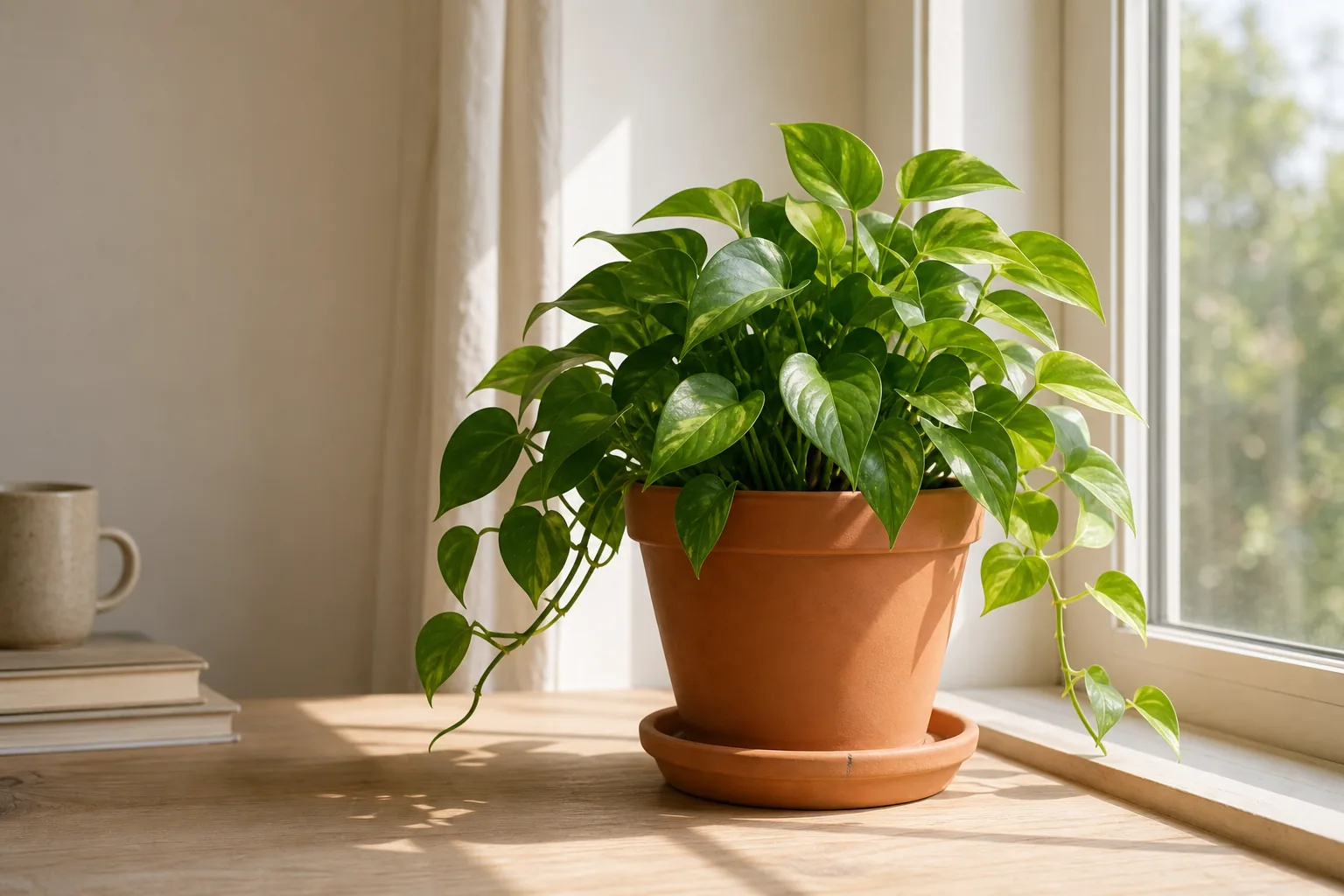
Most rooms give a plant light from one direction, usually a window. On the shaded side of a stem, plant cells elongate more than cells on the lit side, and the stem bends toward the brighter side. This is called phototropism, and it is a passive growth response driven by the hormone auxin, not a deliberate reach. A common foliage plant on a plant stand listing sideways toward a south-facing window is a textbook example of the same mechanism.
Indoor light is usually weaker and more directional than outdoor light, which is why the lean indoors can be so obvious. The Master Gardeners of Northern Virginia describe a houseplant bending toward the window as a clear visible example of phototropism, and the Royal Horticultural Society defines phototropism as the ability of plants to grow toward a light source. The mechanism, as described in a peer-reviewed review in the NIH/PMC literature, is differential cell elongation on the shaded side, with the phototropin light receptors driving the response. Both observations and the underlying biology point to the same practical takeaway: if your plant is leaning, it is responding to where the light is coming from, and turning the pot is the most direct way to give the other sides a turn.
Phototropism addresses unevenness, not light shortage. A plant in a genuinely dim corner will stretch, drop leaves, and grow pale regardless of how often you rotate it. If you want to tell those situations apart, our piece on when a plant is reaching for more light walks through the difference between one-sided leaning and full underlighting.
When a quarter turn actually helps
A quarter turn, about 90 degrees, is the standard adjustment used across horticultural guides. It is small enough that the plant adjusts without a dramatic swing in conditions, and it cycles each side through the brighter position over the course of a few turns.
Rotation is most useful when several conditions line up:
- The plant is established, healthy, and has been in the same spot for at least a few weeks.
- Light is clearly one-sided, usually because the plant is within a few feet of a window and the room does not get strong reflected light from other walls.
- Visible asymmetry is present, with larger or more numerous leaves on one side, or new growth angled toward the glass.
When those conditions describe your plant, rotation is a reasonable, low-effort habit for keeping the silhouette more even. If you are not sure whether your room’s light is actually one-sided, working through how to read the natural light in your room before starting a rotation habit is a useful first step.
When to leave a plant alone instead of rotating it
The same small motion can become a stressor when the plant is already busy adjusting. Skip the rotation habit in these situations:
- During the first one to three weeks after you bring a plant home. It is already adapting to new light, humidity, and handling, and changing orientation on top of that adds another variable. Our guide to the first two weeks with a new houseplant covers that adjustment window in more detail.
- For the first few weeks after repotting, while the root system re-settles.
- Right after moving the plant to a new room or a new spot in the same room.
- When the plant is visibly stressed, with yellowing leaves, soft stems, dropped foliage, or signs of pests.
- When a plant is in active bud or bloom. Because there is no clear general guidance on how rotation affects flowering across species, the safer default during bud set or active bloom is to leave the plant in place until the flowers fade.
In each of these cases, rotation does not become unsafe exactly, but it adds a small change to a plant that is already coping with bigger ones. Standing still is often the better move.
How to rotate without adding stress
A few small habits make rotation easy to repeat and easy to undo:
- Mark the pot or saucer. A small pencil tick or a piece of tape gives you a reference for a quarter turn and lets you return to the original orientation if the plant protests.
- Use the same direction each time, so you are not also asking the plant to reorient around a new starting point.
- Pair the turn with a recurring care moment, like a weekly inspection or watering day. Rotation becomes part of a realistic weekly houseplant routine rather than a separate task to remember.
- Keep the turn small. A quarter turn is enough; a half or full turn exposes a previously shaded side to full window light and can produce a noticeable adjustment period.
The goal is to make rotation boring and predictable for the plant, not a noticeable event.
How often to turn the pot, and what changes the answer
There is no single correct interval. The horticultural sources we reviewed span a wide range:
- A quarter turn as often as every three days for fast-growing foliage in strong, one-sided light.
- About once a week, which is a commonly suggested starting point in indoor plant guides, though not a rule.
- Every two to three weeks for slower growers and plants in lower light, as the Grow Tropicals guide recommends for most foliage houseplants.
What changes the answer is the plant’s growth rate, the strength of the light, and the season. Think of a fast-growing pothos near a bright window, which can produce visible new growth within a week, compared with a slow-growing snake plant or ZZ set back from a dim one, which barely shifts month to month. The first plant benefits from a shorter interval; the second does not need much turning at all.
A simple observation-based test works well: if you turn the plant and a noticeable lean reappears within a week, the light is strong and one-sided enough to support a shorter interval. If the plant stays roughly upright on its own, rotation is mostly cosmetic and you can space the turns out or skip them entirely.
Rotation versus other ways to get even growth
Rotation is one of three common responses to one-sided growth, and it is usually the smallest change you can make:
- Move the plant. Stepping the plant back from the window, closer to it, or to a brighter wall changes the total light it receives and can solve the problem at the source. The University of Missouri Extension categorizes indoor plants by low, medium, and high light needs, which is the right starting point before any rotation habit.
- Add a supplemental grow light. Where window light is dim or unavoidably one-sided, a small grow light raises the total available light and reduces the directional imbalance that drives leaning in the first place.
- Rotate the pot. The smallest intervention, useful for symmetry, but it does not add light.
Rotation is often the easiest option because it requires no equipment and no relocation, but it is not always enough. If you have been rotating a plant regularly and the lean keeps coming back hard, the underlying issue is more likely light quantity than light direction.
It is also worth saying plainly that asymmetry is normal. Plants in nature grow toward open sky, and indoor plants are doing the same thing on a smaller scale. A perfectly symmetrical houseplant is, in the view of many growers, an aesthetic preference rather than a health requirement.
What to watch for in the weeks after you start rotating
Once you begin a rotation habit, a quick check in the following weeks will tell you whether the plant is happy with the change:
- New growth should emerge from several sides of the plant, not just the previously lit side.
- Existing leaves should hold their color and position. Some shedding of older leaves is normal but should not accelerate.
- The plant should not start leaning in a new direction immediately after a turn, which would mean the swing is too large.
If you notice yellowing, leaf drop, or stalled growth within a couple of weeks of starting rotation, stop and let the plant settle. Leaf drop after a move or change usually points to a combination of stresses rather than rotation alone, and giving the plant a stable spot for a few weeks is the right response.
A simple rule of thumb
For established, healthy foliage houseplants in clearly one-sided light, a quarter turn once a week or once every other week is a sensible default. Mark the pot, use the same direction, and skip rotation during the adjustment windows when the plant is already dealing with bigger changes. Treat rotation as a placement habit for symmetry, not as a treatment for poor light, and reach for relocation or supplemental light when a lean keeps coming back.
Sources
- Master Gardeners of Northern Virginia, phototropism glossary entry: https://mgnv.org/plants/glossary/glossary-phototropism/
- Royal Horticultural Society, how plants respond to light and environment: https://www.rhs.org.uk/advice/understanding-plants/how-plants-sense-the-environment
- NIH/PMC, phototropism: growing towards an understanding of plant movement: https://pmc.ncbi.nlm.nih.gov/articles/PMC3963583/
- Khan Academy, phototropism and photoperiodism: https://www.khanacademy.org/science/biology/plant-biology/plant-responses-to-light-cues/a/phototropism-photoperiodism
- University of Missouri Extension, lighting indoor houseplants (G6515): https://extension.missouri.edu/publications/g6515
- University of Illinois Extension, houseplants and indoor lighting: https://extension.illinois.edu/blogs/good-growing/2018-05-31-houseplants-and-indoor-lighting
- Gardening Know How, rotating houseplants — how often should I turn a houseplant: https://www.gardeningknowhow.com/houseplants/hpgen/rotating-houseplants.htm
- Grow Tropicals, should I rotate my houseplants: https://growtropicals.com/blogs/houseplant-tips-tricks/should-i-rotate-my-houseplants