Plant care
How to prune a leggy houseplant for fuller regrowth
· Updated
If your houseplant has long bare stems, small new leaves at the tips, and a sparse crown, pruning can help it look fuller. It will, though, only when the plant actually grows from nodes along a stem, only when each piece you leave on the plant still has at least one healthy node, and only when you fix the underlying light. Cut roughly a quarter inch above a node with sharp, disinfected tools, at a slight angle so water runs off the cut and away from the bud. A bare middle stem with no node will not regrow leaves from the cut end. New growth comes from the nearest node or from the crown, so plan the cut knowing where new shoots will appear rather than hoping they will fill the gap.
Start with the cause, not the shears
Legginess is a light problem that pruning can shape but cannot solve. Stretched internodes (the long, leafless gaps between leaves) appear because the plant is reaching for more light than the room is giving it. Cutting back the stretched stems makes the plant look better for a while, but if the plant stays in the same dim spot, the new growth will stretch again. Before reaching for the shears, take a real look at where the plant sits in your room and consider whether it can handle a brighter window, a different angle, or a simple grow light. The guide on why your houseplant got leggy in the first place covers how to read your light situation. This article assumes you are either addressing light at the same time or planning to.
Confirm pruning is the right tool before you cut
Three problems look similar but call for different responses.
Leggy and otherwise healthy. Long bare stems, small new leaves at the tip, but the plant is producing new growth and the leaves are a normal green. This is the case pruning helps.
Leggy and declining. The plant is leggy and also losing leaves, has yellowing or mushy stems, or shows signs of root trouble. Pruning first is not the move here. Diagnose the broader problem (water, root rot, light, pests) and let the plant stabilize before you cut.
Single-stem, rosette, or rhizome plants. Snake Plant, ZZ plant, African Violet, and most orchids grow from a single point at the soil line and do not branch from a stem cut the way a vine does, because there is no stem with nodes along it. Spider Plant is a useful contrast in a different way: it grows as a clump of rosettes and spreads by sending out stolons that root as plantlets, so it gets fuller through division and plantlet replanting rather than from a tip cut. For any of these, the relevant action is removing whole outer leaves at the base, separating pups or offsets, or dividing the plant. Iowa State Extension’s propagation guide uses Pothos versus African Violet to illustrate just how different the response can be, and our Spider Plant care guide walks through the plantlet path.
If your plant is in the first group and you have a vine or herbaceous houseplant with visible nodes along the stem, pruning is on the table.
Read the plant: nodes, growth points, and species habit
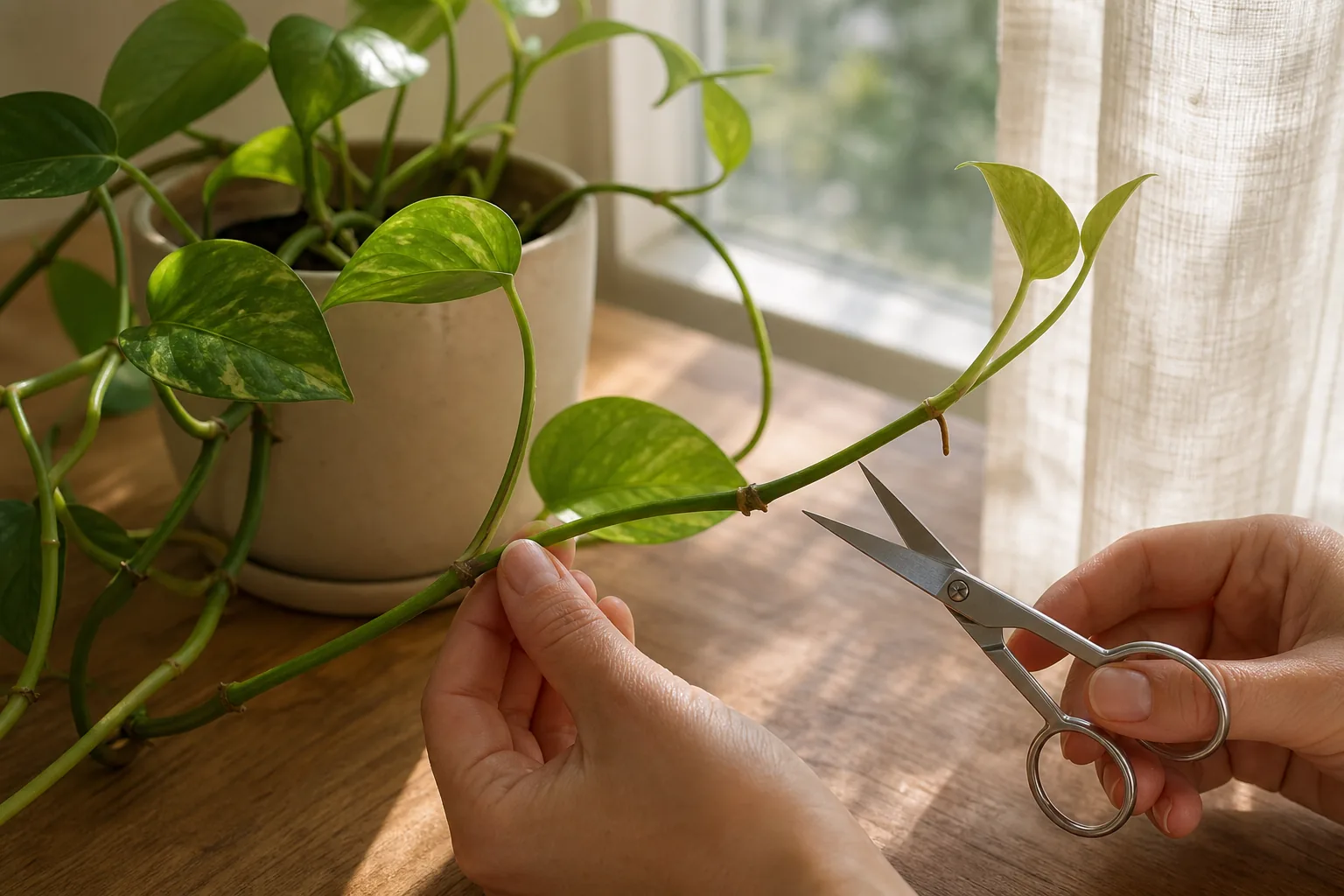
Before you cut anything, spend five minutes finding the nodes. A node is the joint on a stem where a leaf, a pair of leaves, or an aerial root emerges. On a Pothos or Heartleaf Philodendron it usually looks like a small bump, a slight thickening, or a brown ring, sometimes with a little nub that wants to become a root. The smooth stretch of stem between two nodes is called an internode.
This matters because new shoots grow from nodes, not from the internode. A bare middle section of an old stem will not refoliate from the cut end. New growth appears at the nearest node, at the base, or from the crown. This is the central honesty point of pruning a leggy houseplant: you are not magically filling in the gap, you are redirecting where new growth comes from.
To find a node, run a finger along a stretched stem until you feel a bump or a small ridge. Look for the same places where leaves used to attach or where you can see a tiny aerial root starting. If you can find at least one healthy node on every section you plan to leave on the plant, pruning will work for that section. If a section has no nodes (just bare wood between two nodes above and below), that section will not push new growth at the cut end, though it can still be propagated as a cutting if it has nodes further down.
A side note on why this happens: the growing tip at the end of each stem suppresses the buds lower down on the same stem, a pattern sometimes called apical dominance. Removing that tip releases the buds sitting at the nodes just below your cut, which is exactly the branching response you want.
What to use: sharp, clean, and small
You don’t need much. Sharp scissors or small bypass pruners, a cloth or paper towel, and 70% isopropyl alcohol. Wipe the blades with alcohol before you start and again before moving to the next plant. UF/IFAS notes that 70 to 100 percent alcohol can be used to wipe or dip tools as a reasonable precaution against mechanically transferring pathogens between plants. It is not a sterilization step in the strict sense, but for ordinary home use it is the practical standard.
Skip the dull kitchen shears. Dull blades crush the stem rather than cutting it, leaving a ragged wound that heals slowly. Skip the wound sealant: extension guidance is consistent that pruning paints and sealants can trap moisture and slow healing, and small indoor cuts dry and callus on their own. Skip the cinnamon, honey, or other folk remedies, since none of these are evidence-backed for indoor pruning cuts.
Where and how to make the cut
For a vining plant that grows from nodes (Pothos, Heartleaf Philodendron, Tradescantia, Wandering Dude, Pilea peperomioides, and most soft-stemmed houseplants), the rule is simple. Find a node, then cut roughly a quarter inch above it, at a slight angle so water runs off the cut surface and away from the bud rather than pooling on it. The New York Botanical Garden’s pruning introduction gives the same quarter-inch and angled cut as the standard for cuts above a bud. For node-branching cuttings you intend to propagate, ask-extension guidance is to keep at least two or three nodes per piece so there is enough stored energy to push new roots (eXtension master gardener Q&A).
Two practical checks before you snip:
Every piece left on the plant should still have at least one healthy node or a healthy leaf. If you cut a stem back to bare wood with no node above the soil line, that stem will not refoliate at the cut. You can still propagate the section you removed, but the section you kept is finished as a leafy stem.
Stagger hard cuts over a few weeks on a very stretched plant rather than removing every leaf at once. Cutting one or two long stems back to a node this week, another pair next week, lets the plant keep feeding its roots while it activates new buds. Better Homes & Gardens suggests cutting back overly long stems by roughly one-third as a common rule of thumb for vining houseplants, with the same staggered approach when the plant is very sparse.
For rosette and rhizome plants like Snake Plant, ZZ, African Violet, and Phalaenopsis orchids, the action is different. There is no node above a leaf to cut above. Instead, remove whole outer leaves at the base where they attach to the crown or rhizome, or divide the plant by separating pups and replanting them. This is the contrast our Pothos care guide keeps returning to: Pothos branches from a stem cut, African Violet grows from a central crown.
Soft, actively growing tips can be pinched with clean fingers in a pinch, but older hardened stems cut cleaner with sharp scissors or pruners. Pinching a woody Rubber Plant (Ficus) stem will tear the tissue rather than cut it.
Don’t toss the trimmings you don’t keep
Once you have the pieces off the plant, take a second look at them. Any tip or middle section that contains at least one node will often root in plain water for the common node-branching vines. Put the cut end in a jar with the node submerged, refresh the water weekly, and wait. Rooting speed varies a lot by species, season, and light; treat it as a separate project with its own timeline, not as a guaranteed rescue.
If you want the original pot to fill in rather than stay sparse, root the cut tips in water and replant them back into the same pot once they have roots an inch or two long. The crown fills in from the bottom up, and you keep the same plant rather than starting over.
This is also a good moment to think about pets. Many common vining houseplants (Pothos, Philodendron, Dieffenbachia, Peace Lily) are widely listed as toxic to cats and dogs if chewed. Trimmings left on a counter or in an open compost pile are reachable. If you share your home with a curious pet, dispose of cuttings thoughtfully, keep the rooting jar out of reach, and check our pet-aware plant guide before bringing any new species into a home with animals. For suspected ingestion, contact your veterinarian or a pet poison control line rather than relying on home remedies.
After pruning: light, water, and what regrowth realistically looks like
Once you have made your cuts, move the plant to the brightest suitable spot you have. Skip fertilizer until you see active new growth, because pushing nutrients into a freshly pruned, non-growing plant does not help and can encourage salt buildup in the soil. Water on the plant’s normal rhythm, not on a fixed schedule; let the soil dry to the level the species prefers before the next drink.
What regrowth realistically looks like depends on four things: the species, the season, the light the plant receives after the cut, and the overall vigor of the plant. In active growing season under bright, indirect light, a Pothos or Philodendron cut above a node can begin to show a new shoot over the coming weeks. In winter, in low light, with a tired plant, that same cut can take much longer or not push at all until spring. There is no useful single number. What you can predict is the shape: new shoots come from the node just below your cut, often as a pair branching out to either side, and the new growth will be more compact than the stretched section you removed, provided the light has actually improved.
If the plant is a climbing or trailing vine and you want it to fill in rather than hang longer, consider training the new growth upward on a moss pole or trellis rather than letting it trail again from the same stretched point.
What doesn’t work, and a calm checklist before you reach for the pruners again
A short list of what pruning will not do, so the next cut is the right one:
- It will not refill a bare middle section of an old stem. Only nodes produce new shoots.
- It will not fix legginess caused by low light. New growth stretches again in the same dim spot.
- It will not turn a single-crown plant into a branching one. Snake Plant, ZZ, African Violet, and orchids grow from a single point, so a stem cut is the wrong tool.
- It will not replace diagnosis. Pruning a declining plant first often hastens the decline.
- It will not be saved by a bigger pot or more fertilizer. The plant is not hungry, it is stretching for light.
Before you reach for the shears again, run through this checklist:
- Light: has the plant’s light situation actually changed, or are you about to prune in the same spot?
- Health: is the plant actively growing or stable enough to push new shoots?
- Season: is this the active growing season for this species, or am I asking it to recover in winter?
- Node: have I confirmed every piece I plan to leave on the plant still has at least one healthy node or leaf?
- Tools: are the blades sharp and wiped with 70 percent alcohol?
If you can answer yes to all five, the cut will do what cuts can do. The rest is on the light.
Sources
- Iowa State University Extension — Propagating Houseplants
- UF/IFAS Gardening Solutions — Disinfecting Your Garden Tools
- The New York Botanical Garden LuEsther T. Mertz Library — Pruning: An Introduction
- University of New Hampshire Extension — Should I cover large pruning wounds with a tree wound dressing?
- eXtension Ask Extension — Above or below leaf node?
- Better Homes & Gardens — How to Fix Leggy Houseplants