Plant care
Why your variegated houseplant is putting out green leaves
· Updated
If a leaf on your pothos comes in solid green, or a whole vine on your Monstera suddenly looks like a different plant, take a breath. Reversion is one of the most common experiences with variegated houseplants, and it almost always comes down to how that particular plant’s variegation is built, not to anything you did wrong.
The short version: most variegated houseplants in the trade are chimeric, meaning their variegation lives in specific cell layers of the growing tip rather than in every cell of the plant. When the green cell line takes over a growth point, the new growth comes in fully green and tends to keep expanding. A pattern-based plant behaves a little differently; it usually keeps its variegation but loses contrast on newer leaves. The realistic tools are limited and honest: identify the green section, prune back to a clearly variegated node if you want to try to preserve the pattern, move the plant to the brightest indirect light your room offers, propagate only from variegated nodes, and accept that a fully reverted section on a chimeric plant will not re-variegate in place.
The rest of this article walks through what is happening on the plant, why some species revert more than others, and what each step actually does, and does not, accomplish.
What reversion actually looks like on a real plant
Reversion has two common shapes, and it helps to name which one you are looking at.
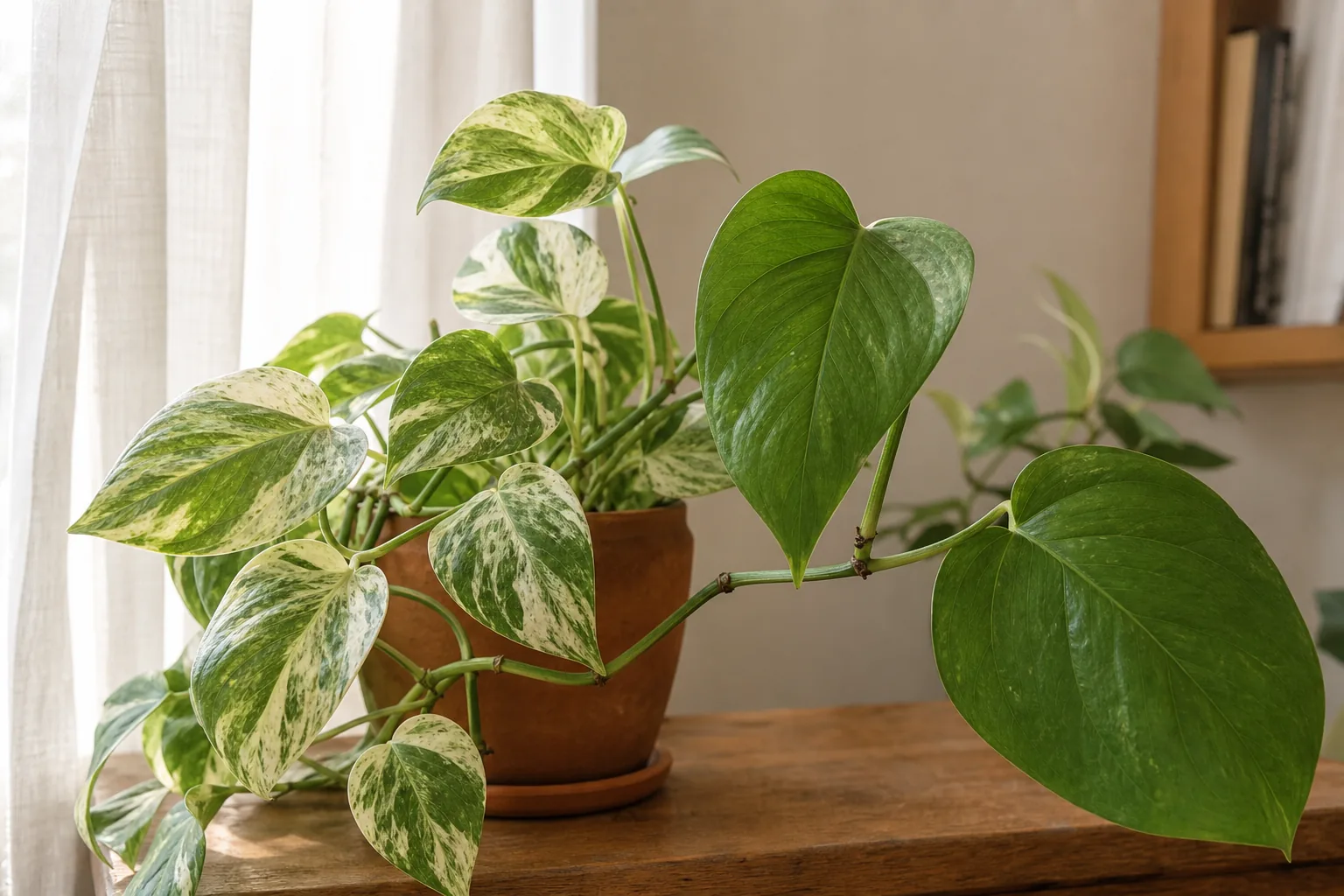
The first is a fully green shoot taking over from a clearly variegated one. On a pothos this looks like a single vine that comes in green at one specific node, while the vines next to it keep producing marbled or speckled leaves. The transition often happens at one node: leaves below it are variegated, leaves above it are solid. The green vine tends to grow visibly faster than the variegated ones around it, which is your first diagnostic clue. The Royal Horticultural Society notes that green reverted shoots tend to be more vigorous than the variegated sections around them and tend to take over if left in place, while pale or white reverted shoots are usually weaker.
The second is a gradual loss of contrast on a pattern-based plant. Existing leaves still show their pattern, but newer leaves come in greener, with smaller patches of white or cream than the older growth. The whole plant is shifting toward green rather than one stem racing ahead.
A third, rarer form is viral variegation, which is caused by infection and follows the spread of a virus through the plant rather than the plant’s own cells. It is worth knowing that this exists so you can recognize unusual, mottled patterns you cannot otherwise explain, but it is not something to seek out or try to recreate indoors.
The two main reasons variegation fades
Most variegated houseplants fall into one of two biological categories, and the categories behave very differently.
Chimeric variegation
Chimeric variegation shows up when the plant’s growing tip (the meristem) contains more than one genetically distinct cell line, distributed across the layers of cells that produce new growth. The pale or white sections of a leaf come from the layer that lacks normal chlorophyll production; the green sections come from the layer that has it. Because this is built into the structure of the meristem rather than into every cell of the plant, it is inherently per cell layer. If the green cell line starts to dominate a growth point, all of the new growth from that point comes in green.
This is why many of the most popular variegated houseplants, including Monstera albo, certain pothos cultivars, and several Thai-style Monsteras, are known to revert. They are chimeric, so they can lose their variegation in one branch while another branch keeps it.
Pattern-based variegation
Pattern-based variegation is governed by the plant’s normal genes and tends to be more stable. Pattern-based cultivars often produce consistent patterns of cream, silver, pink, or yellow through their normal growth. The pattern may vary in intensity from leaf to leaf depending on conditions, but a pattern-based plant usually does not produce a single fully green shoot from a variegated one. Tradescantia varieties and many heartleaf philodendrons (such as ‘Brasil’ and ‘Rio’) sit closer to this end of the spectrum. The species-specific care pages in our archive cover variegated pothos cultivars like Marble Queen, Manjula, and Pearls and Jade, variegated Monstera cultivars and their light expectations, and Brasil and other variegated heartleaf philodendrons if you want the full picture for your plant.
The practical difference is that in a chimeric plant you will usually see reversion as a single green shoot or vine, while in a pattern-based plant you will usually see it as the plant gradually looking less variegated overall.
Why light seems to change how much variegation you see
Light is the most commonly blamed and the most commonly over-credited factor in variegation stories. Here is what it actually does.
The green parts of a variegated leaf photosynthesize normally. The pale or white parts cannot. So a variegated plant of any species uses light less efficiently than its fully green counterpart, and variegated cultivars often grow more slowly and benefit from the brightest indirect light the species will tolerate, as Costa Farms and other grower resources point out. In brighter indirect light, a variegated plant tends to hold its pattern better and stays vigorous enough to keep producing variegated growth.
In dim conditions, the plant may produce less stable or less patterned growth, since the green portions of each leaf must work harder to support the whole plant. This is one reason some owners notice their variegated pothos looking greener over a winter in a darker room and not greener over a summer near a bright window, although seasonal shifts and growth rate both play a role.
What light does not do is reintroduce variegation into cells that have already gone green. A chimeric cell line that has lost its variegated layer will not get it back from a brighter lamp or a new fertilizer. If you are deciding whether to move your plant closer to a window, the right framing is that brighter indirect light supports the variegation that is already there and helps the plant sustain future variegated growth, and that is a real benefit, but it does not “bring back” what has already reverted.
If you are not sure how much light your room actually offers, the honest move is to measure it rather than guess. Our guide to reading the natural light in your room is a useful habit to build before assuming a plant “needs more sun.”
What you can realistically do
There are only a handful of levers, and each one has limits. Treating them as tools with limits is what keeps this from becoming a disappointment cycle.
Identify where reversion started
Walk the plant and find the node where variegated growth stopped and green growth began. On a pothos or philodendron vine this is usually obvious: count the nodes back from the tip until you find the last leaf with clear cream, white, silver, or yellow variegation. That node is your reference point.
Prune back to a clearly variegated node
Cutting the green shoot back to just above that last variegated node is the standard recommendation from horticultural organizations and university extensions. The reasoning is straightforward: the next growth from that node comes from cells that previously produced variegated leaves, so it has a much better chance of being variegated again.
The word to keep in mind is “much better chance,” not “will.” The Royal Horticultural Society notes that reverted green shoots are more vigorous than variegated ones and tend to take over if left alone, which is why removing them is worth doing. The next flush from the variegated node is usually variegated, but it is not guaranteed, especially on highly chimeric plants where cell-layer composition can shift at the growth point. If you want to try to keep as much variegation as possible, prune. If you do not want to fuss with it, leaving the green shoot is also a valid choice; the plant will not die.
Move to the brightest indirect light the species will tolerate
This step supports the plant overall and helps the green portions of existing leaves do their job. For a pothos, philodendron, or Monstera, that usually means a spot a few feet back from a bright window or directly in front of a north- or east-facing window. Harsh direct sun can scorch leaves with large pale sections, so “bright indirect” is the target.
Propagate only from variegated nodes
If you are taking cuttings to start new plants or to share, this rule is straightforward and worth taking seriously. A cutting from a node on a fully green reverted vine contains only the green cell line and should be expected to grow into a fully green plant. A cutting from a node on a clearly variegated section of stem is much more likely to grow into a variegated plant, because it carries at least some of the variegated cell line, as described by Michigan State University Extension on the cell-layer nature of chimeras. Even so, propagation is a probability rather than a guarantee, since the outcome depends on which cell layers are present in the cutting.
For variegated Monstera, where each cutting represents real time and effort, some growers prefer longer cuttings that include several nodes at once. The idea is that more of the parent plant’s tissue gives the variegated cell line more chances to carry into the new plant. This is a reasonable practice rather than a guarantee, since the outcome still depends on which cell layers happen to be present in the cutting.
What you cannot reliably fix
It is worth being direct about this, because the niche around variegated plants carries a lot of unrealistic promises.
Once a section of a chimeric plant has gone fully green, no fertilizer, humidity tweak, repotting, or product reliably restores the variegation on that section. That is not a failure of your care; it is a property of chimeric variegation. The green cell line has taken over the growth point, and the variegated cell line at that point no longer has a way to reassert itself.
So if you come across advice about “variegation boosters,” specific fertilizer ratios, or supplements aimed at bringing back pattern, treat those claims with the same skepticism you would treat any overpromise in plant care. There is no consistent, evidence-backed way to make a green cell line produce white tissue again on the same stem.
What you can do is decide how much of the plant’s variegation you want to preserve and how much pruning and propagation you are willing to take on. That is a real choice, and it is okay to choose “I like it as a mostly green plant now” too.
When a fully green stem is fine to keep, and when it should go
Not every green shoot is a problem to solve. A few situations are worth distinguishing.
A single green shoot on an otherwise nicely variegated plant is usually worth pruning, because it will keep outgrowing the variegated sections and gradually take over.
A plant that is mostly green with only a small amount of variegation remaining is in a different situation. Pruning every green section back to the next variegated node can mean removing most of the plant, and the variegated sections that remain may not regenerate into a full plant quickly. At that point, propagating from the healthiest variegated nodes and starting fresh is often more satisfying than fighting the reversion.
A fully green plant that has lost all variegation is, at that point, a fully green pothos or philodendron or Monstera. It is not a sick plant. If the room is dim and the variegation was always going to fade, it may simply be a sign that this cultivar is no longer the best match for the light you have. Both of these outcomes are legitimate endings, not failures.
If you are reconsidering whether a variegated cultivar is the right plant for your specific room, our guide to choosing a houseplant that fits your room is built for exactly that conversation.
A short observation checklist for this week
You do not need to overhaul your routine to respond to reversion. A short, calm look is usually enough.
- Walk the plant and find the node where variegation ended.
- Decide whether you want to prune the green shoot back to that node, or leave it and accept the look.
- If the plant is in a dim corner, try moving it to the brightest indirect spot your room offers and watch the next leaf or two.
- If you plan to take cuttings, take them from clearly variegated nodes, not from the green shoots.
- Recheck at your normal weekly rhythm rather than every day; new leaves take weeks to unfurl, and changes are slow.
Reversion is part of growing variegated houseplants, not a sign that you got something wrong. With clear eyes on where your specific plant sits between chimeric and pattern-based, and a small set of honest steps, you can decide how much variegation you want to preserve and how much green growth you are willing to live with.
Sources
- Royal Horticultural Society — Reversion in plants: https://www.rhs.org.uk/problems/reversion
- Michigan State University Extension — Plant geek: variegation (April 2023): https://msu-prod.dotcmscloud.com/hrt/our_gardens/News-Images/Plant%20Geek-%20Variegation-April%202023.pdf
- The Spruce — Variegated Monstera deliciosas: everything you need to know: https://www.thespruce.com/everything-you-need-to-know-about-variegated-monstera-deliciosas-5089401
- Costa Farms — Variegation rules: https://costafarms.com/blogs/get-growing/variegation-rules
- Pistils Nursery — Variegated indoor plants: the science behind the latest houseplant trend: https://pistilsnursery.com/blogs/journal/variegated-indoor-plants-the-science-behind-the-latest-houseplant-trend