Plant care
Plant nodes and where to cut on a houseplant stem
· Updated
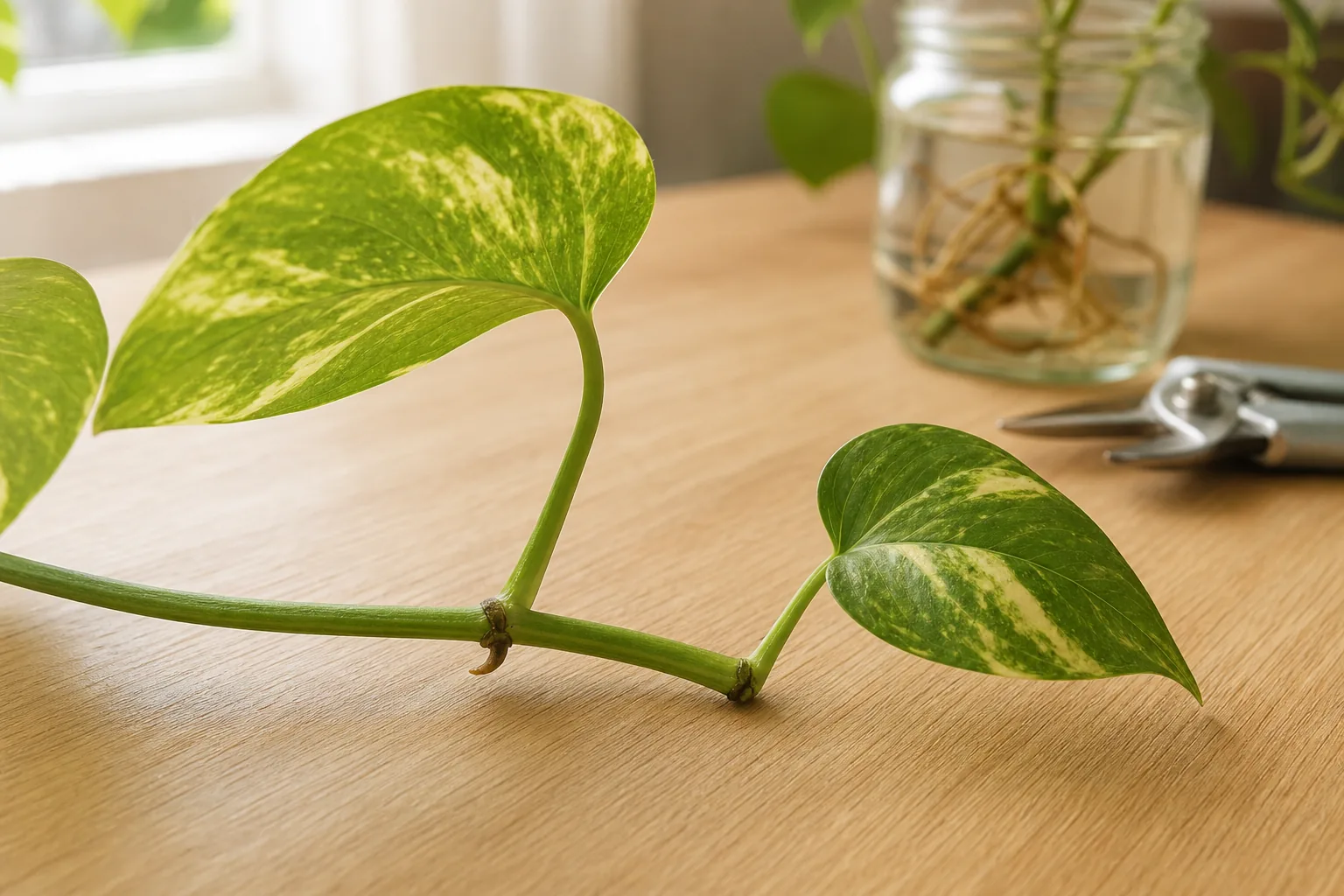
A node is the small joint on a stem where a leaf, branch, or aerial root emerges. To take a viable stem cutting, cut the stem roughly a centimetre or so below a healthy node and keep at least one leaf attached above it. The smooth length of stem between two nodes is called the internode, and for typical vining houseplants it is not the place where roots initiate most easily.
If you can spot the node, the rest of the cutting decision is mostly straightforward. The harder part for most beginners is the opposite: learning to recognise the joint in the first place. This guide starts with the anatomy and finishes with the cut, so you can match the idea to whatever houseplant you actually own.
What a plant node actually is (and what it is not)
A node is a position on the stem, not a separate organ you can snap off. Botanically, it is the point where one or more leaves, branches, or aerial roots are or were attached. Encyclopædia Britannica defines a node in exactly that way, and a USDA Forest Service research paper on stem units uses the same wording: a node is where a leaf attaches, and an internode is the length of stem between two nodes.
Because the node is the meeting point between the leaf and the stem, it also hides a small bud called an axillary bud. University of Maryland plant biology materials describe the axillary bud as sitting in the axil, the angle between the leaf’s stalk (the petiole) and the main stem, normally one per leaf. That bud is the reason a node matters biologically. It contains meristematic tissue, the actively dividing cells that can produce a new shoot, and it is also the most reliable site for adventitious roots to form on a stem cutting.
What a node is not:
- It is not an aerial root. Aerial roots on aroids such as pothos and philodendron often emerge at or near a node, but the aerial root itself is a separate structure.
- It is not a leaf. A leaf is attached at the node by a petiole, but the node is part of the stem.
- It is not a scar. Older stems sometimes show a small ring or ridge where a leaf has dropped. That ring marks where the node sits, but the node itself is the joint, not the scar.
How to find a node on a vining houseplant stem
The single most reliable observation step is the trace-back method. Pick a healthy leaf on your plant. Place one fingertip where the petiole meets the stem. Slowly run your fingertip a few millimetres along the stem in either direction. You will feel a small bump, ring, or change in colour where the petiole attaches. That is the node.
For a closer look, the Brooklyn Botanic Garden recommends identifying the points along the stem where leaves attach before picking up any cutting tool. A practical way to do this is to find a leaf, follow the petiole back to the stem, and the joint you land on is the node.
If the stem is thin and green, as on a pothos or heartleaf philodendron, the node usually shows as a slightly raised green or brown bump, sometimes with a small aerial root nub on or near the same joint as the leaf. On a mature monstera, the node is more pronounced: a thicker stem with a visible ridge or ring, and often a substantial aerial root emerging from the same joint where the petiole attaches. The appearance varies, but the principle does not. A node is the place where something is or was attached to the stem.
The internode, the petiole, and the small details that matter
A handful of related terms come up in every propagation guide, and confusing them is the most common reason beginners cut in the wrong place.
The internode is the section of bare stem between two nodes. It is usually smooth, mostly cylindrical, and has nothing growing from it. According to Britannica and the USDA Forest Service, the internode is the part of the stem that simply elongates between growth points. Because the axillary bud sits at the node, a cutting taken from the middle of an internode has no obvious meristematic tissue to initiate roots from, which is why the standard advice is to cut near a node rather than mid-internode.
The petiole is the small stalk that connects a leaf to the stem. Some beginners, especially when working with plants that have long petioles such as a juvenile monstera, mistake the petiole for a stem and try to root it. The petiole is leaf support, not stem tissue. For typical vining houseplants such as pothos, philodendron, and monstera, a petiole-only piece will not produce a new plant the way a node cutting will.
The axil is the angle where the petiole meets the stem. The axillary bud sits inside that angle. You rarely need to see the bud to find the node. Find the node, and you have found the bud.
Together, these three pieces, node, internode, and petiole, define almost everything you need to know about where to cut on a typical vining houseplant.
Where exactly to cut, and why the bottom cut matters most
A finished stem cutting has three parts: a bare lower stem, a node, and a leaf (or pair of leaves) above the node. The cut at the bottom of the cutting is the one that determines rooting success.
Missouri Botanical Garden’s propagation guide says it directly: cut just below where a leaf attaches to the stem, because roots grow easiest from that location. “Just below” is the key phrase. It is not “somewhere along the stem,” and it is not “through the middle of an internode.” It is a short distance below the node, close enough that the basal end of the cutting sits at the meristematic tissue.
How short is “just below”? In practice, roughly a centimetre, or about the width of a fingernail, is enough. Leaving a long bare stub below the node gives the cutting nothing extra to root from and only adds stem tissue that has to be supported by a cutting that has no roots yet.
Extension guidance on cutting length converges on a range, not a single number. University of Illinois Extension recommends stem cuttings of roughly 3 to 6 inches. Purdue University Extension suggests 2 to 6 inches. Washington State University Extension recommends 3 to 5 inches of soft-tissue material with at least two nodes. The exact number matters less than the principle: enough stem to handle and at least one node, with one or two healthy leaves remaining above the buried node.
What about the top of the cutting? You do not need to make a precise cut above the topmost leaf. Snip the stem roughly half a centimetre above the upper node, or take a tip cutting that ends in a growing point. The bottom cut is what matters for rooting.
Before you set the cutting in water or medium, remove any leaves on the portion that will be submerged or buried. University of Nevada, Reno Extension recommends leaving at least two nodes bare for insertion into the planting medium. The leaves left above the buried node stay attached because they photosynthesise and keep the cutting alive while roots form.
Common houseplants where nodes are easy and hard to see
Some plants make the lesson easy. Tradescantia, including Tradescantia zebrina and T. fluminensis, has visibly segmented stems: each segment is an internode, each joint is a node, and a leaf emerges from nearly every joint. If you own a wandering jew or inch plant, you have already seen a node without knowing it.
Hoya carnosa, the wax plant, has opposite leaves, so each node carries two leaves side by side rather than one. The internodes are short and woody, and the joint is usually visible as a slight thickening where the pair of leaves attaches.
Pothos and heartleaf philodendron are the most common practice plants, and their nodes are easy to find once you know to look. They appear as small green or brown bumps on a slender stem, with the petiole on one side and often a small aerial root nub on or near the same joint. Our pothos care guide and heartleaf philodendron care guide cover the parent plants in more depth, including when a routine trim is also a chance to take a cutting.
Monstera deliciosa is the plant where beginners struggle most. On a mature, fenestrated monstera, the internodes are noticeably long, often several centimetres between nodes, and the node is a thicker ridge where a substantial petiole attaches. The aerial root, when present, can be thick and woody. The node is still the same structure as on a pothos. It is just larger and farther apart. The visual lesson is the same: find where the petiole meets the stem, and you have found the node. Our Monstera care guide goes deeper into how the plant’s stems and aerial roots behave in real rooms, and a piece on climbing houseplant support shows how stems and nodes interact when you give a plant something to climb.
Quick reality check: a healthy cutting has what it needs before you root it
A node is where roots grow most easily, not where they are guaranteed to grow. The Missouri Botanical Garden phrasing is “easiest,” and that word carries real weight. Whether a cutting actually roots depends on the species, the health of the parent plant, the time of year, the light in your room, and how steadily moisture is maintained after the cut. A node on a stressed or etiolated stem does not overcome those conditions.
What a healthy cutting has before you set it to root:
- A node that is firm, green or brown, and not mushy or blackened.
- At least one leaf above the buried node, ideally two, that is not yellowing.
- A clean cut below the node, made with a sharp, sanitised blade so the stem is not crushed.
- The leaves on the buried portion removed, leaving a bare stem section to insert into water or medium.
What it does not need to get started: a long cutting, a special product, or a guarantee. Rooting hormone is optional and, if used, should be applied following the product label rather than at any dose this guide would specify.
If a cutting wilts within a day, loses leaves, or turns black at the base, common causes include the parent plant’s condition, the room’s light, and stale water sitting on the cut end, rather than the node being in the wrong place. In practice, a second attempt on a healthier section of the parent plant often gives better results than recutting the same piece. The parent plant also benefits from stable conditions while it recovers from the trim, which our guide to houseplant care after repotting addresses in a similar spirit.
The takeaway is simple once the anatomy is clear. A node is the joint where a leaf, branch, or aerial root attaches to the stem, and it is the place on a typical vining houseplant where a new cutting has the best chance of rooting. Cut just below it, keep a leaf or two above it, and let the rest of the conditions in your room do the rest.