Plant care
Phalaenopsis rebloom care: reading light and temperature cues after the flowers drop
· Updated
A Phalaenopsis orchid that has dropped its last flower is not finished. In most homes, a healthy plant will rebloom on its own if it gets steady bright indirect light, a real but mild drop in night temperature for a few weeks, and time. What holds most plants back is not lack of forcing. It is inconsistent light, warm steady indoor temperatures that never dip, and well-meaning interventions like ice cubes or fertilizer doping.
This is a quiet process. Expect months, not weeks, between bloom cycles, and resist the urge to do more. The rest of this piece walks through what is actually happening after the flowers drop, what conditions help, and which popular methods to skip.
What “reblooming” actually means for a Phalaenopsis
A rebloom is a new flower spike emerging from the plant, producing buds, and opening them. For Phalaenopsis, this usually happens once a year on a mature, healthy plant. Some plants produce two spikes per year, others skip a year, and a few will produce a small secondary spike off the existing green spike instead of a fresh one from the base.
Dropping flowers is a normal cycle, not a failure. The plant is entering a vegetative rest, a period of leaf and root growth that quietly builds the carbohydrate reserves it will need to push out another spike. The American Orchid Society frames this stored energy as a prerequisite. The plant must have enough reserves before any cue matters.
Before anything else, is the plant healthy enough to bloom?
A struggling Phalaenopsis will not be pushed into blooming by tricks. Before thinking about spikes, check the basics.
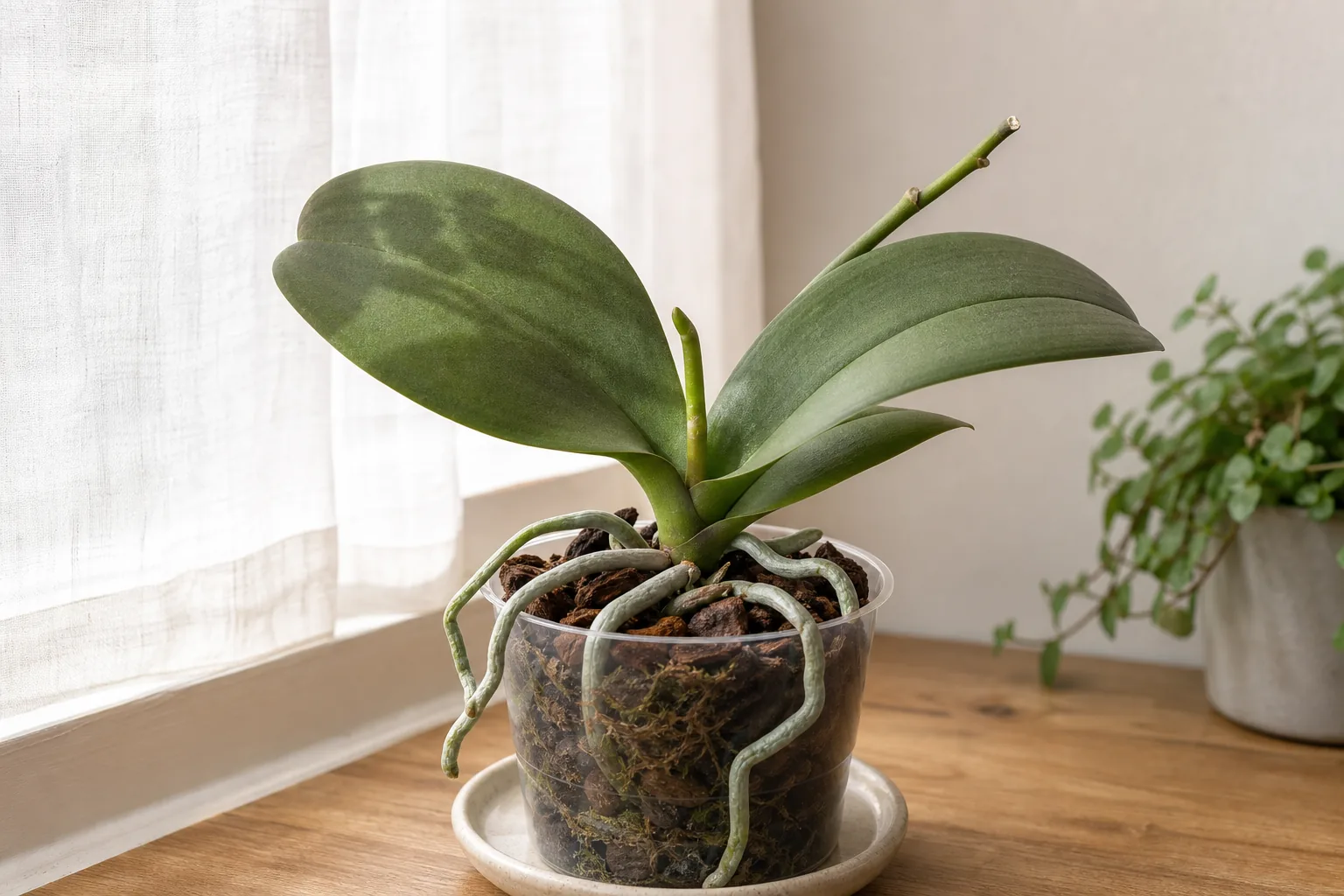
Leaves should be firm, mid-green, and held upright. Wrinkled or leathery leaves usually point to chronic underwatering or root loss. A single yellowing leaf at the base while the rest stay green is often normal aging, not a crisis.
Roots, if visible through a clear pot, should be silvery when dry and green or white when freshly watered. Brown, mushy, or hollow roots indicate rot. A post-bloom plant can recover from a lot, but rot has to be addressed first.
The crown, the center of the plant where new leaves emerge, should be free of black or soft tissue. Crown rot is a serious problem that needs immediate attention, and expecting a spike during recovery is not realistic.
If any of these signs are off, return to the main Phalaenopsis orchid care guide and address the underlying issue. A spike will not fix a sick plant.
The honest timeline, months not weeks
Reputable sources do not give a specific week count for rebloom because the variables differ. The cycle depends on light, temperature, plant age, root health, and what the previous bloom cost the plant. A common range across horticultural society and consumer sources is several months, sometimes a year or more, between bloom drop and the next open flowers.
Treat this as a quiet project. A spike that first appears in late fall may not open until late winter or spring. That is normal, not a sign that something is wrong.
What to do with the spent flower spike
The spent spike is one of the most asked-about decisions, and the answer is mostly about observation, not cutting.
If the spike is still green and firm, leave it alone. A green spike can still photosynthesize and may push out a secondary branch from one of its nodes. Cutting it back early removes that possibility.
If the spike has turned yellow, brown, or hollow and papery at the tip, the plant has finished with it. Trim at the base with clean, sterilized scissors.
Some growers trim the green spike one or two nodes above the base to encourage a secondary branch. This is an option, not a rule. Results are inconsistent, and it is not endorsed by any extension publication as a guarantee. If you do trim, cut just above a visible node and let the plant decide what to do next.
The light cue, bright indirect and intensity over hours
Light is the most documented bloom trigger for Phalaenopsis. The American Orchid Society recommends bright indirect light, noting that Phalaenopsis grow easily in a bright window with little or no sun.
A workable home test for “bright indirect” comes from the AOS light guide. Hold your hand a foot above the leaves at midday and look at the shadow. A fuzzy or faint shadow means the light is in the right range for Phalaenopsis. A sharp, dark shadow means the light is too intense and may scorch the leaves over time. No visible shadow at all means the window probably does not have enough energy to drive a bloom.
Most Phalaenopsis species are native near the equator, which means day length is not the trigger for this genus. Light intensity and the temperature differential are what cue a spike. A consistent bright spot matters more than shifting the plant between windows.
For a deeper method of judging whether your window really provides the right light, see how to read natural light in a room.
The temperature cue, a real cool-night resting period
The second documented cue is a sustained drop in night temperature. The AOS specifically notes that Phalaenopsis naturally flower in winter and spring following a period of day temperatures below about 84 °F combined with cooler nights.
Consumer horticulture sources often translate this into a more specific home range, citing nights in the mid-50s to mid-60s °F, or nights roughly 10 to 15 °F cooler than daytime, sustained for several weeks. These are useful ranges to aim for, not fixed thresholds.
Most homes naturally produce this kind of differential in fall and winter, especially near a north or east window that does not get forced-air heat at night. The plant often does this work on its own without any conscious effort from the grower.
Two cautions. The cool-night cue refers to ambient air temperature, not to the temperature of the roots. Putting ice cubes on the medium is not the same thing, and university extension sources do not recommend the ice-cube method for tropical orchids like Phalaenopsis. The chill also must come from air, not from contact with a freezing window or a cold draft, both of which can damage leaves. If you want to understand the difference between a real cool night and a damaging draft, see drafts, vents, and cold windows.
Water and fertilizer during the resting window
During the resting window, the plant does not need a special watering rhythm. The standard touch-and-weight method still applies: water thoroughly when the medium has dried, then let it dry down again. Healthy roots and active leaves will use water at roughly the same rate as during the bloom, sometimes a little less. For a refresher on the method itself, see watering by observation.
Fertilizer is the part where most folklore goes wrong. Across university extension and horticultural society sources, fertilizer is framed as ongoing nutritional support, not as a bloom trigger. The AOS and Iowa State University Extension describe it as one contributing factor among several, not the cause of spiking.
The honest read is to not increase feeding to try to force a spike. A light, balanced fertilizer at half strength during active growth is enough. Hold steady, and resist the “bloom booster” formulas marketed for this purpose. Bloom boosters are not supported by extension sources as a way to initiate a spike. For a baseline on what fertilizer actually does and when less is the better answer, see when to hold fertilizer.
What “forcing” actually does, and why it usually backfires
Most of the well-meaning tips that circulate online fall into one of three buckets, and none of them are what triggers a Phalaenopsis spike.
Ice cubes on the medium. Phalaenopsis roots are tropical. Cold water on the roots is a stress, not a signal. The cool-night cue is an air-temperature phenomenon, not a root-temperature phenomenon.
Dark-closet shock. Some sources suggest putting the plant in a dark closet for a few days to “shock” it into spiking. There is no extension support for this approach. It reduces photosynthesis, weakens the plant, and delays the very energy storage the next spike will need.
Bloom-booster fertilizer. These formulas are usually higher in potassium or phosphorus. Sources do not support them as a spiking strategy. The plant’s trigger is its environment and its reserves, not its N-P-K ratio.
The pattern across all three is the same. Each tries to replace the actual triggers, which are light and a real temperature differential on a vigorous plant, with a shortcut that does not work and may set the plant back.
Reading a new spike versus a new root
A common concern is cutting off a new growth by accident. The two are easier to tell apart once you know what to look for.
A new spike usually emerges from a node on the existing green spike or from the base between the leaves. The tip is often mitten-shaped or slightly flattened, and you can usually see small triangular bracts along its length as it grows.
A new root tends to be rounder at the tip, more uniformly green or silvery, and aims downward or outward rather than upward. Roots also lack the visible bracts that a spike shows.
When in doubt, wait a week. Both will declare themselves as they grow. Do not cut anything just because it looks unfamiliar.
When to ask a local orchid society, nursery, or extension office
If your plant is healthy, has had time, and still has not produced a spike after a full year, a local resource can help in ways an article cannot. Conditions vary by region, by season, and by what is happening inside your specific home. A nearby orchid society, an independent nursery, or your state extension service can look at a photo and your conditions together.
This article covers Phalaenopsis care only and is educational in nature. It is not a substitute for hands-on local advice or for veterinary or medical guidance if a pet or person ingests any plant.
Sources
- Iowa State University Extension: How to Get Orchids to Rebloom
- American Orchid Society: Why won’t my orchid re-bloom?
- American Orchid Society: Why Will It Not Bloom, Part 2: Phalaenopsis
- American Orchid Society: Phalaenopsis Culture Sheet
- American Orchid Society: Light, the Key to Successful Blooming