Plant care
Orchid bark for monstera: what it actually does in an aroid mix
· Updated
What orchid bark does for monstera, in plain terms
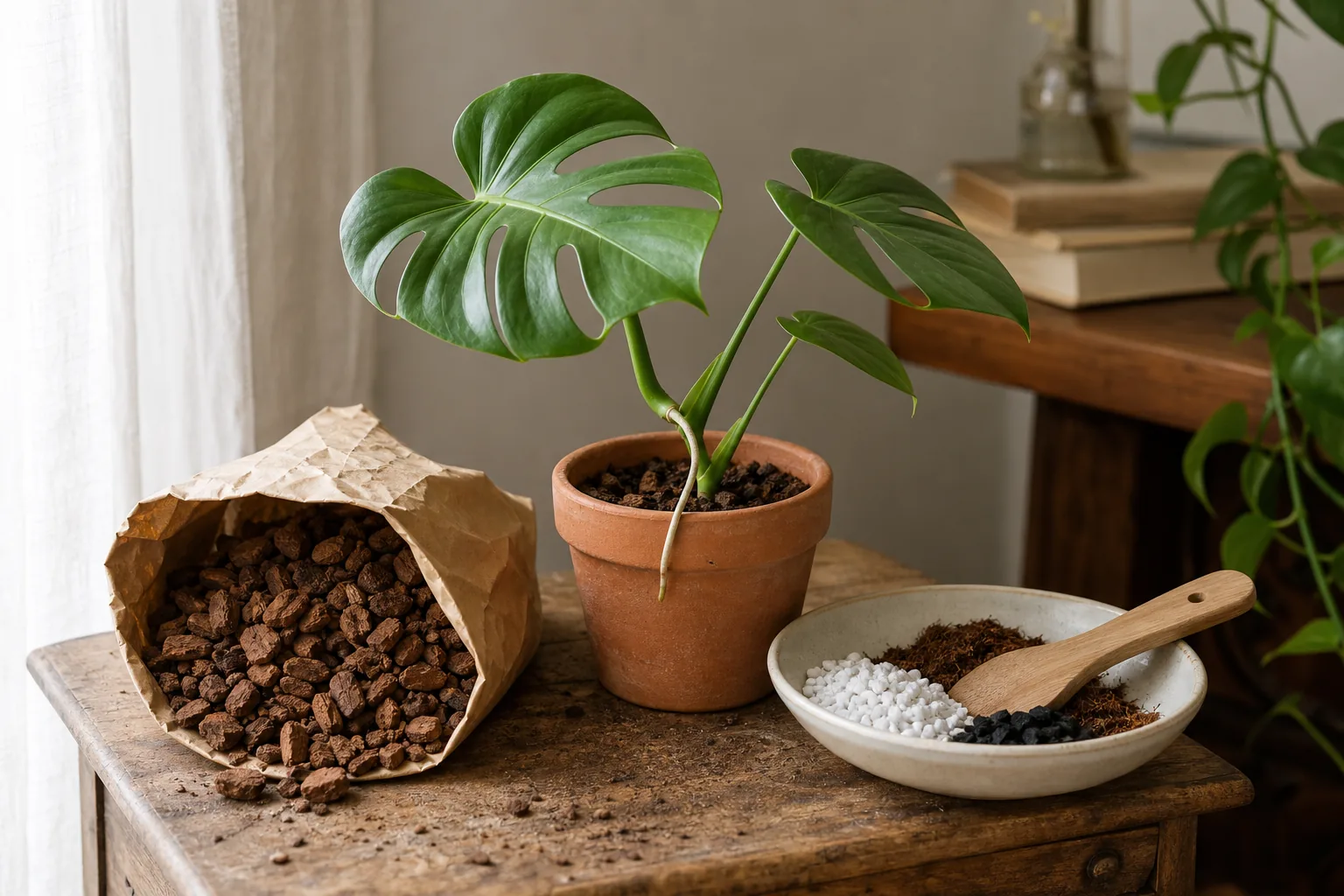
Orchid bark is a chunky, slowly decomposing organic particle that gets mixed into a potting medium to make the spaces between particles larger. For a monstera, pothos, or philodendron in a dense, peat-heavy standard mix, adding orchid bark (or buying a pre-made aroid mix that already contains it) makes the mix drain faster, lets more oxygen reach the roots, and makes watering easier to read because the surface dries out at a more predictable pace. It is one useful ingredient, not a required one, and because it is organic it will break down inside the pot over time, which means any mix that contains bark needs refreshing on a multi-year timeline.
This article focuses on the physical role of bark in the mix. For full species-level guidance, see our monstera care in a real room guide, and for the bigger picture of how to read a bag of mix, see how to read a potting mix bag.
What orchid bark actually is, and what is in a typical bag
Orchid bark sold for orchids and aroids is usually graded fir or pine bark, screened to consistent chunk sizes that range from about a quarter inch up to roughly three quarters of an inch. Most retail bags are labeled with a grade: fine, medium, or large. The American Orchid Society’s guide on orchid media treats medium-grade bark (around half an inch) as a practical default for most orchid pots, and that same size translates well to monstera-scale pots in the four to eight inch range.
A few things you can observe from the bag:
- Orchid bark feels light for its size, because the irregular chunks trap a lot of air between them.
- The pieces are hard and slightly fibrous when new, not soft or crumbly.
- A bag labeled “orchid bark” is generally more uniform than landscape mulch. Landscape mulch is typically less consistent in size and is intended for outdoor beds rather than pots.
- A bag labeled “orchid mix” usually contains bark plus perlite or charcoal, so it is a pre-blended product rather than pure bark.
If you only want the structural effect of bark without buying a separate ingredient, an “aroid mix” or “chunky tropical mix” that lists bark on its ingredient panel is the easier route.
What orchid bark does inside a potting mix
University extension publications describe organic amendments such as bark as materials that improve soil aeration, water infiltration, and water- and nutrient-holding capacity over time. The mechanism inside a pot is straightforward: bigger particles mean bigger gaps between particles, and bigger gaps mean water moves through faster and air occupies more of the space between waterings.
Three changes you can actually observe:
- Drainage speed. Water runs through a bark-amended mix noticeably faster than through a dense peat-based mix. The pot stops dripping within seconds rather than minutes.
- Surface drying. The top of the pot dries out sooner, which is helpful if you tend to overwater on a schedule rather than by feel.
- Pot weight. A bark-heavy mix feels lighter than a peat-heavy mix of the same volume, partly because of the trapped air and partly because bark itself is less dense than wet peat.
Those changes are why aroid growers reach for bark. A monstera’s roots are adapted to climbing and to feeding in loose, aerated organic debris, so a mix with more air space tends to suit them better than a fine, moisture-retentive one. The bark does not recreate the exact substrate a monstera grows in, which in the wild is accumulated leaf litter, moss, and bark fragments on a tree trunk; it creates conditions closer to what aerial-rooted aroids prefer.
Is orchid bark right for a monstera or other aroid?
For most apartment and home conditions, adding bark (or choosing a pre-made mix that includes it) is a reasonable move for a monstera, philodendron, or pothos that has been sitting in a dense standard mix and staying wet for too long. The clearest signs that bark might help your specific plant are:
- The soil surface stays visibly damp for more than a week after a thorough watering.
- New growth is slow, leaves are pale, or you see yellowing lower leaves with no obvious pest or underwatering cause.
- The mix smells stale or sour when you push a finger into it.
- The pot feels heavy long after you would expect it to dry.
Those signs suggest the root zone is staying saturated, and adding chunkier structure is one of the more reliable ways to fix that, alongside reviewing your watering rhythm and making sure the pot has drainage holes.
If your monstera is already in a chunky mix and is pushing out new leaves with healthy fenestrations, the bark is doing its job and you do not need to change anything.
How much orchid bark to use, and what to pair it with
There is no single correct percentage of bark for monstera. Across published homemade aroid recipes, bark usually makes up somewhere between roughly thirty and fifty percent of the mix by volume, paired with a drainage component such as perlite or pumice, a smaller share of a water-holding component such as coco coir, peat, or worm castings, and sometimes a small amount of horticultural charcoal. The exact share depends on three things you can observe in your own home:
- Pot size. Smaller pots (under about three inches) physically cannot hold large bark chunks well, so as a general rule they tend to dry out very quickly. A finer grade or a smaller share of bark works better there.
- Watering habit. If you tend to water lightly and often, a higher bark share helps the mix dry evenly. If you water deeply and infrequently, you can afford a slightly lower bark share and a higher share of coir or peat to keep the root zone from drying out too fast.
- Indoor humidity. In dry winter air, a very bark-heavy mix can dry out faster than the plant can keep up. In humid rooms, the same mix is comfortable.
A simple starting point for a four to six inch monstera pot is about three parts orchid bark, two parts coco coir or peat, one part perlite or pumice, and a small handful of horticultural charcoal if you have it. Treat this as a starting ratio to adjust based on your pot, your watering habit, and your home, not a fixed rule.
If mixing your own feels like too much, a pre-made aroid mix that lists bark, perlite, and coir on the ingredient panel is a perfectly good shortcut. The label matters more than the brand name.
Where orchid bark does not help (and situations where it can cause trouble)
Bark is a physical tool, and like any tool it has situations where it is the wrong choice.
- Very small pots under about three inches. The chunks are too large for the pot volume, and the mix dries out faster than the plant can replace what it uses. Use a finer mix or a smaller grade of bark.
- Plants that are watered on a strict schedule with the same volume every time. A chunky mix changes how fast the pot dries, so a fixed watering schedule will either overwater or underwater depending on the season.
- Mixes that are already mostly bark with no fine component. Without some coir, peat, or worm castings to slow drainage, water can run straight through and the plant wilts between waterings even though the soil is “wet.”
- Outdoor or low-light rooms in winter. The mix dries slowly when light and temperature drop, so the benefit of added air space shrinks.
Adding bark does not, on its own, prevent root rot. Root rot depends on pot drainage, watering rhythm, temperature, and the whole mix working together. Bark helps, but it is not a substitute for letting the top of the mix dry between waterings and using a pot with drainage holes.
How long orchid bark lasts in the pot before it breaks down
Orchid bark is organic, so it decomposes inside the pot. Indoors, in a typical monstera pot with average watering, bark-based mixes usually hold their structure for roughly one to three years before the chunks start breaking down meaningfully. University extension publications describe organic amendments as materials that improve soil structure while fresh and then contribute to soil organic matter as they decompose, which matches what you see in a pot: the mix gradually compacts, holds more water, and behaves more like a standard peat-based mix over time.
Visible and sensory signs that bark is breaking down:
- Pieces that used to be hard and fibrous now crush easily between thumb and forefinger.
- The chunks have darkened from tan or reddish brown to dark brown or black.
- The mix has compacted and the surface no longer dries in a predictable pattern.
- A sour or stale smell comes off the pot when you stick your nose into the surface.
When those signs show up, the mix is aging out and it is time to refresh or repot. Our guide on when a potting mix has aged out walks through that decision in more detail.
When you can safely skip orchid bark
You can skip orchid bark without harming your monstera if:
- Your current mix already contains bark, perlite, or other chunky material and the plant is growing steadily.
- You water by feel, not by schedule, and the pot dries at a rate that matches the plant’s needs.
- Your home is on the dry side and you do not want the mix to dry out faster than it already does.
- You would rather buy a pre-made aroid mix than measure and blend your own.
Bark is one knob you can turn to adjust drainage and air space. If the rest of your watering routine and your light conditions are working, turning that knob is optional.
A short checklist before you buy
- Decide whether you want to mix your own or buy a pre-made aroid mix. The mix is more important than any single ingredient.
- If mixing, plan on bark making up roughly a third to half of the mix by volume, with perlite or pumice, a water-holding component, and optional charcoal.
- Choose a medium grade for pots in the four to eight inch range; finer grades for smaller pots, coarser grades for larger pots.
- Plan to refresh the mix on a roughly two-year cycle, or sooner if the chunks start to crumble.
If you want to learn more about the larger context of when to repot and how to handle that day, our guide on when does a houseplant actually need a new pot is the natural next read.
Sources
- American Orchid Society, Beginner’s Series — Part 2: Media Mania Revisited
- Colorado State University Extension, Choosing a Soil Amendment
- University of Maryland Extension, Organic Matter and Soil Amendments
- Oregon State University Extension, Improving Garden Soils with Organic Matter (EC 1561)
- Washington State University Extension, Organic Soil Amendments in Yards and Gardens: How Much Is Enough?
- Ask Extension, Soil, Potting Soil and Gardening Mix
- Just Add Ice Orchids, 4 Signs It’s Time to Repot Your Orchid