Plant care
Mushrooms in houseplant soil
· Updated
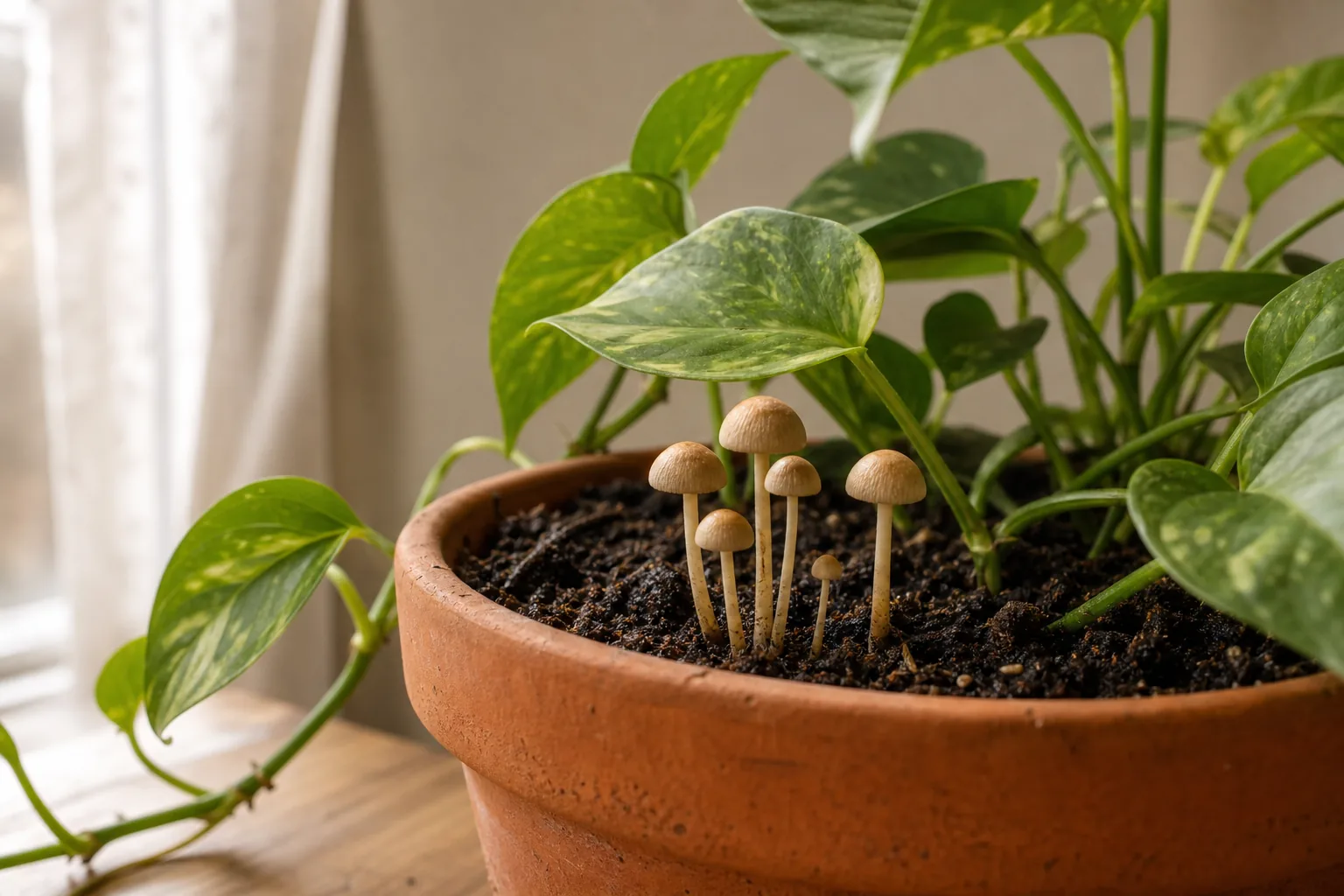
Mushrooms in houseplant soil usually appear as small capped structures rising from the potting mix, often white, tan, or yellow, and they often show up after a watering during a warm, humid stretch. They are the visible fruiting bodies of fungi that are already living in the mix and feeding on dead organic matter such as peat, coir, bark, and compost. Their presence most often signals moisture plus organic substrate at warm indoor temperatures, not a sick plant, but it is also not a clean bill of household safety, because some small brown and yellow mushrooms found in pots are toxic if eaten by pets or people. The proportionate household response is to glove-pick the caps, let the surface dry between waterings, and route any pet or child ingestion question to a veterinarian or a poison-control line rather than trying to identify the species from a photo.
What you are looking at when mushrooms appear in houseplant soil
A mushroom is only one part of the fungus. The bulk of the organism is a network of fine threads called mycelium that grows through the potting mix. When conditions favor reproduction, the mycelium sends up a fruiting body, the recognizable stem and cap, to release spores. The Royal Horticultural Society describes saprotrophic fungi as networks of thin, elongated hyphae that grow through dead material they decompose, which is exactly what is happening inside a moist, organic-rich houseplant pot.
Extension guidance from the University of Florida describes the fruiting trigger for these fungi as a combination of high humidity, low light, and warm temperatures, which fits the conditions most houseplant pots offer for at least part of the year. The same publication names a specific species commonly observed in pots, Leucocoprinus birnbaumii, which produces small yellow mushrooms and a dense yellowish-white mycelium on the surface of potting soil. This is the one species an indoor gardener is most likely to see referenced in an extension publication, and even then it is best treated as a commonly observed example rather than a diagnostic answer for whatever you are looking at.
How mushrooms end up in a potted plant
Fungal spores are everywhere. They arrive in a sealed bag of potting mix, on a trowel or watering can, through an open window, in compost or worm castings added as top-dressing, and on the plant itself after a summer outside. Bagged mixes are not sterile, and they contain organic components in your potting mix such as peat, coco coir, pine bark, compost, and worm castings, all of which are exactly the kind of dead organic matter that saprophytic fungi are built to decompose. The fungal threads living quietly in the mix are a normal part of an organic growing medium.
That framing matters, because it shifts the question from “what is wrong with the soil” to “why is this fungus fruiting now.” Moisture plus warmth plus organic substrate is a more accurate description of the trigger than overwatering or contamination.
What their presence actually indicates, and what it does not
Mushrooms in a pot usually indicate three things together: a moist mix, organic substrate, and warm indoor temperatures. They do not, on their own, prove that the soil is contaminated, that the bag was defective, or that the plant is overwatered. The moisture that supports fruiting is often just the steady moisture most bagged mixes are designed to hold.
It is also fair to notice what else is happening in the pot at the same time. A persistently soggy mix that smells sour, a plant that is wilting in wet soil, or yellowing lower leaves are separate observations that can point to a real drainage problem. To avoid jumping from “I see a mushroom” to “my plant has root rot,” it helps to walk through a structured inspection first. Our guide on overwatered or underwatered houseplants lays out the order if you want a step-by-step way to do that.
Is it a mushroom, mineral crust, mold, or fungus gnats?
Before treating what you see, it helps to confirm what you are actually looking at. Here is a quick observation checklist:
- Mushroom. A defined stem and a cap, sometimes small as a fingernail. Stays in place. Often white, tan, or yellow.
- Mineral crust. A flat, white to tan, powdery or crystalline layer on the soil surface that wipes off and leaves a residue. No stem, no cap. If this is what you see, the white crust on houseplant soil guide is the closer read.
- Surface mold. Fuzzy or cobwebby growth without a defined stem or cap. Often white and dusty. Same general fungal lifestyle, different expression.
- Slime mold. Yellow, brown, or tan foamy or shiny growth on the surface, sometimes appearing to move over a day or two. No cap. University of Minnesota Extension notes that slime molds are present in all soils and usually cosmetic.
- Fungus gnats. Small, dark, winged insects that lift off the soil when the pot is moved or watered. They are insects, not fungi, and they often show up at the same pot because both favor moist, organic mix. Our guide on fungus gnats and houseplants covers that side.
If what you see has a cap, you are looking at a mushroom. If it wipes up like dust, it is mineral. If it is fuzzy without a cap, it is more likely surface mycelium than a fruiting body.
Are they harmful to the plant?
Most mushrooms found in houseplant pots are saprophytes, which means they are decomposing dead organic matter in the mix, not feeding on living roots. In that sense, they are not attacking the plant. The trade-off is that the same moisture and organic content that supports the fungus is also what supports the plant, so there is no clean way to remove the food source without also changing how the mix works.
The practical risk to the plant is not the mushroom itself. It is whatever else is happening in the pot that you might be missing because of the mushroom. A moist mix that is also poorly drained, a pot with no functioning drainage hole, or a watering rhythm that never lets the top inch dry down are all things worth checking on their own.
Are they harmful to pets, children, or adults in the home?
Some small brown and yellow mushrooms that turn up in pots are toxic if eaten, and household identification from a photo or a written description is not reliable enough to call any given specimen safe. The UF/IFAS extension guide treats identification of small pot mushrooms as unreliable enough that safety decisions should not rely on a photo.
If a pet or a child has chewed or eaten any part of a mushroom from a houseplant pot, the right next step is to contact a veterinarian, the ASPCA Animal Poison Control Center, or the Pet Poison Helpline, rather than waiting for symptoms or trying to look the species up yourself. For a home with regular traffic between pets and plants, our pet-aware houseplant choices article covers a broader verification approach. Adults are not immune either; eating unknown small mushrooms from a pot is a bad idea for the same reason.
A proportionate household response
A small handful of mushrooms in one pot does not call for chemicals, soil sterilization, or replacing the whole plant. The reasonable steps are:
- Wear gloves and pluck the caps and stems out by hand. Bag them and discard them outside the home rather than in an indoor compost or kitchen bin, so spores are not spread to other pots or to the kitchen.
- Let the top inch or two of the mix dry between waterings. Increasing airflow around the pot and moving it to a brighter spot, if appropriate for the plant, both help.
- Wait and observe. New caps can reappear between waterings because the mycelium is still in the mix, and that is normal. Repeated fruiting is a signal to revisit the watering rhythm and the mix, not an emergency.
- Do not reach for an indoor fungicide as the default. Saprophytic fungi are doing what they do in organic media, and most extension guidance frames manual removal and moisture adjustment as the proportionate response. If you do use any product, follow the label exactly and keep it out of reach of pets and children.
Removing the visible mushroom does not remove the fungus. The mycelium stays in the mix, so a calm expectation that caps may reappear is more honest than promising a quick fix.
When the situation is more than a cosmetic mushroom
A few mushrooms in one pot, in a plant that otherwise looks healthy and is potted in a mix that drains and dries at the surface, is a cosmetic observation. The picture changes when several signals line up:
- Mushrooms keep appearing across many pots in the same room, week after week.
- The mix stays wet for a long time after watering, or the pot has no functioning drainage.
- The plant is wilting in moist soil, has yellowing lower leaves, or the mix smells sour.
- Mushrooms are paired with persistent fungus gnat activity that does not respond to basic dry-down steps.
These are the situations where the underlying moisture problem, not the mushroom, is the real issue. A partial or full mix refresh, a change in pot or watering rhythm, or a conversation with a local independent nursery about the specific mix you are using can all be reasonable next steps.
When to ask a local expert
For a one-off mushroom or two in a healthy plant, a calm household response is enough. For anything more, the right expert depends on the question:
- For a pet or child who may have eaten a mushroom from a pot, contact a veterinarian, the ASPCA Animal Poison Control Center, or the Pet Poison Helpline right away. Do not rely on a photo or a guess.
- For repeated fruiting across many pots paired with plant decline, an independent local nursery or your county extension office can look at the actual mix and the plant. It helps to call ahead and ask what kind of sample or description they will need, since mushroom identification from a photo is often not something an office can confirm remotely.
- For an ongoing safety question about which houseplants and which household fungi belong in a home with pets, the broader pattern of verifying with primary toxicology references rather than social-media IDs is laid out in our pet-aware houseplant article.
The point is to keep the questions separate. A mushroom in one pot is a plant-care observation. A mushroom eaten by a pet is a veterinary question. A mushroom in a chronically wet, declining plant is a soil and drainage question. Treating each on its own terms is the most useful thing a calm reader can do.
Sources
- A Basic Guide to Mushrooms Commonly Encountered in Potted Plants, UF/IFAS Extension PP377
- Saprotrophic fungi, Royal Horticultural Society
- Fungus - Saprotrophism, Decomposition, Nutrition, Britannica
- Common fungi in yards and gardens, University of Minnesota Extension
- Surprise! You’ve got mushrooms in your houseplants, New England Botanical Garden