Plant care
Should you buy a humidifier for your houseplants? A room-first guide
· Updated
A humidifier is one possible tool, not a default answer. The decision is worth making from the room out: read your actual humidity with a basic hygrometer for at least a week, look at which plants you keep and how they respond over weeks, and only buy a humidifier when the room reading and plant signals together point to a sustained gap that other adjustments, such as grouping, placement, watering rhythm, or a pebble tray, cannot close. A small tabletop humidifier is sized for an enclosed room, not an open living space, and it brings an ongoing commitment to cleaning and water quality.
That is the whole article in one paragraph. The rest of this piece walks through how to get to that decision in your own home.
A humidifier is a tool, not a default answer
Indoor humidity is one variable among several that shape how a houseplant actually grows. Light, watering rhythm, water quality, pot size, potting mix, and airflow all sit alongside it, and most plant-care problems blamed on humidity turn out to be one of those instead. Our guide to brown tips and crispy edges walks through that diagnostic order and is worth reading before assuming you need equipment.
Penn State Extension notes that during the winter heating season indoor relative humidity can easily fall below 30%, so a dry-air worry in January or February is not imagined. Heating-season dryness is also the most common context in which readers start shopping for humidifiers, which is why our winter houseplant care observation guide pairs naturally with this piece. But “the air feels dry” and “your plants need a humidifier” are not the same statement. The first thing to find out is what your room is actually doing on the hygrometer, and the second is which of your plants, if any, are showing it. The broader humidity guide for houseplants covers that measurement step in more detail, and the weekly houseplant routine is where hygrometer readings and plant signals actually get noticed over time.
Start by reading the actual humidity in your room
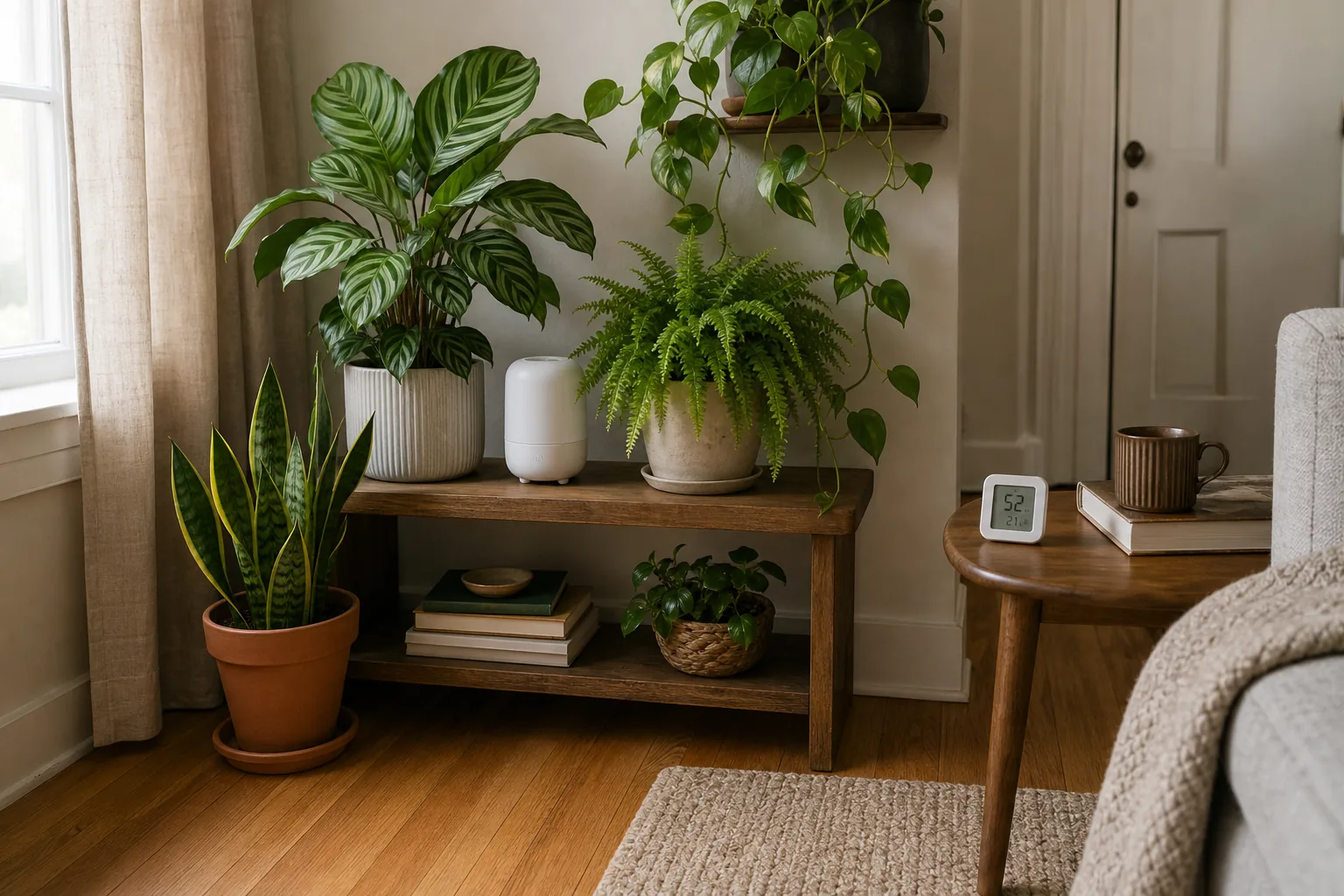
A basic digital hygrometer costs very little and is the single most useful tool in this whole decision. Place it at plant-canopy height, not on the floor and not on top of a tall shelf, somewhere it is not in direct sun, near a heating vent, or right next to a humidifier. Log the reading at two times of day for at least a week, ideally across both a warm spell and a cold one.
For context, not as a target, building-science and health sources cluster ordinary indoor relative humidity at roughly 30–50% in winter and 40–60% in summer. The Center for Energy and Environment in Minnesota and the Australian Sensitive Choice program both sit in this general range, with Carrier’s residential guidance in the same neighborhood. Sustained indoor RH above about 60% is widely flagged as a mold and bacterial growth risk. The point is to anchor your reading against an envelope, not to chase a number.
If your hygrometer is reading 25% in February and your plants are fine, the room is dry but the plants are not asking for help. If your hygrometer is reading 45% and a calathea is still crisping at the edges, humidity is probably not the cause. Both readings are useful.
Match the room reading to what your plants actually use
Plants differ in their humidity tolerance, and not in a way that maps neatly onto “tropical means high humidity.” Succulents, cacti, sansevierias, ZZ plants, and other water-storing species are consistently described across plant-care sources as tolerant of drier indoor air. Common “tropical” houseplants, including pothos, monstera, philodendron, and ficus, generally sit in the middle and tolerate ordinary indoor humidity. Calatheas and prayer plants, many ferns, and several orchids are repeatedly described as more sensitive. Our piece on calathea and prayer plant care in an ordinary home goes into that group specifically.
Because tolerance is a range rather than a fixed target, treat species lists as “which of these would actually notice a lift” rather than “this one needs exactly X percent.” A single calathea in a dry living room is a more pointed reason to consider local humidity management than a shelf of pothos.
Colorado State University Planttalk is direct about the link: plants in low indoor humidity or in drafts lose more water through transpiration and therefore need more water at the root. That phrasing matters. Humidity and watering are connected, so if you raise humidity you may need to adjust watering down. A humidifier that produces soggy roots is not a win.
When a humidifier is the practical choice
The case for buying one is narrow but real:
- Your hygrometer is consistently reading well below the 30–50% winter envelope and you have done what you can with placement.
- You keep a meaningful number of plants that are commonly described as humidity-sensitive, such as calatheas, ferns, some orchids, and possibly a few begonias, and grouping them in one room is realistic.
- That room can be closed off from the rest of the home at least part of the day, so a small unit’s output concentrates where the plants actually sit.
- You can commit to the ongoing maintenance, which includes emptying, rinsing, deeper cleaning on a schedule, and replacing filters or wicks where applicable.
If those four conditions line up, a humidifier starts to make sense.
When a humidifier is probably not the answer
There are also clear cases where it isn’t:
- The plants doing worst are succulents, snake plants, ZZ plants, or other dry-air-tolerant species. The fix is almost never more humidity.
- Brown tips keep appearing on plants that are otherwise well lit and on a reasonable watering rhythm. Our piece on brown tips and crispy edges runs through water quality, watering rhythm, light, and root health as more common causes. Humidity is on the list, but it is not the top of the list.
- The “problem room” is an open-plan living space shared with a kitchen. Tabletop humidifiers are designed for enclosed rooms, and manufacturer and product-tester framing positions them as inadequate primary tools for whole-home or open-plan coverage. AprilAire is explicit that a single-room unit can use more energy to humidify one room than a whole-home system uses for the entire house.
- Nobody in the household will own the cleaning routine. A poorly maintained unit can grow mold or bacteria that get dispersed into the air, which both the Mayo Clinic and GoodRx Health flag as a real concern.
In any of those situations, grouping the humidity-sensitive plants together, moving them closer to a bathroom or kitchen, or accepting the room as it is and choosing more tolerant species will usually serve better than buying equipment.
What actually matters in a humidifier for a plant room
Without recommending a specific brand or model, a few features matter more than marketing copy:
- Tank size and refill cadence. A small tank that runs out by mid-morning in a dry room is a daily chore. A larger tank with a clear water line is easier to live with.
- A built-in hygrometer or humidistat with an adjustable target. Running a unit flat-out in a small room will push the RH above 60% and into the mold-risk zone.
- Cool-mist versus warm-mist. Both add moisture to the air. Warm-mist units boil the water, are generally quieter, and may reduce some microorganisms in the water, but they pose a burn risk and use more electricity. Ultrasonic cool-mist units are common and quiet but can aerosolize minerals from hard water, leaving a fine white dust on leaves and nearby surfaces. Manufacturer and reviewer guidance commonly recommends distilled or demineralized water in ultrasonic units to limit this. Evaporative units use a wick and can capture some minerals but bring filter replacements.
- Cleaning access. A tank you can actually reach into, with no fiddly corners, makes the maintenance commitment realistic.
Coverage ratings printed on the box describe intended room size, not a guaranteed relative-humidity lift. Consumer Reports organizes its ratings the same way. The only honest test is a hygrometer before and after in your actual room.
Placement, runtime, and what to watch in the first weeks
Place the unit on a stable, elevated surface a foot or so away from leaves, walls, curtains, and electronics, with the mist aimed so it does not wet foliage or wood directly. Run it on a humidistat or a timer rather than continuously. In heating season, expect a single small unit to lift an enclosed room’s RH by a modest, finite amount. In an open-plan space the lift will be smaller and more local than the marketing suggests.
Re-check the hygrometer and look at the plants two to four weeks in. A few honest signals to watch for:
- New growth on humidity-sensitive plants that looks clean and unfurled properly rather than torn or stuck.
- Stable or rising soil moisture intervals, because transpiration has dropped and you may be able to water less often.
- Hygrometer readings that settle somewhere inside the broad comfort envelope (roughly 30–50% in heating season, 40–60% in summer) without climbing past about 60%.
- No new white dust on leaves or nearby surfaces. If there is, switch to distilled water in an ultrasonic unit or reconsider the unit type.
A reading that climbs into the 60s with the windows closed in winter is its own problem. Mold and bacterial growth on walls and in soft furnishings becomes a real concern, and the humidifier should be turned down or turned off before that point. Over-humid conditions can also encourage mold and mildew on leaves and nearby surfaces, which is a sign to reduce output rather than a feature to live with.
Limits, maintenance, and honest expectations
A humidifier is not a substitute for light, a reasonable watering rhythm, or the right plant in the right room. It does not reliably fix brown tips on its own, and it does not prevent pests such as spider mites. Humidity response varies by pest and by plant and is not endorsed by extension sources as a control method.
It does add a recurring commitment: refilling, rinsing the tank daily in most cases, a deeper weekly clean on the manufacturer’s schedule, filter or wick replacement, and the cost of distilled water if your supply is hard. The Cochrane review of indoor air humidification, published through the National Library of Medicine, describes the health-effect evidence as uncertain and emphasizes that humidifiers carry ongoing costs, notably electricity. That is a reasonable frame for a plant-room decision too. If the routine does not fit the household, the honest answer is to keep humidity-sensitive plants in a smaller cluster, use a pebble tray if it helps, and pick species whose tolerance matches the room you actually have.
Buying a humidifier for plants is justified only when a measured gap, a real species need, and a closable room all line up, and when the cleaning and water-quality commitments will actually be met. In every other case, the better answer is a hygrometer, a short list of plants that match the room, and a calm look at whether the problem was ever humidity at all.
Sources
- Humidity and houseplants — Penn State Extension
- Houseplants: temperature and humidity — Colorado State University Planttalk
- Warm-mist versus cool-mist humidifier — Mayo Clinic
- Cool mist vs. warm mist humidifiers — GoodRx Health
- Humidification of indoor air for preventing or reducing dryness — Cochrane review via PMC / NCBI
- Whole home versus room humidifier — AprilAire
- Humidifier buying guide — Consumer Reports
- Managing indoor humidity levels all year round — Center for Energy and Environment
- Indoor humidity levels — Sensitive Choice
- What humidity should my house be at? — Carrier