Plant care
How long should a grow light stay on for houseplants?
· Updated
Most foliage houseplants do well with roughly 12 to 16 hours of grow light per day, paired with a real dark period of about 6 to 8 hours at night. The exact timer setting is not a fixed number, though. It shifts with how much natural daylight the room already provides, what type of plant you are growing, how strong your fixture is, and the time of year. Running the light overnight tends to stress the plant rather than help it.
If you only remember one thing from this article, make it this: pick a starting hour in the 12 to 14 range for most foliage houseplants, use a simple outlet timer so the schedule is consistent, and adjust up or down by an hour or two based on what the plant actually does over the next two or three weeks.
What “hours per day” actually means for a grow light
When a grower talks about a grow light schedule, they mean the photoperiod: the total number of hours in a 24-hour day that usable light is reaching the leaves. That total includes any natural daylight coming through the window plus whatever the fixture adds.
The timer on your outlet controls only the artificial part. The plant responds to the sum of both. If a south-facing window already bathes the plant in bright light for five hours, the timer does not need to add another 14. The same plant in a dim interior hallway with no window at all may need the timer closer to the upper end of the range.
This is why university extension and botanical garden sources give ranges rather than single numbers. The University of Minnesota Extension recommends 12 to 14 hours per day for foliage houseplants, and the New York Botanical Garden echoes that 12 to 14 hours of supplemental light is usually enough for plants already getting some natural daylight.
A calm starting range for most foliage houseplants
For typical tropical foliage plants such as pothos, philodendron, monstera, peperomia, and similar species, a starting timer setting of 12 to 14 hours per day is the safest choice. This matches what University of Minnesota Extension recommends for general indoor plants under supplemental lights.
You can extend toward 14 to 16 hours if the room is genuinely dim, the plant is a high-light species, or you are trying to push growth in winter when natural daylight is short and weak. Going past 16 hours of total light per day (natural plus artificial combined) is not usually useful, and University of Maryland Extension specifically recommends staying at or under 16 hours of total light in a 24-hour period.
If you are not sure where to start, set the timer for 13 hours and run it from, say, 7 a.m. to 8 p.m. That window is easy to remember and lines up with the actual day in most homes.
Why a real dark period still matters
Plants respire at night. During the dark period they break down the sugars they made during the day, move nutrients around, and carry out other biological processes that light itself interrupts. University of Maryland Extension caps the combined daily light total at 16 hours, which leaves a minimum of roughly 8 hours of dark in every 24-hour cycle, and that floor exists for a reason.
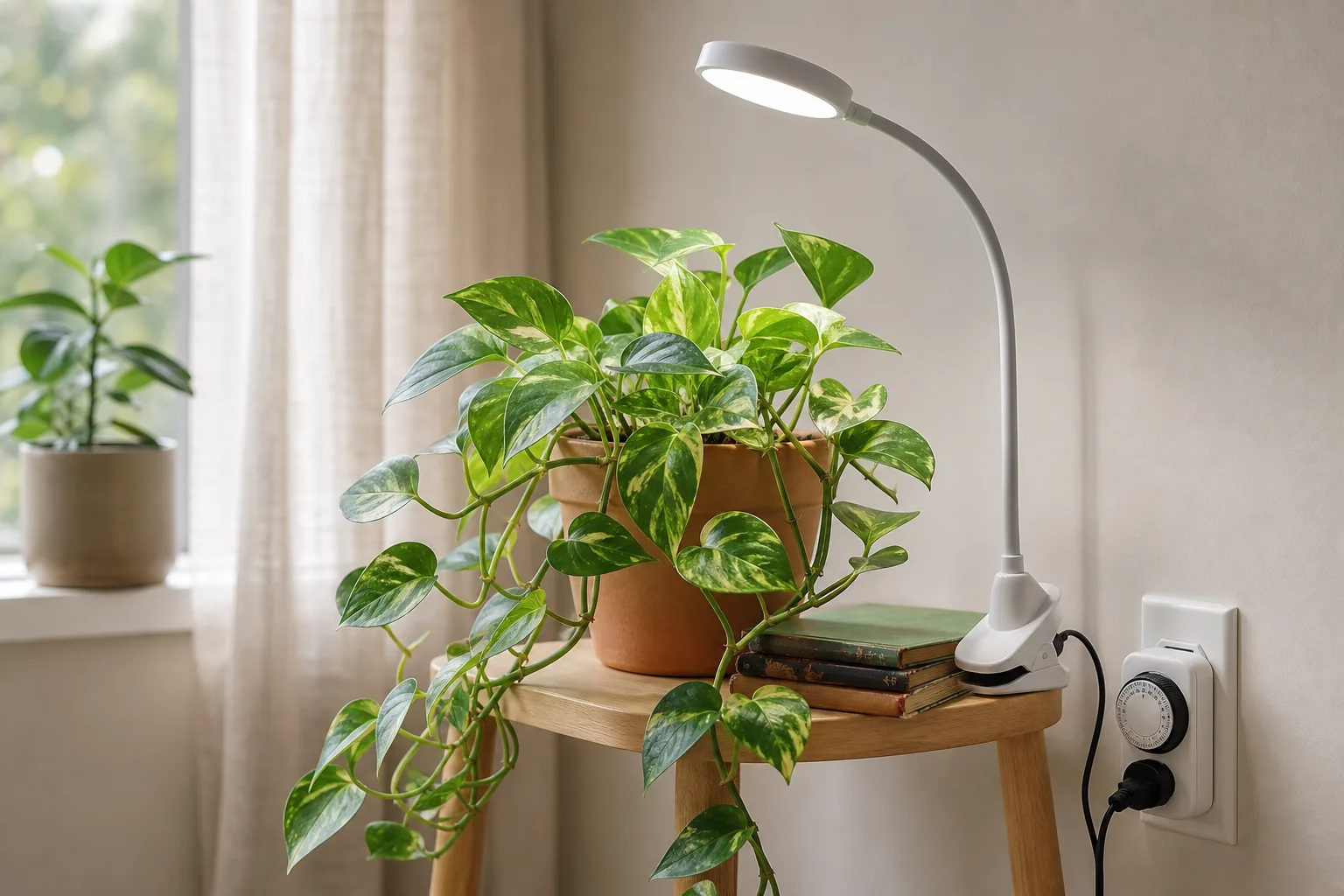
A practical target is at least 6 to 8 hours of true darkness per day. True darkness means the timer actually clicks off and the room is not lit by a hallway nightlight, a television glow, or another nearby fixture. An outlet timer is the easiest way to make sure the off-block happens the same way every day.
If you have ever wondered whether running the light a few extra hours at night helps a struggling plant, the answer in almost every case is no. Add hours during the day, or move the fixture closer to the canopy. Do not run it overnight.
How natural daylight changes the timer hours
The single biggest variable in how long to run your grow light is the natural daylight already reaching the plant. Before you set a timer, it is worth spending a few minutes actually observing the room across a normal day. Our guide on how to read the natural light in your room walks through that observation step by step.
As a rough rule:
- A bright room with several hours of direct sun or strong indirect light: the timer can sit at the low end of the range, around 10 to 12 hours.
- A medium room with a couple of hours of bright indirect light: the middle of the range, around 12 to 14 hours.
- A dim interior room with little or no useful daylight: the upper end, around 14 to 16 hours, and consider whether the fixture itself is strong enough. Our piece on realistic expectations for low-light houseplants covers what plants can and cannot do in dim corners, which can help you decide whether more hours or a better-placed plant is the real fix.
This is also the reason why the same plant may want different timer hours across the year, which we will get to shortly.
Plant type adjustments: foliage, succulents, flowering, and edibles
The 12 to 14 hour starting range is built around foliage houseplants. Other categories lean differently:
- Succulents and cacti. These are usually high-light plants, and extension sources treat them as an intensity-led category rather than an hour-led one. Most will tolerate the foliage band as a starting point, but the bigger adjustment is usually how strong and how close the fixture is, rather than how many hours it runs. A weak bulb far from the plant will not produce a healthy succulent no matter how long it stays on.
- Flowering houseplants. University of Minnesota Extension gives flowering houseplants 14 to 16 hours per day, though this depends heavily on the species (see the short-day note below).
- Leafy herbs, seedlings, and propagation setups. University of Minnesota Extension cites 14 to 18 hours per day for seedlings and cuttings, with hydroponic lettuce and herbs at 12 to 14 hours. If you are running a propagation shelf or a kitchen herb garden, lean toward the longer end of the foliage range.
Most readers will spend 90 percent of their timer setting on foliage plants, which is why this article keeps coming back to that 12 to 14 hour band.
Short-day and long-day plants: the one exception worth knowing
This is the section worth slowing down on, because a flat “run it 14 hours a day” recommendation will actively keep certain plants from blooming.
Plants respond to day length in three ways. Short-day (also called long-night) plants set buds and flower when the photoperiod is shorter than a critical threshold, often less than about 12 hours. Long-day plants flower under longer photoperiods. Day-neutral plants flower based on age or maturity rather than day length.
Common indoor short-day plants include poinsettia, kalanchoe, and Christmas cactus. Oregon State University Extension names these species specifically. For these plants, running a constant 14-hour timer through the fall and early winter keeps them in leaf growth and prevents the bud set that triggers their holiday blooms. The practical fix is to shorten the photoperiod to roughly 10 hours or less in the weeks before you want blooms, or simply rely on the natural shortening days of autumn by moving the plant somewhere the timer cannot reach it.
UMass Extension adds that some short-day responses are obligate, meaning the plant really cannot flower without short days, while others are facultative, meaning short days help but are not strictly required. For most houseplant owners this nuance does not change the practical advice: if you are growing poinsettia, kalanchoe, or Christmas cactus and want flowers, give them shorter days rather than longer ones.
How intensity changes the hour count
Hours and intensity trade off against each other. A strong LED panel a few inches above the canopy delivers a lot of usable light in a short time. A weak bulb a foot or two away needs more hours to deliver a comparable dose.
Extension sources frame the timer recommendation in terms of usable light reaching the leaves rather than tying it to a specific fixture type. University of Missouri Extension gives a wattage-per-square-foot figure for medium- and high-light plants, but that kind of math does not translate cleanly to modern LEDs and is not necessary for setting a timer. A practical approach is to treat your timer as a starting hypothesis and let the plant’s response be the confirmation or correction.
If the foliage is rich green, the new leaves are coming in at normal spacing, and the plant is not leaning toward the fixture, the hours and the intensity are probably in the right zone. If something looks off, the next move is usually to adjust either the timer or the distance by a small amount, not both at once.
Seasonal adjustments without resetting the timer weekly
You do not need to fiddle with the timer every time the season changes. A simple approach is to set two schedules across the year:
- Dark months (roughly late fall through early spring, or whenever your windows get short and dim): set the timer toward the upper end of the foliage range, around 14 hours.
- Bright months (roughly late spring through summer): set the timer toward the lower end, around 10 to 12 hours, because natural daylight is doing more of the work.
Switch between the two a couple of times per year rather than constantly recalibrating. Our guide on how shorter winter days change houseplant care covers the rest of the seasonal adjustments beyond lighting, including watering and humidity shifts that often come along with shorter days. For the other side of the year, our notes on summer houseplant care and stronger sun explain why a sunlit room in July may not need any supplemental hours at all.
Signs your hours are too few or too many
The plant is the confirmation. Two or three weeks of consistent timer settings is usually long enough to see a response.
Too few hours (or too little intensity): new leaves come in smaller than older ones, internodes stretch out, growth leans toward the fixture, and new foliage looks paler than the older growth. Our piece on what leggy growth usually signals about light covers this in detail and walks through what to change first.
Too many hours (or too much intensity): you see bleached or yellowing patches on the upper surface of the leaves closest to the fixture, dry or crispy edges, and sometimes sudden leaf drop. If the upper leaves are showing damage but the lower leaves are fine, the answer is usually to move the light farther away or trim an hour or two, not to remove the timer altogether.
A short checklist for setting a daily grow light schedule
A quick sequence you can work through on the day you install the light:
- Start at 13 hours for a typical foliage plant in a medium room.
- Run the timer on a clock that lines up with actual daylight, such as 7 a.m. to 8 p.m.
- Add an hour or two if the room is dim or the season is dark; trim an hour or two if the room is sunlit or the season is bright.
- Drop the timer to roughly 10 hours or less for poinsettia, kalanchoe, or Christmas cactus when you want them to set buds.
- Watch the plant for two to three weeks. Green color, normal spacing, and an upright stance mean the timer is in the right zone. Stretch, paleness, leaning, or bleached patches mean an adjustment is due.
- Recheck at the turn of each season and shift between the two settings you have been using rather than starting over. A simple weekly houseplant care routine keeps this kind of light check from falling through the cracks.
Plant behavior varies with the species, the cultivar, the potting mix, the temperature, the water quality, and the rest of the room. None of the numbers above are guarantees; they are starting points for an observation-based routine. If a plant is showing symptoms that do not match the descriptions here, a local nursery or your regional cooperative extension service is a good next stop.
Sources
- University of Minnesota Extension, Lighting for indoor plants and starting seeds
- University of Maryland Extension, Lighting for indoor plants
- New York Botanical Garden, How many hours of supplemental light do my houseplants need?
- Oregon State University Extension, Day length plays key role in plant flowering
- UMass Extension Greenhouse & Floriculture, Photoperiod and bedding plants