Plant care
Plants for a low-light bathroom
· Updated
The short answer
A small group of houseplants — pothos, heartleaf philodendron, snake plant, ZZ, peace lily, Chinese evergreen, cast iron plant, and spider plant — can tolerate a low-light bathroom better than most. Low-light tolerance is documented in university extension and botanical-garden sources for the best-supported picks in that group (snake plant, pothos, cast iron plant), and is corroborated by other horticulture references for the remainder. The harder constraint is light, not humidity: bathroom humidity is intermittent and depends almost entirely on whether you run the exhaust fan. Read your actual light and your actual humidity pattern before choosing a species, because most generic bathroom plant lists do not.
Why a ‘low-light bathroom’ is not one type of room
Three situations get lumped together as “the bathroom” in most plant lists, and they produce very different growing conditions:
- A bathroom with a frosted window and dim daylight. A frosted pane lets in less light than a clear one, and a heavy frost film transmits a much smaller share of visible light than a light frost. Whether your frosted window sits closer to the high or low end of that range changes which plants are realistic here.
- A bathroom with a skylight or borrowed light. A skylight admits the most usable light because it takes light from above without privacy concerns. An interior bathroom that only borrows light from a hallway sits at the low end.
- A fully enclosed, windowless bathroom. With no daylight source at all, usable light is effectively zero unless you add a small grow light. Most shortlist species will not survive here long-term without supplemental light.
Which one you have is the single biggest decision ahead of any species. If you want a refresher on how to estimate this, the article on how to read the natural light in your bathroom walks through the shadow test and observation order.
Read the actual light in the bathroom before any species shortlist
Most extension and botanical-garden sources divide indoor light into low, medium, and bright indirect. The shortlist species below come from sources that place them firmly in the low-to-medium range. A bathroom with a clear skylight or an unshaded window can sit at medium indirect for several hours a day. A frosted window, a small window, or borrowed light usually drops a bathroom into the low-to-medium range at best. A fully enclosed interior bathroom falls into low light, and any plant there will be surviving rather than growing.
A quick test: hold your hand near the brightest wall at midday. A soft, blurred shadow with no sharp edges suggests low or medium indirect light. A sharp-edged shadow suggests bright indirect. If you cannot see any direct sunlight at all from your brightest spot, your bathroom is in the low-light category for plant purposes. That matters because what “low light tolerance” actually means is that the plant persists in dim conditions, not that it grows actively there.
What bathroom humidity actually does, and what an exhaust fan changes
Humidity is the variable most bathroom lists get wrong. Showers do raise humidity enough to cause visible condensation on mirrors and other cool surfaces, and that brief spike is real. But a running exhaust fan pulls that humid air out and replaces it with drier air from outside, which is the entire purpose of the fan. In a ventilated bathroom, humidity is intermittent: it spikes during a shower, drops sharply while the fan runs, and then settles to roughly the same level as the rest of the house.
This pattern matters because most species that get called “bathroom plants” — Boston fern, calathea, prayer plant, moth orchid — are humidity-loving, not humidity-only. They want sustained elevated humidity, and a ventilated bathroom does not give them that. A bathroom with the fan off, the door closed, and no ventilation for hours can give them closer to what they want, but most households run the fan during or after a shower for good reasons.
The honest framing is that humidity tolerance matters more than humidity preference in a low-light bathroom. A species that tolerates a wide humidity range will not be hurt by the spike-and-drop pattern, even if it does not benefit much from it either. The article on what humidity actually does in an ordinary bathroom separates constant from intermittent humidity in more detail.
Other conditions that quietly change the answer
Light and humidity are the headline variables, but a few bathroom-specific conditions can override them.
- Cold tile at night. Tile and exterior walls cool overnight more than interior walls in living rooms, which can drop the microclimate around a pot sitting directly on the floor. Nebraska Extension notes that most foliage houseplants tolerate days of 65–75°F with nights 10–15°F cooler. A small bathroom at the cool end of that range is fine for shortlist species, but a pot resting on cold tile all night can experience root-zone chilling. Setting the pot on a wood vanity, a shelf, or a mat limits this. The article on drafts, vents, and cool tile in the bathroom covers this kind of microclimate in more detail.
- Splash zones. A plant on the edge of a sink or tub gets watered at the soil surface during hand-washing and face-washing, which keeps the top of the soil wetter than the rest of the room and encourages fungus gnats. The fix is placement, not species: keep the pot out of splash zones where possible.
- Outlets and heated towel rails. Bathrooms are divided into electrical zones by code that restrict where receptacles can sit relative to tubs and showers. Any plant that could be reached by splashing water toward a receptacle adds an unnecessary variable in a wet zone, and a heated towel rail creates a drier, warmer microclimate that suits succulent-leaved species better than humidity-dependent ones. Treat this as a placement decision rather than a plant-health one.
- Door-closed airflow. A bathroom with the door closed all day is a stagnant-air room. Airflow matters more than most readers expect for keeping leaf surfaces dry and fungus gnats in check.
Houseplants that tolerate the combination of low light and a bathroom
These species are documented in extension or botanical-garden sources as tolerant of low light, which is the limiting constraint. Treat them as a shortlist rather than a ranking.
- Snake plant (Dracaena trifasciata, formerly Sansevieria). Iowa State University Extension groups snake plant with low-maintenance houseplants that tolerate lower light, and the Chicago Botanic Garden names it among indoor plants suited to low-light interiors. It also tolerates dry air, which makes it a fit for a ventilated bathroom.
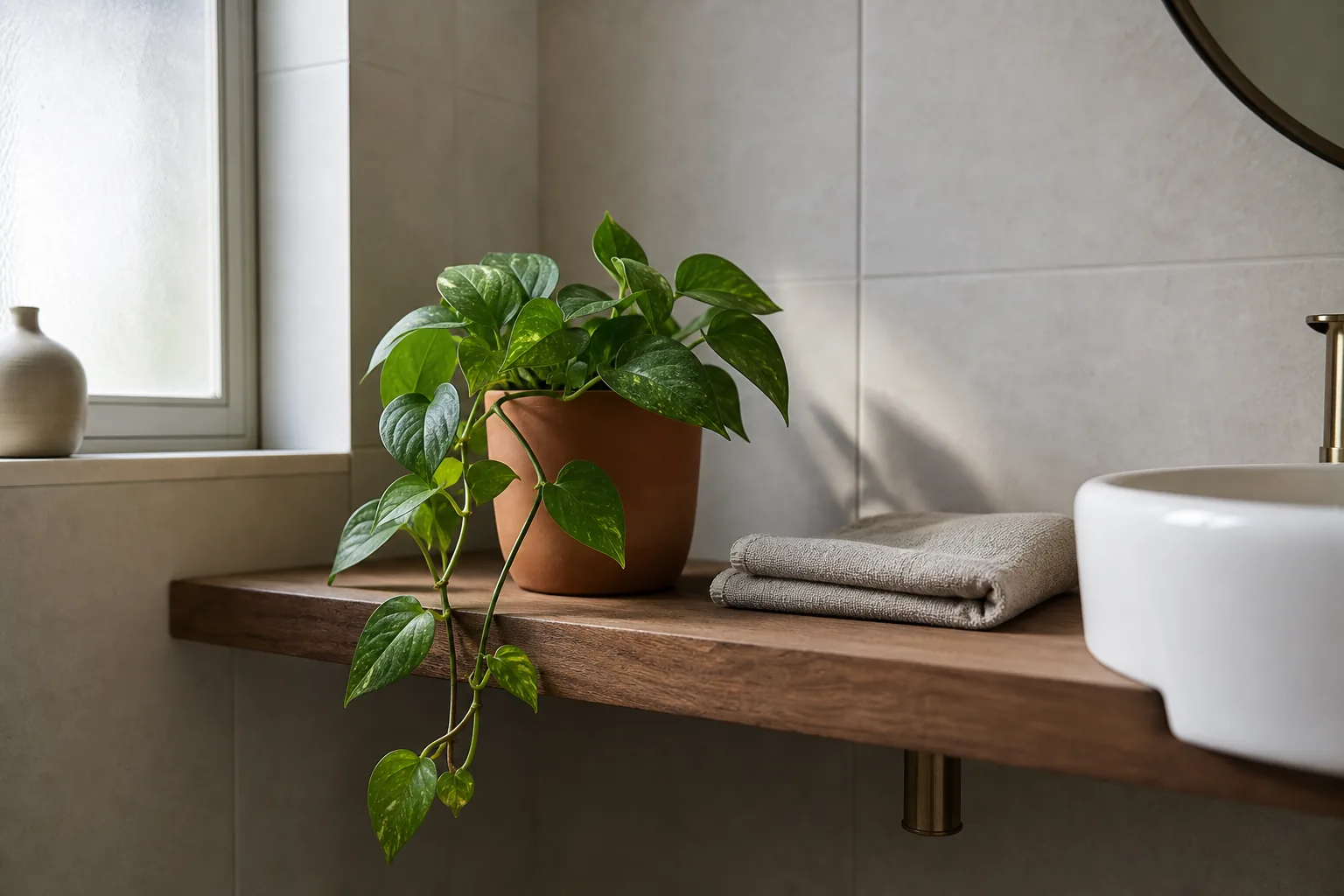
- Pothos (Epipremnum aureum). Clemson HGIC notes that pothos prefers bright indirect light but tolerates lower lighting. In a low-light bathroom it will survive; it will not grow quickly, and variegated cultivars will hold their variegation less strongly than in brighter spots.
- Heartleaf philodendron (Philodendron hederaceum). Documented in horticulture sources as low-light-tolerant and tolerant of a wide humidity range. A small pot on a shelf away from splash works well.
- Cast iron plant (Aspidistra elatior). The Chicago Botanic Garden names cast iron plant as a low-light-tolerant indoor species, with the understory framing that supports realistic expectations about slow growth.
- ZZ plant (Zamioculcas zamiifolia). Frequently listed as tolerant of low light across horticulture references. It stores water in rhizomes, so the spike-and-drop humidity pattern is fine for it.
- Chinese evergreen (Aglaonema spp.). Listed in horticulture references as low-light-tolerant. Cultivar differences in leaf color and growth rate are worth noting.
- Peace lily (Spathiphyllum). Often recommended for bathrooms. Tolerates low light; flowering may be limited in dim conditions. Its droop signal is a useful watering cue if you learn to read it.
- Spider plant (Chlorophytum comosum). Frequently listed as low-light-tolerant across horticulture references. Tolerates a wide humidity range and is forgiving of occasional dry-outs.
Most of these species are toxic to cats or dogs to some degree, which is worth knowing before you bring one home. Use the verification method in checking a houseplant against pet safety rather than relying on a list summary, because list summaries of toxicity vary in how specific and how current they are.
Houseplants to be cautious about in a low-light bathroom
These are the species that show up on most bathroom lists but whose light requirement disqualifies them in a low-light or windowless bathroom:
- Boston fern, calathea, and prayer plant. Humidity-tolerant, not low-light-tolerant. They want medium to bright indirect light, so in a low-light bathroom they slowly decline even with the humidity spikes.
- Moth orchid (Phalaenopsis). Often sold as a bathroom pick, but orchids need bright indirect light to rebloom and will tolerate a low-light bathroom only for short periods.
- Most succulents and cacti. They prefer dry air and bright light, so a humid, low-light bathroom is the opposite of what they want.
- Any species recommended only because it “likes humidity.” Humidity preference without a low-light match is the most common reason bathroom lists mislead.
A short placement and care routine for one bathroom plant
Pick one shortlist species in a small pot, and start with this routine:
- Place the pot on a shelf, mat, or wood vanity rather than directly on tile, a few feet from — but not directly under — any frosted window.
- Keep it out of splash zones near sinks and tubs.
- Water by feel, not on a schedule. Stick a finger into the top inch of soil and water only when it feels dry at that depth.
- Rotate the pot a quarter turn each week if the only light comes from one direction, so growth stays even.
- Run the exhaust fan during and after showers as your household normally does. The plant will tolerate the resulting humidity pattern.
Signs the bathroom is not working, and when to move the plant
A plant that survives a low-light bathroom for months without much new growth is normal. A plant that shows these signals is asking for a change:
- Soggy soil that does not dry between waterings, especially in a pot sitting on cold tile or in a splash zone.
- Yellowing lower leaves across multiple stems, often a sign of consistently wet soil.
- Fungus gnat flare-ups, which suggest the soil surface stays too wet.
- Mushy stems at the soil line, which indicates rot.
- A plant that grows well for a while and then stalls once the season changes, often because light dropped further.
When these appear, move the plant to a brighter room for a few weeks to recover, then decide whether to return it. A bathroom with no daylight at all is not a long-term home for any of these species without a grow light.
Sources
- Iowa State University Extension – Easy low-maintenance houseplants: https://yardandgarden.extension.iastate.edu/how-to/easy-low-maintenance-houseplants
- Clemson HGIC – How to grow pothos indoors: https://hgic.clemson.edu/factsheet/how-to-grow-pothos-indoors-epipremnum-spp-care-cultivars-and-common-problems/
- Chicago Botanic Garden – Denizens of the dark: indoor plants for low-light spaces: https://www.chicagobotanic.org/plant-information/smart-gardener/denizens-dark-indoor-plants-low-light-spaces
- Nebraska Extension – Guide to growing houseplants: https://go.unl.edu/4hhouseplants
- Green Building Advisor – Running bath fans to control humidity: https://www.greenbuildingadvisor.com/article/running-bath-fans-to-control-humidity