Plant care
Root pruning houseplants: when the technique helps and how to limit the damage
· Updated
Root pruning houseplants is one of those techniques that looks routine on social media and turns out to be a special-purpose move in real life. Most indoor plants never need it. For a generally healthy plant with a crowded pot, the safer default is to move up one pot size or to divide the plant. Root pruning is the answer when you cannot up-pot, when there are clearly damaged or rotted roots to remove, or when you are preparing the plant for division.
If a reader takes one thing from this guide: do not reach for pruners first. Reach for the triage.
Root pruning is a special-purpose tool, not a routine step
A rootbound houseplant is a plant whose roots have filled the pot and started circling. The standard fixes are well established: step up one pot size, or divide the plant into two or more pieces. Root pruning is something different. You are deliberately cutting part of the root system so the plant can stay in the same container, or so you can remove parts that should not be there in the first place.
Horticulturist Melinda Myers describes root pruning as “a bit risky,” and presents it as an answer specifically for situations where moving up is not practical, whether because there is no space for a larger container, no larger container is available, or the plant has become too heavy to handle. That framing matters. Root pruning trades root mass for the ability to keep a plant in a particular pot. It is a tradeoff, not an upgrade.
When root pruning is actually appropriate
Three situations justify the technique. In all three, the plant should otherwise be in reasonable health.
The first is the size-cap situation. You want to keep the plant in its current pot because the shelf, the floor space, or the windowsill cannot accommodate a larger container. Some readers keep large houseplants in the same pot for years to manage size, particularly species that would otherwise outgrow their space. Root pruning, paired with fresh potting mix, is the technique that makes that possible.
The second is damaged or girdling roots. A plant lifted from its pot may show thick roots circling the outside of the rootball, or roots wrapping the main stem or trunk and slowly strangling it. It may also show dark, mushy, sour-smelling roots that have begun to rot. Those specific roots need to come out. The rest of the root system should be left alone.
The third is preparation for division. Many aroids, ferns, and other clumping plants can be split into multiple plants at repotting. Loosening and lightly pruning the rootball is part of separating clean divisions, not a separate maintenance step.
If none of those three apply, root pruning is probably not what your plant needs.
When the better answer is a bigger pot or a division
For a healthy but crowded plant, two options almost always beat root pruning.
Up-potting means moving the plant to a container one size larger with fresh potting mix. You add room for new root growth without removing anything that is currently working. This is the default path when the pot can be larger.
Division splits one plant into two or more plants, each with its own root system. It works for plants that grow in clumps, with multiple growth points that can be teased apart. It is not an option for single-stem plants.
Before considering root pruning, confirm that the plant is genuinely rootbound rather than just dry or hungry, and check whether up-potting is the better fit for the situation.
Triage before you cut: three quick checks
Three questions decide whether to prune.
Is the plant actively growing? Active growth is the right window for root work because the plant can replace lost roots quickly. Indoor light through winter is often weak, which can keep a plant effectively dormant even when the calendar says spring. Look for new leaves, new stems, or visible root tips. If the plant has been sitting still for weeks and the light is low, wait.
Are there actually bad roots, or just a tight mass? A dense, white-to-tan root system that holds the shape of the pot is a healthy rootbound plant. Brown or black roots that crush between your fingers and smell sour are rotted. Thick roots that wrap the trunk are girdling. Healthy roots should not be removed just to reduce volume. If you are unsure how to read wet versus dry roots, the differences between overwatered and underwatered plants walk through the same visual cues.
Does the pot actually need to stay the same size? If you can up-pot by one size, you can avoid cutting at all. The size-cap is the most common honest reason to root-prune, but it is also the most often skipped over.
If any answer is “no” or “I’m not sure,” pause. The next step is more observation, not more cuts.
Tools, surface, and sanitation - kept proportionate
You need sharp, clean pruners or scissors, and a work surface you can wipe down. A sharp blade makes a clean cut; a dull blade tears root tissue and slows recovery. Wipe the blades with a cloth before you start, and again between plants if you are working on more than one. Some home gardeners also wipe blades with rubbing alcohol or a dilute bleach solution, though none of the extension sources we reviewed prescribe a specific sanitizer for houseplant root work. The goal is simply not to drag a problem from one plant to another, not a sterile-procedure setup.
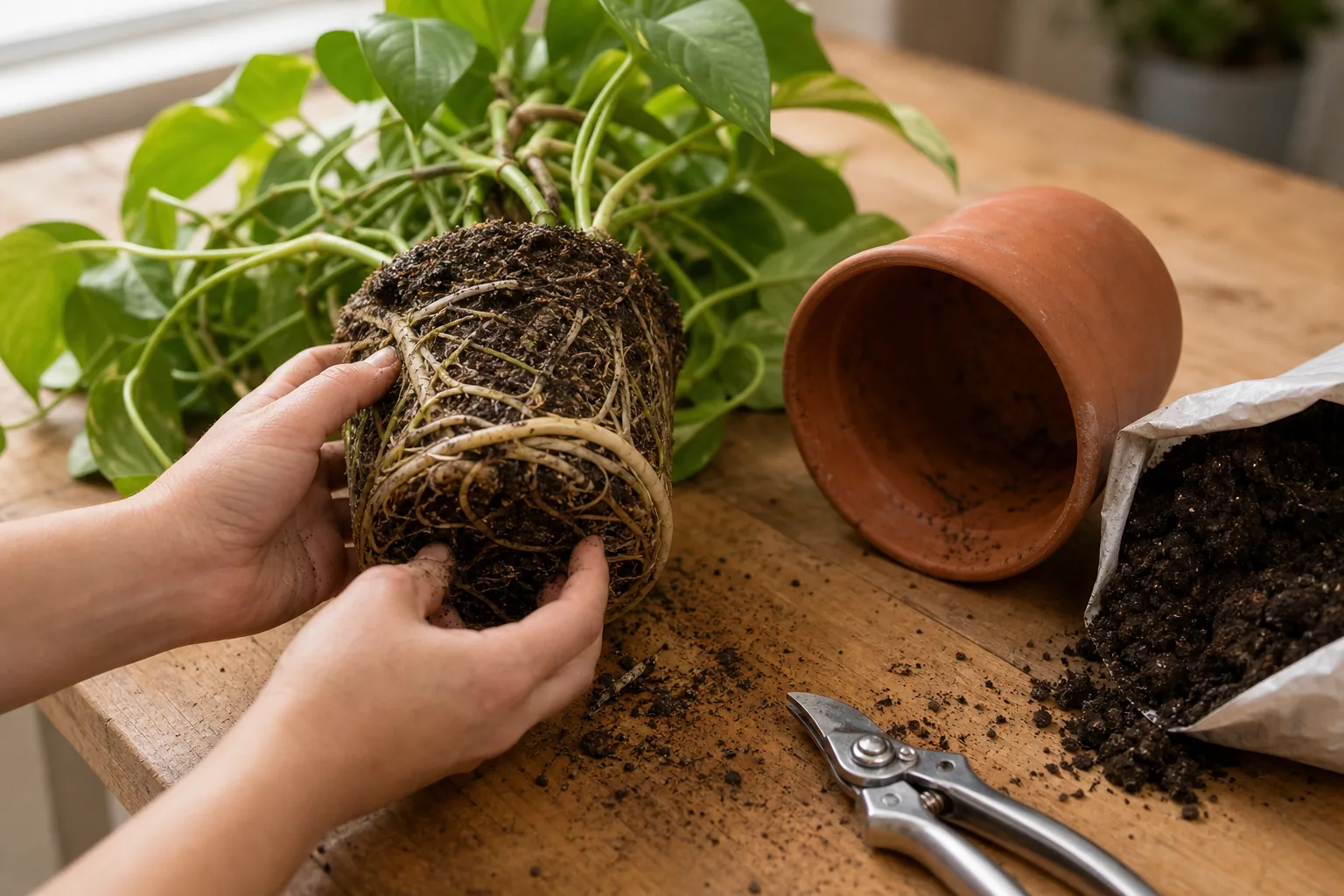
Lay the pot on its side, slide the rootball out, and set it on the surface. If the rootball is stuck, run a blunt knife around the inside edge rather than yanking the stem. A few firm taps on the pot base often release it without damage.
The cut: how much, and which roots
Start by removing the soil you can shake off or tease out with your fingers. You do not need to remove all of it. You are trying to expose the worst roots and make room to work, not to wash the plant bare.
Then target the specific roots that need to go: dark, mushy rotted sections, thick circling roots that wrap the trunk, and any broken or torn ends. Cut back to firm, pale tissue. For circling roots on the outside of the rootball, slice a shallow cross or shave off the outer half inch of the mass to interrupt the circle without slicing deep into healthy roots.
For the question of how much to remove: there is no clean percentage rule for houseplants in the extension and horticultural literature. The percentages that get quoted, around 10 to 20 percent in some tree-care guidance and no more than 30 percent in other woody-plant guidance, are drawn from landscape trees and mature nursery stock, not indoor plants. Translated to a houseplant, the practical version is to take only what is clearly needed and leave the fine, white, hair-like feeder roots that actually take up water and nutrients. If the goal is simply to fit the plant back into its original pot, trim less rather than more. If you find yourself approaching the 30 percent upper bound cited in woody-plant SOPs, it is worth reconsidering whether up-potting or division would have been the cleaner choice.
After the targeted cuts, loosen the remaining root mass gently with your fingers. The goal is to free circling roots so they can grow outward into the new mix, not to shave the rootball into a flat-topped stump.
Aftercare that supports recovery
Treat the weeks after root pruning the same way you would treat the weeks after a standard repot. The plant has a reduced root system relative to its top growth, and the same recovery playbook applies.
Put the plant back in the original pot with fresh, well-draining potting mix. Settle the mix around the roots without compacting it. Water carefully so the new mix is moist but not soggy; a smaller root system sitting in saturated soil is the most common way a plant is lost after root work. Place it in stable light, somewhere close to what it had before, and avoid the temptation to push it into brighter light to “help.” Hold off on fertilizer until you see clear new growth, often four to six weeks. Most fresh potting mixes supply some initial nutrition, and added fertilizer salts on cut roots do not help.
If you are working through this for the first time, the aftercare steps for a freshly repotted plant translate directly. The two situations are functionally identical.
Watch for new leaves, new stems, or fresh white root tips at the drainage holes. Those are the cues that recovery is underway.
Species reality check - some houseplants tolerate this poorly
Different houseplants respond to root work in different ways, and the extension sources we reviewed do not give a clean species-by-species tolerance table. The general principle is that soft-tissue, rot-prone plants tend to tolerate less root disturbance than tougher, woodier houseplants. Plants with thick storage roots or rhizomes often take longer to recover than plants with finer, faster-growing root systems. Beyond that broad pattern, individual species can vary, and a plant that has been root-pruned routinely in your home may behave differently from the same species under different light or watering.
If you are working with a species you have not root-pruned before, default to less, not more, and consider asking a local nursery or your regional extension service what they would do for that specific plant. This is a place where a five-minute conversation with someone who handles that species regularly is more useful than a generic online guide.
When to stop and ask a local expert
There are situations where the right move is a second set of eyes rather than another cut.
If a plant is wilting while the soil stays wet, the problem is likely root rot, and the aftercare is different from a planned root-pruning situation. The same is true if more than a third of the visible root mass looks dark and soft, or if the plant has been under recent stress like a move, a temperature swing, or a pest outbreak. A local nursery, a master gardener program, or your regional extension service can look at the actual plant and give species-specific advice.
Root pruning is a tool, not a habit. Used in the right situation, with the right restraint, it solves a problem that up-potting cannot. Used on a healthy plant on a schedule, it just adds stress.