Plant care
Grow light bulb vs grow light fixture for houseplants: what actually changes
· Updated
Both categories can grow houseplants, but they differ in form factor, how the light is shaped and aimed, how much heat they add to the spot, and how easy they are to move. A screw-in grow-light bulb reuses a lamp you already own, swaps in cheaply, and works well for a single plant or small cluster. A dedicated grow-light fixture is engineered for plant use, spreads usable light across a wider area, and manages heat through its own housing, but costs more and is harder to reposition. The decision mostly comes down to the lamp or socket you already have, the size of the area you need to light, and how permanent you want the setup to be.
If you already have a specific shelf, windowsill, or corner in mind, the rest of this article walks through what genuinely changes between a screw-in bulb and an integrated fixture, and how to read the box so the choice reflects your room rather than the marketing on the front.
What “grow light bulb” and “grow light fixture” actually mean here
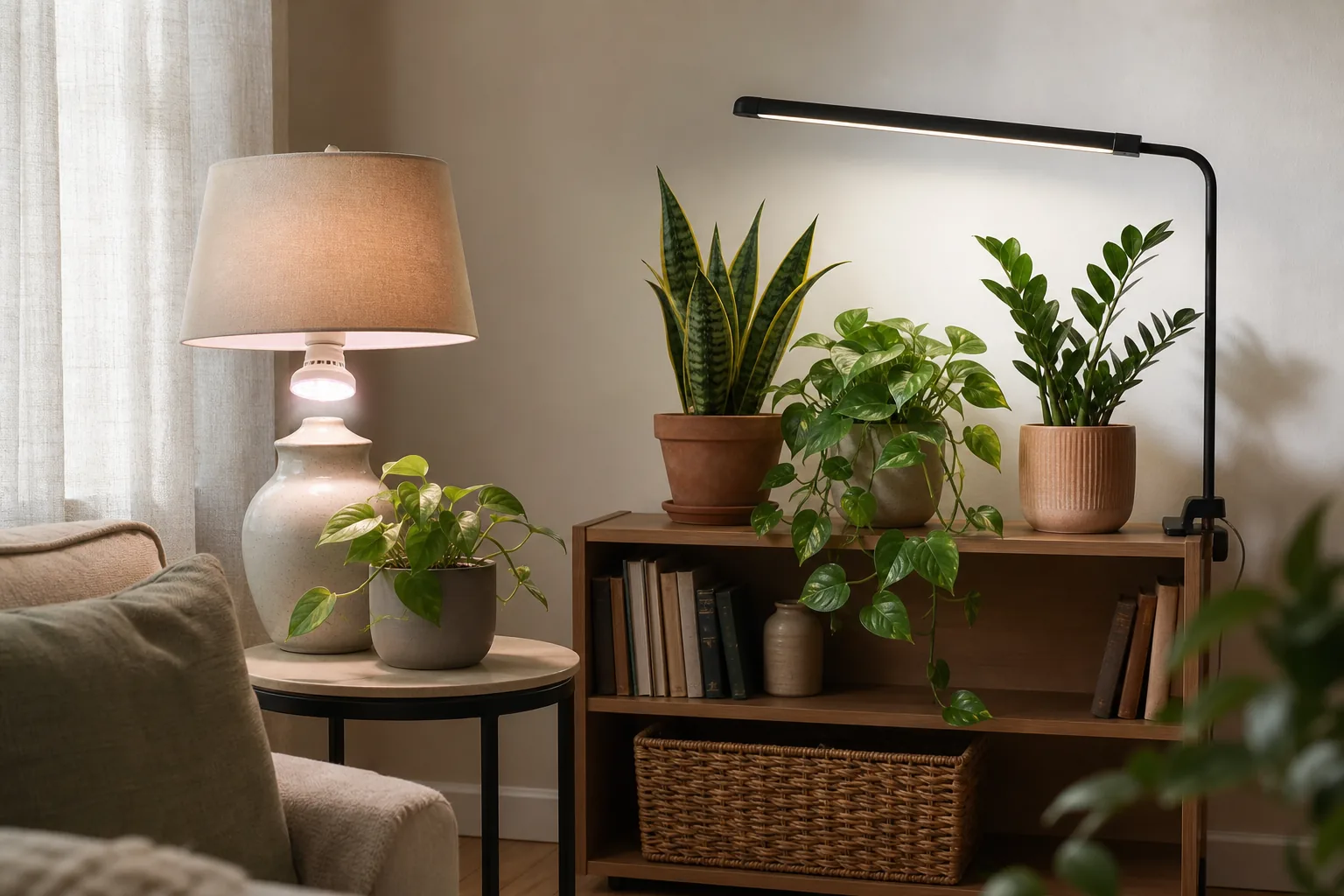
A “grow light bulb” in this article means a screw-in replacement bulb, usually built around a standard E26 or E27 base, that drops into an ordinary table lamp, floor lamp, clamp light, or pendant socket. The bulb is engineered to emit wavelengths associated with plant photosynthesis, often with a high proportion of red and blue, but it relies entirely on the lamp around it for aiming, beam shape, and heat behavior.
A “grow light fixture” or “integrated fixture” means a self-contained unit with built-in LEDs, a reflector or lens system, a housing designed for thermal management, and its own mounting hardware (clamp, stand, hanging kit, or shelf bracket). The diodes, driver, and housing are designed as a single system rather than as a bulb that drops into someone else’s lamp.
University extension services tend to group indoor plant lights by technology family (fluorescent, high-intensity discharge, and light-emitting diode) rather than by form factor. The practical distinction between bulb and fixture is still real, though: one is constrained by the lamp you own, the other is engineered from the socket out.
What genuinely changes for the plant: coverage, spectrum label, and how long the unit runs
The first real difference is coverage. A screw-in bulb in a downward-facing socket sends most of its usable light to a small patch directly underneath. That is well-suited to one plant or a small cluster, and it is why industry form-factor descriptions position screw-in bulbs for single shelves, propagation corners, and seed-starting racks.
An integrated fixture is generally built to spread usable light across a wider footprint than a screw-in bulb, with reflectors or lenses designed to shape the beam for plant growth, though actual coverage depends on the fixture’s design and the beam-angle spec on the label.
The second difference is how the spectrum is described on the box. Grow-light packaging usually lists a Kelvin (color temperature) number, sometimes the words “full spectrum,” and occasionally PAR, PPF, or PPFD figures. These terms measure different things:
- Kelvin describes how white light looks to human eyes, not how plants respond.
- PAR (Photosynthetically Active Radiation) names the wavelength band plants use for photosynthesis.
- PPF (Photosynthetic Photon Flux) measures total photon output per second across that band.
- PPFD (Photosynthetic Photon Flux Density) measures how much usable light lands on a given area at a given distance.
“Full spectrum” is treated by industry explainers as a descriptor of intended spectral coverage rather than a regulated scientific term. Higher Kelvin does not automatically mean better plant light. Wattage does not automatically mean more usable output. The numbers that actually describe plant-usable light are PAR, PPF, and PPFD, and they are not always printed on the front of the box. Before you compare two products, look at what each one actually claims to deliver at the canopy, and read the back of the box as carefully as the front.
What changes for the room: heat, glare, noise, and where the unit can sit
LED sources used for plants produce much less heat than incandescent or HID sources, which is why university extension guidance allows LEDs to sit closer to foliage than older grow-light technologies. Heat does not disappear, though; it just moves.
With an integrated fixture, the housing is designed to dissipate that heat. The diodes, driver, and thermal path are part of the same engineered unit, so the warmth is predictable at a given distance. With a screw-in bulb, the heat behavior depends on the lamp the bulb sits in. A tight fabric shade, a glass dome, or a downward-facing socket can trap warmth around the bulb. Whether that becomes a problem depends on the lamp and on how long the light runs. If you notice the shade warming up, that is information about your specific setup, not a documented hazard from extension sources.
Glare is the other room-level difference. A bare bulb in a reading lamp is rarely pleasant to look at from the side, while many integrated fixtures are designed to aim light at the plants rather than at the reader’s eye line. Worth thinking through if the light will share a room where you also read, eat, or watch TV, and worth checking on the fixture’s design if glare matters in your space.
Noise is rarely an issue with either form factor, since most modern grow LEDs used for a shelf of houseplants run without fans.
What changes for your wallet and your future moves: cost, bulb replacement, and repositioning
The cost gap is straightforward. A screw-in grow bulb costs less to try, and replacing an aged bulb is a small purchase. An integrated fixture costs more up front and is usually replaced as a whole unit when the diodes age out, since the diodes, driver, and housing are designed as one system.
Longevity ratings trend in the same direction. Industry sources note that integrated LED fixtures are typically rated for longer service lives than replaceable screw-in bulbs, but the actual hours are on the label of the specific product. Read the rated-hours number on the box rather than generalizing from form factor.
Repositioning is where the bulb has a real advantage. A grow bulb in a portable lamp follows the lamp. You can move it to a different shelf when daylight shifts, store it during a summer when your plants are outside, or bring it to a propagation tray without rebuilding a setup. An integrated fixture with its own clamp, stand, or hanging hardware is less portable but more stable in the spot it was designed for.
The trade-off is real: flexibility usually comes at the cost of beam quality, because a portable reading or task lamp usually does not have the engineered reflector of a dedicated grow fixture.
What changes about the lamp you already own: fit, socket, and the limits of a borrowed shade
Screw-in grow-light bulbs are commonly built around standard E26 or E27 bases, so they fit ordinary lamp sockets. That is the practical reason a bulb is the lowest-effort way to test supplemental light in a spot you already have.
Before you commit, look at the lamp honestly:
- A tight fabric or paper shade will shape the beam and trap some heat. The bulb alone cannot overcome that.
- A glass dome or enclosed fixture changes how the light spreads and how warm the lamp gets.
- A downward-facing socket aims the light at one plant. An upward- or sideways-facing socket aims it somewhere else.
- A long-arm clamp fixture gives you more placement freedom, but the clamp and arm become part of how the light behaves.
In other words, the bulb is only as good as the lamp around it. If the lamp is the wrong shape for the spot, no bulb will turn it into a fixture.
When a bulb is the practical answer
A screw-in grow bulb makes sense when:
- You already have a table lamp, floor lamp, or clamp fixture in the right spot.
- You are lighting a single plant or a small cluster that fits under one lamp.
- You want a low-cost way to test whether supplemental light actually changes growth in that corner before committing to a fixture.
- You want a setup you can move easily as daylight or seasons change.
When a fixture is the practical answer
A dedicated grow-light fixture makes sense when:
- You need to light more than one plant at a time across a wider footprint.
- The existing lamp you would use is the wrong shape, size, or socket orientation for the spot.
- You want a stable, repeatable distance from the canopy that does not depend on remembering to move a lamp.
- You want a unit with engineered thermal management and a longer rated service life.
A short decision checklist before you buy
Before you reach for the box, walk through this list in the room where the light will live:
- What is the lamp or socket situation? If you already own a usable lamp, start with a bulb. If the lamp is wrong for the spot, start with a fixture.
- How much area needs usable light? One plant or a small cluster favors a bulb. Several pots across a wider surface favors a fixture.
- How permanent is the spot? A bulb moves with the lamp. A fixture is more stable.
- How long will the unit run each day? Long runtimes make heat management and rated service life more important, which favors a fixture.
- What does the label actually say? Look for the PAR, PPF, or PPFD figure if it is printed, the rated service life in hours, and the recommended mounting distance. Treat “full spectrum” as marketing language rather than a measurement.
- What does the plant actually need? If you are not sure whether the room is dim enough to justify supplemental light at all, it helps to read the natural light in your space first. If a plant is already stretching toward the window, that is a different starting point than a healthy plant in a bright room, and it is worth knowing what low-light-tolerant houseplants can realistically do before adding more light on top.
The right answer is whichever form factor matches the lamp you already have, the area you need to light, and the kind of plant sitting under it. Read the box, look at the room, and let those two things decide together.
Sources
- Iowa State University Extension. Sources of Supplemental Light for Indoor Plants
- University of Georgia Cooperative Extension (DeKalb County). Not All Grow Lights Are Created Equal
- LED Light Expert. Grow Light Spectrums: Understanding Kelvin, PAR and Spectrum
- SuperBrightLEDs. Pros and Cons of Integrated LEDs vs LED-Ready Lights
- SLTMaks. Indoor LED Grow Lights: Choosing Panels, Bars and Bulbs