Plant care
Organic vs synthetic fertilizer for houseplants: what the label actually tells you
· Updated
Walk up to any fertilizer shelf and you’ll see two bottles that look like they’re making different promises. They aren’t, at least not in the way the front label suggests. On a houseplant fertilizer, the words “organic” and “synthetic” mostly describe where the NPK numbers come from, not whether one is safer, gentler, or better for the plant. Both deliver nitrogen, phosphorus, and potassium. The practical differences that show up in a small indoor pot are salt buildup, release speed, smell, and fill ingredients, and those are visible on the back panel if you know where to look.
What ‘organic’ and ‘synthetic’ actually mean on a fertilizer label
University extension services define these two categories by source and by how nitrogen becomes available to the plant. The University of Nebraska–Lincoln Lancaster County Extension puts it plainly: synthetic fertilizers are not animal- or plant-based and do not contain carbon, while organic fertilizers typically rely on microbial activity to break down and release nitrogen. The Ask Extension network makes the same point. Oregon State University Extension frames the comparison as organic products building soil and feeding the soil food web, with synthetics feeding the plant directly.
The key thing for an indoor reader is that “organic” here is a source category, not a regulated quality seal the way “USDA Organic” is on food. The regulated core of any fertilizer label, under the AAPFCO-aligned labeling framework, is the net weight and the guaranteed analysis, which is the three NPK numbers. The word “organic” on the front of the bottle is a manufacturer’s description of the source, supported by the “derived from” line on the back. It is not a guarantee that appears on the same regulatory footing as the NPK.
You’ll also see a separate mark on some bottles: OMRI Listed. OMRI, the Organic Materials Review Institute, reviews input products against organic standards and publishes a list of products that pass. OMRI explicitly does not “certify” products and will not list a product that itself claims “certified organic,” “USDA organic,” or “Canada organic.” And USDA Organic itself is a federal food and agriculture certification program, not a fertilizer-grade guarantee. These are three different things: a front-label “organic” word, an OMRI Listed mark, and a USDA Organic seal.
What stays the same: NPK, dilution, and the plant’s actual needs
Both categories deliver the same three macronutrients to the plant: nitrogen, phosphorus, and potassium. Once those nutrients are in soluble form in the pot, the plant does not distinguish whether the nitrogen came from urea, fish emulsion, kelp, or a kelp-and-bone-meal blend. Clemson University’s Home and Garden Information Center lays out how to read the guaranteed analysis on any fertilizer bag or bottle, organic or synthetic.
That matters because it gives a simple starting rule for a houseplant reader: read the NPK first, not the front-label word. For most indoor houseplants, both categories cluster in the low single digits. As a rough illustration from common labeled examples, an organic-labeled liquid might show something like 3-4-3 or 2-3-1, while a synthetic liquid might show something like 3-1-2 or 4-3-4. Those are typical ranges, not a category verdict. Higher numbers mostly mean more salt loading at the labeled rate, especially in a small pot.
If you’re not sure whether to fertilize at all, our houseplant fertilizer basics guide covers the prior step.
Where the practical differences show up in an indoor pot
Four things actually change between most organic-labeled and most synthetic houseplant liquids: salt risk, release speed, smell, and fill ingredients.
Salt risk and buildup. Salt index is a real agronomic property that measures how much a fertilizer raises the salt concentration of the soil solution. It is source-specific, not category-wide. The specific salt-index values vary by nitrogen source and by formulation, so different products within either category can rank differently depending on what’s in the bottle and at what rate. Urea and ammonium nitrate are not the same as fish emulsion or kelp in this respect, and a finished fertilizer’s salt-loading depends on how it’s formulated and how it’s diluted, not just the front-label word. The reason this matters in a small indoor pot is concentration: a 4- or 6-inch pot doesn’t dilute salts the way a garden bed does, and a pot that isn’t regularly flushed will accumulate visible buildup over time, regardless of which category you chose. Our guide to white crust on houseplant soil covers what that visible signal looks like.
Release speed and consistency. UNL Lancaster and Ask Extension both describe organic nitrogen sources as typically slow-release and dependent on microbial activity to free the nitrogen for plant uptake. Most synthetic houseplant liquids are designed to be fast-release and water-soluble, so the plant sees the nutrients quickly. The catch with the slow-release framing is that it assumes a living substrate. A 4- to 10-inch indoor pot is a very different environment from the garden beds and outdoor containers extension publications were written for, and microbial release may not behave the same way. Don’t transfer “organic builds soil life” claims wholesale to a small indoor pot.
Smell. Many organic-labeled houseplant liquids are fish- or kelp-based, and they smell strongly of the source. Synthetic liquids are usually odorless or nearly so. In a living room or a small office, smell is a real, observable difference and a legitimate reason to pick one category over the other.
Fill ingredients. “Organic” on the front does not mean the bottle contains only nutrients. The “derived from” line on the back panel names the actual source materials, and the inert or “other ingredients” line names the carrier and stabilizers. Read both, especially if you are sensitive to specific protein-based products.
Reading two labels side by side: a short checklist
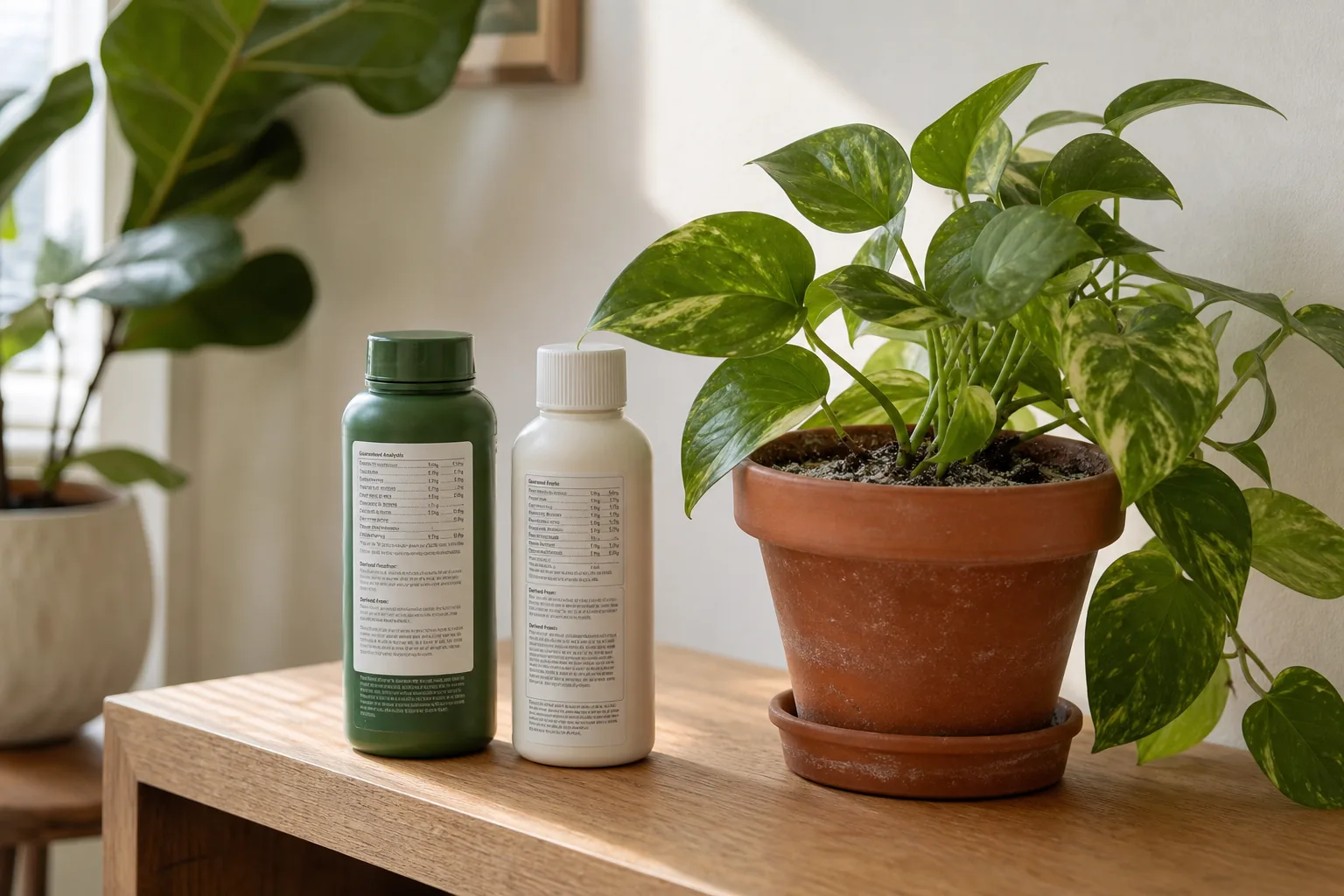
Take two bottles off the shelf, one organic-labeled, one synthetic, and walk through this with them.
- Front label. Note the marketing word (“organic,” “natural,” “plant-based,” or nothing of the sort). That word is a category label, not a regulated guarantee.
- Guaranteed analysis. The NPK numbers. These are the only regulated, on-bottle claim both categories share. For most houseplants, you want low single digits. High numbers on a houseplant label are a reason to dilute further, not a reason to dose more.
- “Derived from” line. This is the source list. In typical labeled examples, an organic-labeled liquid will list animal-, marine-, or plant-derived sources (fish, kelp, bone meal, alfalfa), while a synthetic liquid will list manufactured nitrogen, phosphorus, and potassium sources such as urea, ammonium nitrate, potassium nitrate, or potassium phosphates. The exact wording varies by product.
- Dilution rate. Usually printed as teaspoons or tablespoons per gallon on the back. For indoor containers, the safer move is to feed at or below the printed rate, especially in small pots.
- OMRI mark or other third-party review. If present, this is a voluntary external review, not a federal certification. Its absence is not a verdict against the product.
This is a label-reading exercise. Any specific product used here is a labeled example, not a recommendation.
How the choice interacts with your room and your routine
Small pots concentrate salts faster than large ones, and a pot that is rarely flushed will accumulate salts from either category. A reader who waters lightly, who lets the pot dry down hard between waterings, or who uses hard tap water will see fertilizer-related salt effects sooner. None of that is category-specific; it is pot and routine.
Two related decisions sit next to this one. Form, meaning liquid versus slow-release granular or spike, is a separate question from source, meaning organic versus synthetic, and our comparison of liquid and slow-release houseplant fertilizer walks through that side of the aisle. And if the pot has been in the same mix for a year or more, the right answer may be to refresh the mix and reset the salt conversation, which our guide to refreshing old potting mix covers.
Repotting is also the moment when the right answer is usually to wait before resuming fertilizer. Our post-repotting care guide has the timing on that.
Claims the label does not actually support
A few phrases show up often on houseplant fertilizer bottles and marketing, and they don’t come from the label panel.
“Safer for pets” or “pet-safe.” The front-label “organic” word is a source statement, not a pet-safety guarantee. Pet-aware plant and product decisions are a separate question and belong with a veterinarian or a resource like the ASPCA, not on a fertilizer bottle.
“Gentler on roots” or “won’t burn.” Salt-loading depends on the source and the rate, not the category, and a blanket “won’t burn” claim isn’t supported by the NPK line.
“Builds soil life.” Extension publications use this framing for outdoor and container-garden soils. A small indoor pot is not the same environment, and we are not extending that claim to indoor houseplants here.
“Chemical-free.” Both organic and synthetic fertilizers deliver nutrients as chemical compounds; the distinction is source and manufacturing route, not the presence of chemicals. This phrase is misleading on either category.
A short, honest bottom line
For most houseplants, the choice between an organic-labeled and a synthetic fertilizer is a label-reading decision and a routine decision, not a quality verdict. Read the NPK, check the “derived from” line, follow the printed dilution, and flush the pot regularly. The bigger risks are over-fertilizing a small pot and letting salts accumulate. If the front label is doing more talking than the back panel, treat that as a signal.
Sources
- University of Nebraska–Lincoln Lancaster County Extension — Natural vs. synthetic fertilizers: https://lancaster.unl.edu/natural-vs-synthetic-fertilizers/
- Ask Extension (eXtension network) — Organic vs. non-organic fertilizer: https://ask.extension.org/kb/faq.php?id=213730
- Oregon State University Extension Service — A guide to understanding fertilizers: https://extension.oregonstate.edu/gardening/techniques/guide-understanding-fertilizers
- Clemson University HGIC — Reading a fertilizer label: https://hgic.clemson.edu/factsheet/reading-a-fertilizer-label/
- OMRI — Organic claims: https://www.omri.org/organic-claims
- USDA — Organic 101: what the USDA organic label means: https://www.usda.gov/about-usda/news/blog/organic-101-what-usda-organic-label-means
- AAPFCO Product Label Guide (hosted by Montana Department of Agriculture): https://agr.mt.gov/_docs/fertilizer-docs/AAPFCO_FertandSoilLabelingGuide_2012.pdf