Plant care
Why your houseplant isn't visibly growing, and how to tell if that's actually a problem
· Updated
Most houseplants that look stuck are not sick. The most common reason a plant puts out no new leaves for weeks or months is a normal indoor pause: shorter days, less usable light at the plant’s spot, a slow species, or a quiet recovery after a recent change. The right first move is observation, not fertilizer, repotting, or a new window.
Before changing anything, re-read the season, the usable light at the plant’s spot, and the root situation in that order. Each fix only helps if the layer before it is already in place.
What “not growing” actually looks like on a houseplant
“Active growth” on a typical indoor foliage plant means something visibly new: a new leaf emerging and unfurling, a new node pushing at the tip, a stem extending, or a flower stalk developing. Purdue University extension notes that propagation success depends on the plant being in that phase, when stems are soft and tissues are visibly expanding. Outside that window, a healthy plant can look completely unchanged for weeks.
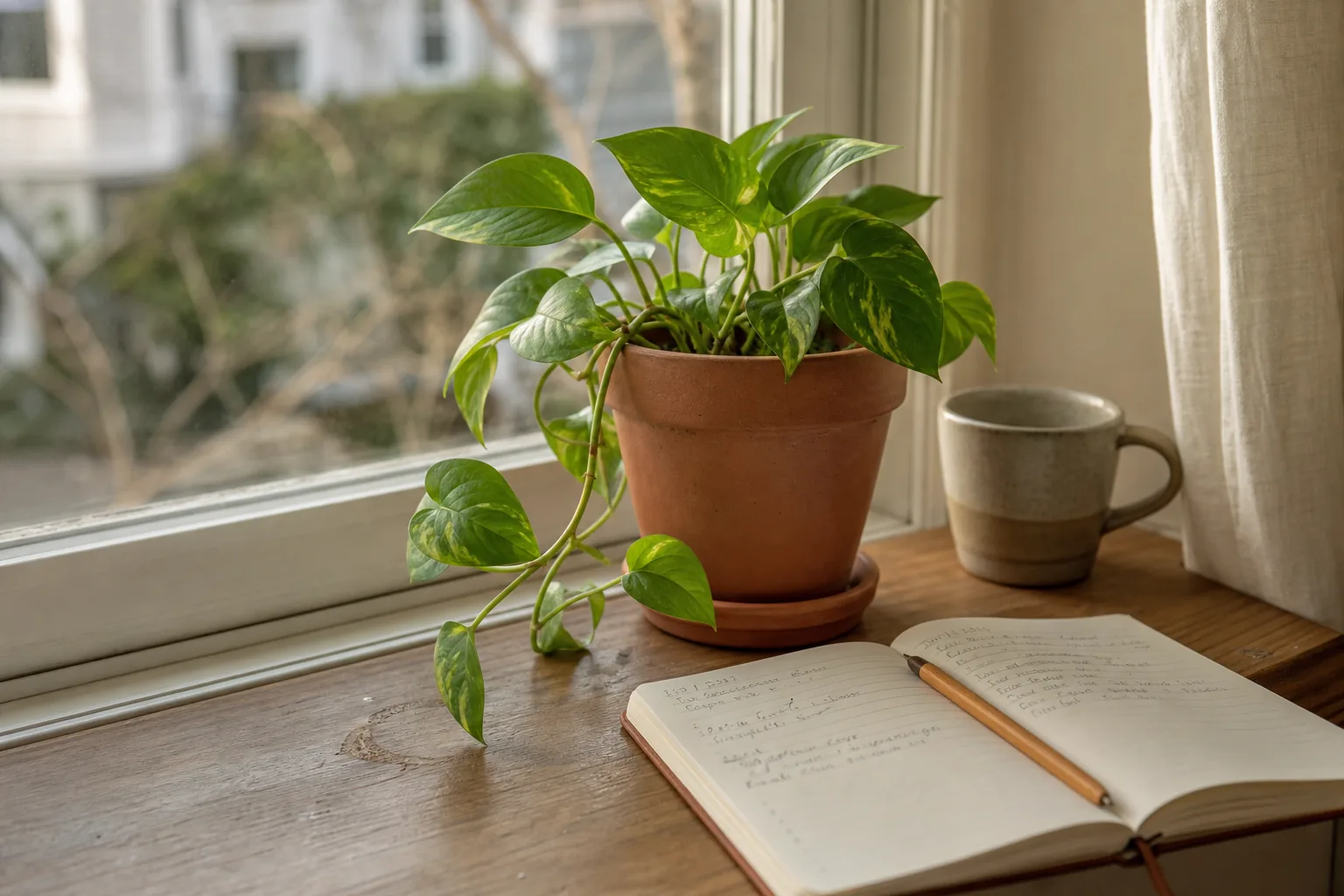
That definition matters because the most common reader mistake is to interpret a still plant as a sick plant. A pothos with firm green leaves that has not produced a new leaf since November is often just on its indoor winter rhythm. A snake plant that has been static for six months can be exactly on its normal indoor pace.
The plant you should treat as a real problem is the one that is also changing in a way that worries you: new leaves coming in smaller than older ones, leaves yellowing in a pattern that does not match the season, soft stems, a pot that smells sour, or a steady thinning of the canopy. Those are decline signals. This article is for plants that look essentially the same as a month or two ago.
Confirm what you’re seeing before you change anything
A short, specific check beats a guess.
- Look at the newest leaf you can find. If it is lighter green, smaller, or partially unfurled compared with the rest, that is growth in progress, even if no fully opened leaf has appeared yet.
- Check the node closest to the tip. On aroids like pothos, philodendron, and monstera, a swelling or a pointed sheath (called a cataphyll) is a sign the plant is preparing a new leaf, not stalled.
- Compare the plant’s pace to the season. In temperate homes, late fall through winter is when slowdowns are most common and least concerning.
- Note any recent change. A move across rooms, a repot, a new window, or a new heat source can quietly pause visible growth for weeks. Our guide to leaf drop after a move or change covers the broader recovery-pause window those changes can trigger.
If those checks line up with a normal seasonal or post-change pause, the next step is usually to wait and watch, not to intervene.
Season and temperature: the most common reason growth stops
Tropical foliage houseplants evolved under relatively stable conditions. In a temperate home, fall and winter bring shorter days, a lower sun angle, and cooler indoor air near windows. University of Florida extension notes that direct-light houseplants generally need four or more hours of direct sun from unshaded south- or southwest-facing windows, a supply that naturally shortens in winter at temperate latitudes. As usable light drops, most tropicals take up less water and visibly slow or stop producing new leaves.
This is a rhythm, not a switch. A plant that pushed a leaf every few weeks at a south window in summer may go static from November through February at the same window. The leaves stay, the stems stay, the plant stays alive, and it usually resumes when days lengthen and light improves.
Two practical habits help here. First, water less in winter, because a slower plant drinks less and is more sensitive to overwatering. Second, hold the plant off the cold window or supplement with a grow light if you want to keep growth steady rather than letting it pause. Our winter houseplant care and lower light guide walks through the seasonal routine in more detail.
Light: growth needs usable light, not just any light
A plant that is not producing new leaves in a spot where it survives but does not grow is one of the most common hidden causes of this question. South Dakota State University extension lists slow or no new growth, small leaves, leaning toward the light, and yellowing among the signs of too little light. University of Minnesota extension puts it directly: a plant may tolerate lower light but still need more light to produce dense foliage and flowers.
Most extension publications group indoor plants into low, medium, and high light categories rather than offering a single universal minimum, and the practical question is whether the spot supports growth for that specific plant, not whether it crosses a single number. Light needs vary by species, and a spot that sustains one plant can quietly fail to push another.
A simple way to read your spot: watch it across a full day, not at one moment. A room corner that is bright at noon can still be a low-light spot for the rest of the day, and an unobstructed east window can be brighter than a shaded west one. If your plant is not stretching or leaning but is also not producing new leaves, the spot is sustaining it without pushing it, and a small move closer to the window is a reasonable experiment. If the plant is reaching for light, that is a different signal, covered in our post on leggy houseplant growth and reaching.
Roots: a quiet plant may be a crowded plant
A root-bound plant can look fine for months. N.C. Cooperative Extension explains that when roots displace most of the container media, the pot’s water and air dynamics change. Plant root research has shown that roots adjust their branching and shape in response to water contact and physical space, which is one mechanical reason that crowding can suppress above-ground growth without producing obvious wilting.
What that means in your home: the existing roots can still drink enough to keep the leaves hydrated and the plant looking normal, but there is not enough room or fresh media for the plant to push new roots, and without new roots, new leaves slow or stop.
Quiet signals worth checking:
- Roots circling the drainage hole or visible on the surface.
- A pot that dries much faster than it used to.
- A plant that lifts out of the pot with a tight rootball and little loose media.
- Water running straight through the pot instead of soaking in.
If those signs line up, a one-pot-size-up repot into fresh mix is worth doing in the active growing season. Without those signs, the pause is more likely seasonal or light-driven, and repotting adds stress without solving anything. Our signs your houseplant is root bound guide walks through the full check.
Water, fertilizer, and the rest of the routine
Water and fertilizer only help when light and roots are already in a workable range. Fertilizing a light-starved plant does not restart growth, because the plant cannot use nutrients faster than its current light supports. University of Minnesota extension makes a related point clearly: a plant may tolerate lower light but still need more light to produce dense foliage and flowers. Fertilizer cannot close that gap; it only helps once light, water, and roots are already adequate for the species.
A few checks for the rest of the routine:
- Watering: a still plant in winter usually wants less water, not more. Wet soil with no active growth is the most common path into root rot.
- Fertilizer: hold off during a true seasonal pause. Resume light feeding only when you see a new leaf, new node, or new stem starting.
- Pot size: a pot that is too large holds more moisture than the roots can use and can produce a different problem (sour, slow-drying mix) than the one you are trying to solve.
When fertilizer does enter the picture, less is usually the better answer. Our houseplant fertilizer basics covers how to think about strength and frequency.
Realistic indoor growth timelines by plant type
Honest answer here: houseplant growth timelines vary widely by species, cultivar, and individual plant, and there is no single number of weeks that applies across all conditions. What extension sources do support is a rough pace range you can use as a sanity check.
- Moderate-to-fast indoor foliage growers such as pothos, philodendron, monstera in good light, and spider plant commonly produce new leaves repeatedly across the active season in good light, with summer generally being the most productive window for them.
- Slow indoor foliage growers such as ZZ plant, snake plant, and cast iron plant can go months between visible new leaves and still be perfectly healthy.
- Succulents and cacti follow their own rhythm, with active growth concentrated in their preferred season rather than on a uniform indoor calendar.
If your plant is on the slow list, a static few months is consistent with normal indoor behavior, not with a problem. If your plant is on the faster list, a full season of no new leaves is worth checking light and roots before assuming it is just slow.
When the honest answer is “wait” and when to ask a local expert
“Wait” is the right answer when the leaves are firm, the color is normal for the species, the season is short-day or cool, the spot supports the plant without obvious leaning, and the roots are not crowding the pot.
Investigate sooner when you can name a real change in the plant: yellowing, softening, leaf drop, a sour smell, a sudden lean, or pests on the leaves or stems. Those are decline signals, not pauses, and they benefit from a closer look.
For anything that looks like a pest, disease, or sudden decline, a local nursery, a master gardener program, or your regional cooperative extension service can look at the actual plant and give you a grounded read. We are an educational journal, not a diagnostic service, and we are not a substitute for that in-person help.
Static-looking and steady is almost always a pause. Static-looking and changing for the worse is worth a closer look.
Sources
- Troubleshooting common problems: houseplant how-to - SDSU Extension
- Lighting for indoor plants and starting seeds - University of Minnesota Extension
- Light for houseplants - UF/IFAS Gardening Solutions
- Root-bound plants - N.C. Cooperative Extension
- New plants from cuttings (HO-37-W) - Purdue University