Plant care
Fiddle leaf fig care: read the light, place once, and stop rearranging
· Updated
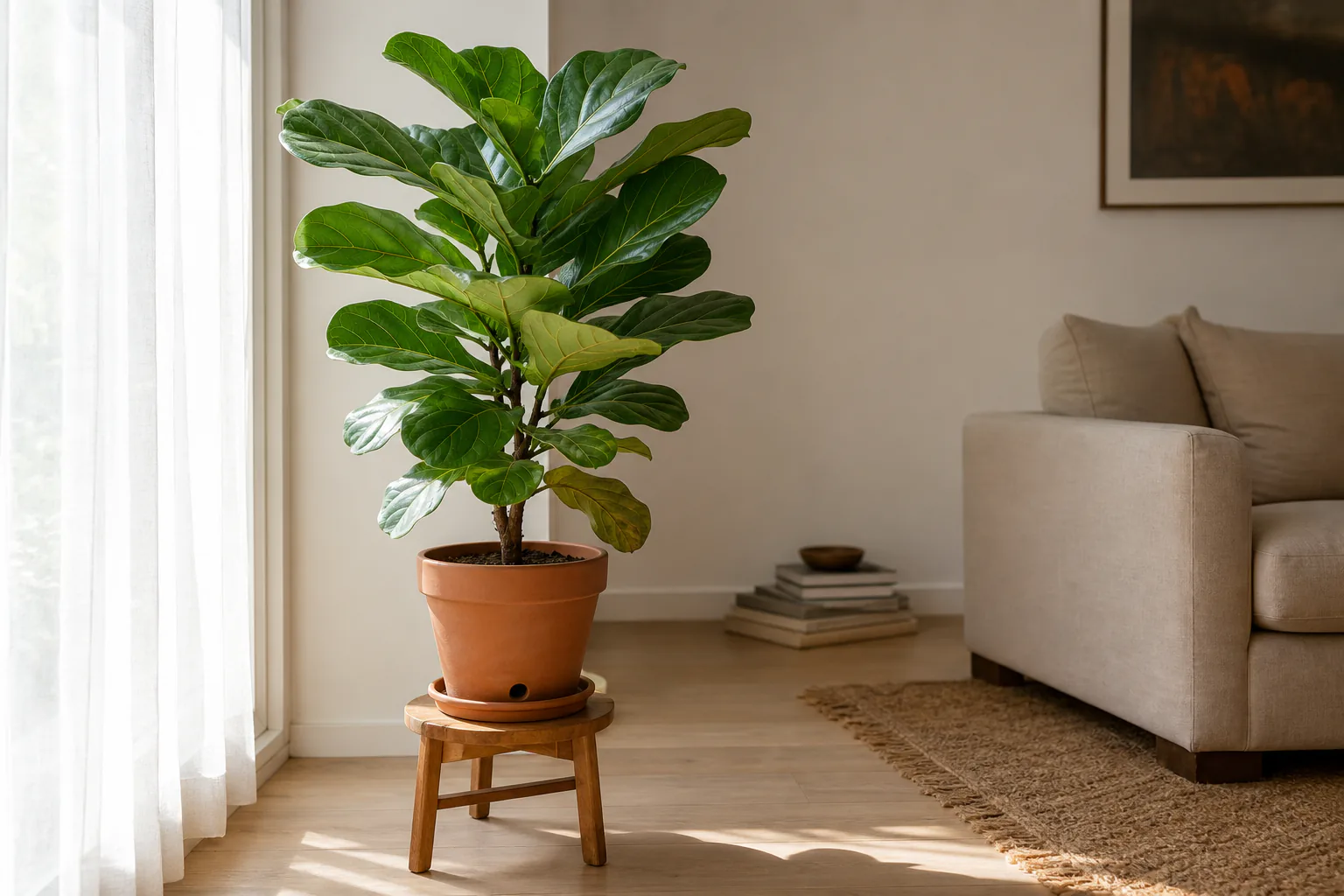
A fiddle leaf fig is far less demanding than its reputation suggests, but it does demand stability. Pick a spot with honest, appropriate light using the same observation method you would use for any plant, leave the plant there, water when the soil tells you to rather than on a calendar, and treat leaf drop as information about recent change, not as a verdict on your care.
Most of the trouble people have with Ficus lyrata starts after the plant is moved, rotated, or otherwise rescued out of worry. The first leaf to drop often triggers another move, which triggers more leaf drop, and so on. The alternative, supported by botanical garden and university extension guidance, is much quieter: place the plant once, observe weekly, and let the leaves tell you what they need.
What the fiddle leaf fig reputation gets right and wrong
The fiddle leaf fig has a reputation for being difficult, and a separate reputation for being the most photogenic houseplant on social media. The two ideas do not agree with each other, and neither captures what the plant actually wants indoors.
What the reputation gets right: Ficus lyrata is a tropical tree, not a hardy houseplant in the snake-plant sense, and it responds to abrupt changes in light, temperature, drafts, and soil moisture. If you change several of those conditions at once, you will see leaves drop.
What the reputation gets wrong: the plant is not fragile in any absolute sense. The behavior that gets called drama is a normal response to a recent change, not a verdict on the plant or on your care. Oklahoma State University Extension notes that Ficus commonly drop leaves when moved indoors and that reacclimation typically takes four to six weeks. In practice, many long-lived indoor fiddle leaf figs are left in a reasonable spot and checked on a weekly basis rather than managed daily, which is consistent with the stability guidance from NYBG and Oklahoma State.
A useful reframe: the plant is not high-maintenance, it is high-sensitivity to change. Once the conditions are right and stable, the day-to-day work is small.
Light a fiddle leaf fig actually uses indoors
In its native range, Ficus lyrata grows as a tropical tree in bright but filtered light rather than sustained direct sun. Indoors, this translates to strong light with protection from the sun’s direct rays, according to the New York Botanical Garden. A few feet from a large south- or east-facing window usually works. Direct sun on the leaves through glass can scorch them; a corner far from any window is usually too dim.
The room-by-room method for figuring this out is the same one you would use for any plant. Before you commit to a spot, observe where direct and indirect light actually fall at different times of day. The way to do this thoroughly is covered in the observation-first method for reading natural light. A quick version: if the room casts a clear, sharp shadow for several hours, you likely have enough light. If shadows are faint or the room only brightens briefly during the day, you may not.
The clearest in-the-room signal that the current spot is too dim is leggy or unstable growth, with stems leaning toward the window or new leaves spaced far apart on the stem. That observation, not anxiety, is what should drive a relocation decision.
Choose the spot, then leave it there
This is the part that most online advice gets wrong by accident. Ficus species, including Ficus lyrata, prefer a consistent and stable environment. Indoor Ficus commonly drop leaves when moved, and the recovery window is typically four to six weeks. Moving the plant again during that window restarts the clock.
The practical version of this rule:
- Pick the brightest appropriate spot based on observation, not on a corner you happen to like.
- Confirm the pot has drainage and a saucer or cachepot that does not let the plant sit in standing water.
- Confirm the spot is away from heating vents, exterior doors, and cold drafts.
- Leave the plant there.
If you have just brought the plant home or recently moved it across rooms, a calm acclimation routine for a new houseplant covers what to expect and when to act. The short version is: expect some leaf drop, do not move the plant again to fix it, give it weeks rather than days to settle.
About rotation: some care sheets suggest turning the plant a quarter turn at each watering to keep growth even. The botanical-garden and university extension sources that mention rotation describe it as an aesthetic choice for balanced shape, not as a survival requirement. If you want symmetry, a gentle turn is fine. If you forget for a few weeks, the plant will not suffer for it.
Watering that responds to the soil, not the calendar
The single most common mistake with fiddle leaf figs indoors is overwatering on a fixed schedule. UC ANR specifically recommends being conservative with watering and warns that allowing the plant to sit in excess water causes root rot. None of the supplied extension or botanical-garden sources recommend a weekly or biweekly interval, and that omission is the point: the same pot in a bright window dries out faster than the same pot in a dim corner, and a plant in active growth drinks more than one at rest.
A soil-conditional routine looks like this:
- Check the top inch or two of soil with a finger. If it feels dry at that depth, water thoroughly until water runs from the drainage holes. If it still feels moist, wait.
- Lift the pot when it is freshly watered and again a few days later. The difference in weight is a faster signal than the calendar.
- Empty the saucer or cachepot of standing water within a few minutes of watering. Do not let the pot sit in water.
- In lower light or winter, expect the soil to stay moist longer. In a bright window during the growing season, expect it to dry faster.
If you are seeing yellowing lower leaves with soft stems and consistently wet soil, that pattern is more consistent with overwatering than with thirst, and the right response is to let the soil dry further, not to add fertilizer. If you are seeing dry, crispy edges and soil that has pulled away from the pot sides, that pattern is more consistent with underwatering.
What leaf drop is really telling you
Leaves drop for reasons that have to be sorted by recent history, not by guesswork. The same symptom has different causes depending on what just changed in the plant’s life.
- Drop within a few weeks of bringing the plant home or moving it to a new spot: usually acclimation, often normal, and usually settles if conditions are stable.
- Drop alongside consistently wet soil: usually a watering problem, and the response is to let the soil dry further and to check that the pot drains.
- Drop in a spot that was previously fine: usually a light change, often seasonal as the sun angle shifts, and worth a reassessment of placement rather than a move on the spot.
- Drop with spotting, sticky residue, webbing, or visible insects: that is a different category, often pest-related, and is a reason to seek in-person help rather than to self-treat.
The mistake to avoid is responding to leaf drop with a flurry of changes. Each change resets the plant’s adjustment window. One correction at a time, given weeks to take effect, is more useful than three corrections in a week.
When a move or change is actually warranted
Stability does not mean never moving the plant. It means moving only when there is a clear, observed reason. The cases that justify a change:
- Leggy growth, leaning toward the window, or new leaves spaced far apart on the stem: the spot is likely too dim, and a brighter location is reasonable.
- Repeated yellowing with soil that stays wet for a week or more: the pot, the mix, or the watering pattern needs an adjustment. Repotting into a faster-draining mix, or moving to a brighter spot where the soil dries more reliably, is the kind of change that addresses the cause.
- A clear pest or disease problem, where local help has confirmed a diagnosis: in that case, an isolation move away from other plants is reasonable.
What does not justify a move: a single yellow leaf, a single dropped leaf, a few brown edges, or worry. Those are observations, not emergencies.
A simple weekly look instead of a daily ritual
A daily inspection of a fiddle leaf fig tends to produce daily anxiety. A weekly one produces useful information. The weekly look can be brief:
- Soil moisture at the top inch or two.
- Leaf surfaces for dust, which reduces light and is easy to wipe with a damp cloth.
- New growth direction: leaning, even growth, or leggy spacing.
- Any spotting, residue, or visible insects.
- Pot drainage: water still draining freely, no standing water in the saucer.
That is the whole routine. Anything more frequent is unlikely to add useful information and increases the chance of moving or adjusting the plant in response to normal variation.
When to ask for in-person help
A houseplant article cannot diagnose your plant from a written description, and trying to do so usually leads to a list of guesses rather than an answer. There are a few situations where an in-person resource is the right next step:
- You see pests (small insects, sticky residue, webbing, white flecks) and want to confirm what they are and what to do.
- The plant has been dropping leaves for more than six weeks despite stable conditions and adjusted watering.
- There is sudden collapse, soft stems, or a smell from the soil that suggests root rot.
- Spots are spreading in a defined pattern, rather than appearing as general yellowing or browning.
For any of these, a local independent nursery, a master gardener program through your state extension service, or a botanical garden help desk can look at the plant and give specific advice. If the plant is accessible to a pet or a small child and you are concerned about safety, your veterinarian or local poison control resource is the right contact for medical questions; the plant’s reputation should not stand in for a professional opinion.
Sources
- Fiddle-leaf fig (Ficus lyrata) — New York Botanical Garden
- Don’t fear if the leaves on your Ficus are falling — Oklahoma State University Extension
- Fiddle leaf fig houseplant: proper care — University of California ANR / Coastal Gardener
- Ficus lyrata — NC State University Plant Toolbox
- Fiddle leaf fig (Ficus lyrata) — Penn State Extension, Adams County Master Gardener