Plant care
ZZ plant care: a realistic routine for an actual plant
· Updated
If your ZZ plant (Zamioculcas zamiifolia) has earned a reputation for being unkillable, that reputation is half right. The plant is genuinely drought tolerant, which means it can survive stretches without water in a way most houseplants cannot. It is also very good at declining in a pot that stays wet. A realistic care routine is built around that tradeoff.
The short version: let the potting mix dry through most of the pot before watering, keep the plant in the brightest indirect light the room offers, use a pot with drainage, and treat slow or static growth as the species behaving normally. Most ZZ losses trace back to wet soil in a dim spot, not to neglect.
Why the “indestructible plant” reputation gets ZZs into trouble
The “indestructible” label is shorthand for a real biological feature. ZZ plants store water in rhizomes, the potato-like structures at the base of each stem. Missouri Botanical Garden lists the species in the aroid family, Araceae, and describes its native habitat as the dry grassland and forest of Eastern Africa. Those rhizomes are the reason a ZZ can sit in a corner for a few weeks and still be alive when you come back. The New York Botanical Garden’s houseplant guide is direct about the other side of that coin: the most important care requirement is not to overwater this plant.
Drought tolerance and zero care are two different things. The same rhizomes that let a ZZ survive a dry spell also make the plant very sensitive to soil that stays damp, especially in a dim room where the mix dries slowly. That is the failure mode behind most of the wilted, yellowing ZZs people describe as “the one I could not keep alive”: not too little attention, but too much water in a setup that had no way to get rid of it.
The implication is simple. Treat the marketing line as a description of what the plant can survive, not as a care instruction.
What a ZZ plant actually does in a normal room
A healthy ZZ in a normal room does very little over the course of a season, and that is the species behaving normally. The University of Connecticut describes ZZ as a moderate to slow grower, with growth even slower in lower light. In a medium-bright spot you can reasonably expect some new stems to appear across a growing season. In a dim corner the same plant may produce none for many months at a time.
That is worth saying out loud because it is the most common source of overcorrection. A new owner who expected “a plant that fills the room” reads slow growth as a problem and reaches for more water, more fertilizer, or a bigger pot. For a ZZ, none of those moves help and all of them add risk.
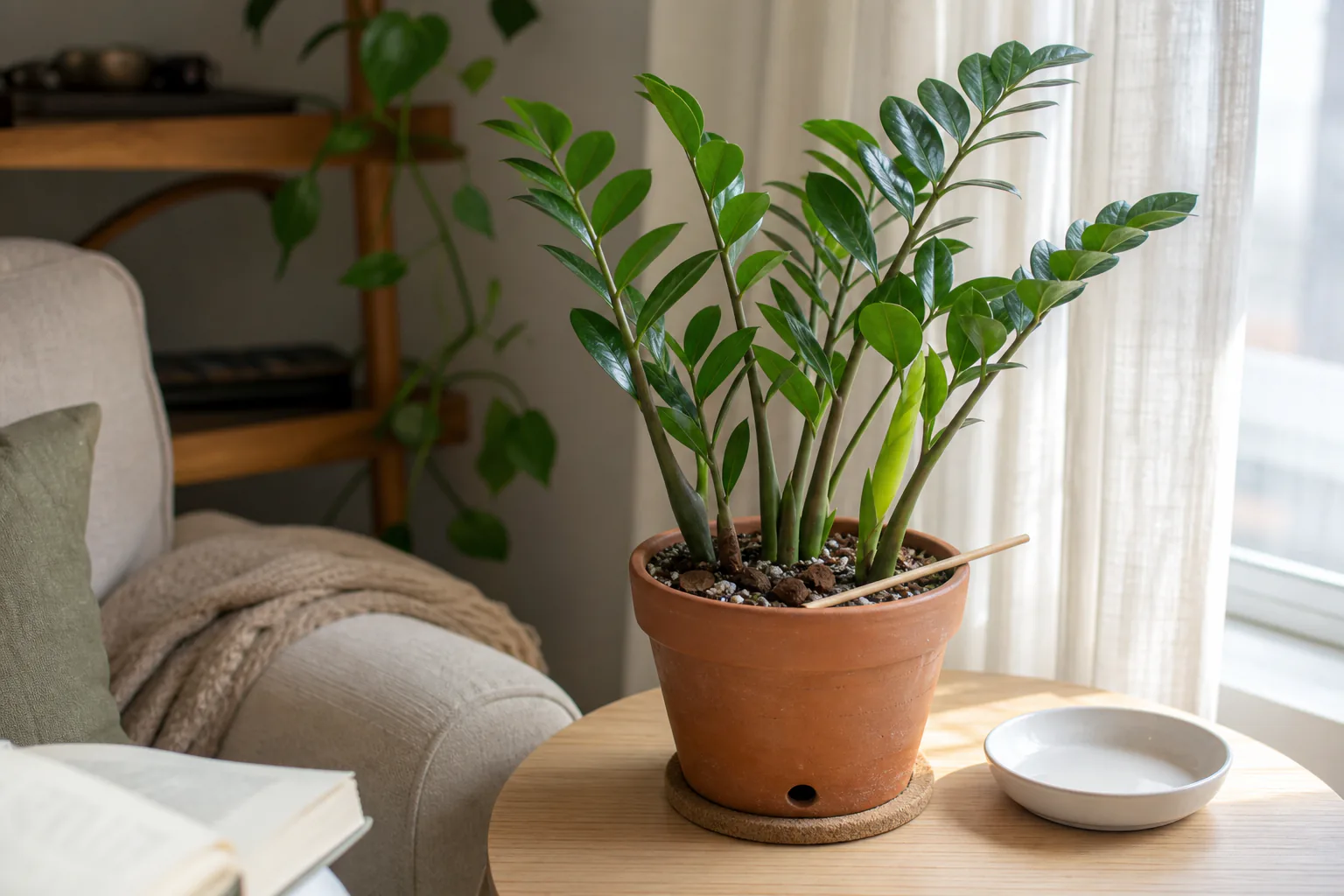
New stems often emerge as pale, almost lime-green shoots that look tender against the older, darker foliage. They darken and stiffen as they mature. That color shift is growth, not sunburn or a nutrient deficiency.
Reading light for a ZZ without rearranging the room
Light is the variable a ZZ owner has the most control over, and the variable the marketing copy most often muddles. The Illinois Extension’s houseplant spotlight gives the cleanest published phrasing on this: the ZZ “tolerates low levels of light but thrives in areas of bright, indirect light.” In other words, the plant can survive in a dim corner, but the brighter the indirect light, the more it actually grows and the more reliably the pot dries between waterings.
A useful working range, drawn from that phrasing:
- Bright indirect light near an east- or west-facing window, set back a foot or two or behind a sheer curtain, is where a ZZ grows the most and dries the most predictably.
- Medium indirect light a few feet back from a bright window still works well. Growth is moderate.
- Deep corners and rooms with only small or north-facing windows hold the plant in a survival mode. The mix stays wet longer, growth slows or stops, and overwatering risk climbs.
The method for deciding which category a given spot falls into is laid out in the guide on reading the natural light in your room. The short version of that method: hold your hand where the plant would sit and look at the shadow it casts. A sharp, defined shadow is bright indirect. A soft, fuzzy shadow is medium. No real shadow at all is the dim corner where a ZZ will survive but not really grow.
In practice, hot direct sun through a window tends to scorch the leaflets on a ZZ, so “bright indirect” is the target, not “bright direct.”
Watering a ZZ: dry-down, rhizomes, and patience
For a plant with built-in water storage, the right watering rhythm is less about frequency and more about what the pot is doing between waterings. UF/IFAS Extension’s publication on the species is the clearest published anchor: allow the soil to become dry between waterings, and recognize that the plant is very drought tolerant.
Two practical checks work better than a calendar for this species:
- Pot weight. Lift or tip the pot right after a thorough watering, and lift it again a few days later. The difference in weight is your personal baseline for that specific pot and mix. Water when the pot is meaningfully lighter than it was just after watering.
- A wooden probe. Push a chopstick, bamboo skewer, or untreated wooden dowel deep into the mix. Pull it out and look at the lower end. Damp soil sticks to the wood and darkens it; dry mix leaves the wood clean or only faintly marked.
When you do water, water thoroughly until it runs from the drainage holes, then let the pot drain. Do not let the pot sit in a saucer of standing water. Empty the saucer within an hour.
In lower light and during cooler months, expect the gap between waterings to lengthen noticeably. That is the plant using less water, not a sign you have stopped caring for it. When in doubt about whether to water, wait a few more days. ZZs recover from being a little too dry far better than from being a little too wet.
Soil and pot choices that match a slow-drinking plant
Dry-down only works if the setup supports it. Two choices matter most.
Pot. Use a pot with drainage holes. Double-potting into a cachepot is fine, as long as you lift the inner pot out, water it over a sink, and never let water pool at the bottom of the decorative outer pot. Oversized pots are a quiet hazard. A pot that holds far more mix than the roots can reach stays wet for longer than the plant wants, which compounds overwatering risk on a species that already stores its own water in rhizomes.
Soil. Aim for a mix that dries through most of the pot rather than a dense, peat-heavy bag mix. A standard indoor potting mix lightened with perlite, bark, or similar coarse particles dries faster and lets air reach the rhizomes. The extension sources do not publish a specific commercial recipe for this species, but every watering recommendation they do publish assumes a mix that can actually dry.
Leaf and stem signals worth noticing
A ZZ is a quiet plant, but it does communicate, mostly through its stems.
- Soft, drooping, or yellowing stems, especially near the base, often point to a pot that has been wet too long rather than too dry.
- Wrinkled, slightly shriveled leaflets on stems that are still upright tend to suggest underwatering, or a root-bound plant that is drinking faster than the pot can keep up with.
- Pale, lime-green new shoots that darken with age are normal growth, not a problem to address.
- Blackened, mushy stems at the base, or stems that come away easily from the rhizome, are a clearer danger sign than gradual yellowing and call for inspecting the rhizome and roots.
None of these are diagnostic on their own. They are what to look for so the next move is based on the plant rather than on a guess.
Repotting, fertilizing, and when to leave the plant alone
For ZZs, well-meaning over-care is the second-most-common problem after overwatering.
Repot only when the plant gives you a reason: roots crowding the surface, roots pushing through drainage holes, or the pot visibly distorting. That tends to mean every few years, not every year. The plant does better being a little tight in its pot.
Fertilize sparingly. A diluted general-purpose fertilizer once or twice during the spring and summer is enough. Fertilizer does not push a ZZ to grow faster. Using more of it, or using it more often, mostly stresses the plant and builds up in the mix over time.
Wipe the leaflets now and then with a soft, damp cloth. Dust on the leaves reduces the light the plant can actually use, and a ZZ in a dim spot does not have light to spare.
Resist the urge to move, repot, or fertilize the plant in the same week you bring it home. ZZs do not like abrupt changes, and the first few weeks are usually a period of adjustment.
A short first-month checklist for a new ZZ
A simple ordered list to work through this week, without rereading the rest of the article:
- Pick the spot using the room-light method, choosing the brightest indirect light that room has.
- Check the pot and soil before the first watering. If the mix is already moist and the pot is heavy, leave it. Do not water on day one just because the plant is new.
- Note the stem count, and lift the pot to feel its weight dry versus just watered. That is your baseline.
- Resist repotting, fertilizing, or moving the plant again in the first month. One change at a time is easier to read than several at once.
A ZZ cared for this way tends to sit quietly for a long time and slowly build new stems across the seasons. That quiet is the plant doing well, not a plant waiting for a fix.
Sources
- New York Botanical Garden, ZZ plant (Zamioculcas zamiifolia): houseplant care guide: https://libguides.nybg.org/ZZPlant
- University of Florida / IFAS Extension, Florida foliage house plant care: ZZ plant (EP480): https://ask.ifas.ufl.edu/publication/EP480/pdf
- University of Illinois Extension, Good Growing blog: houseplant spotlight: the ZZ plant: https://extension.illinois.edu/blogs/good-growing/2026-01-09-houseplant-spotlight-zz-plant
- University of Connecticut Home & Garden Education Office, ZZ plant factsheet: https://homegarden.cahnr.uconn.edu/factsheets/zz-plant/
- Missouri Botanical Garden Plant Finder: Zamioculcas zamiifolia: https://www.missouribotanicalgarden.org/PlantFinder/PlantFinderDetails.aspx?kempercode=d179