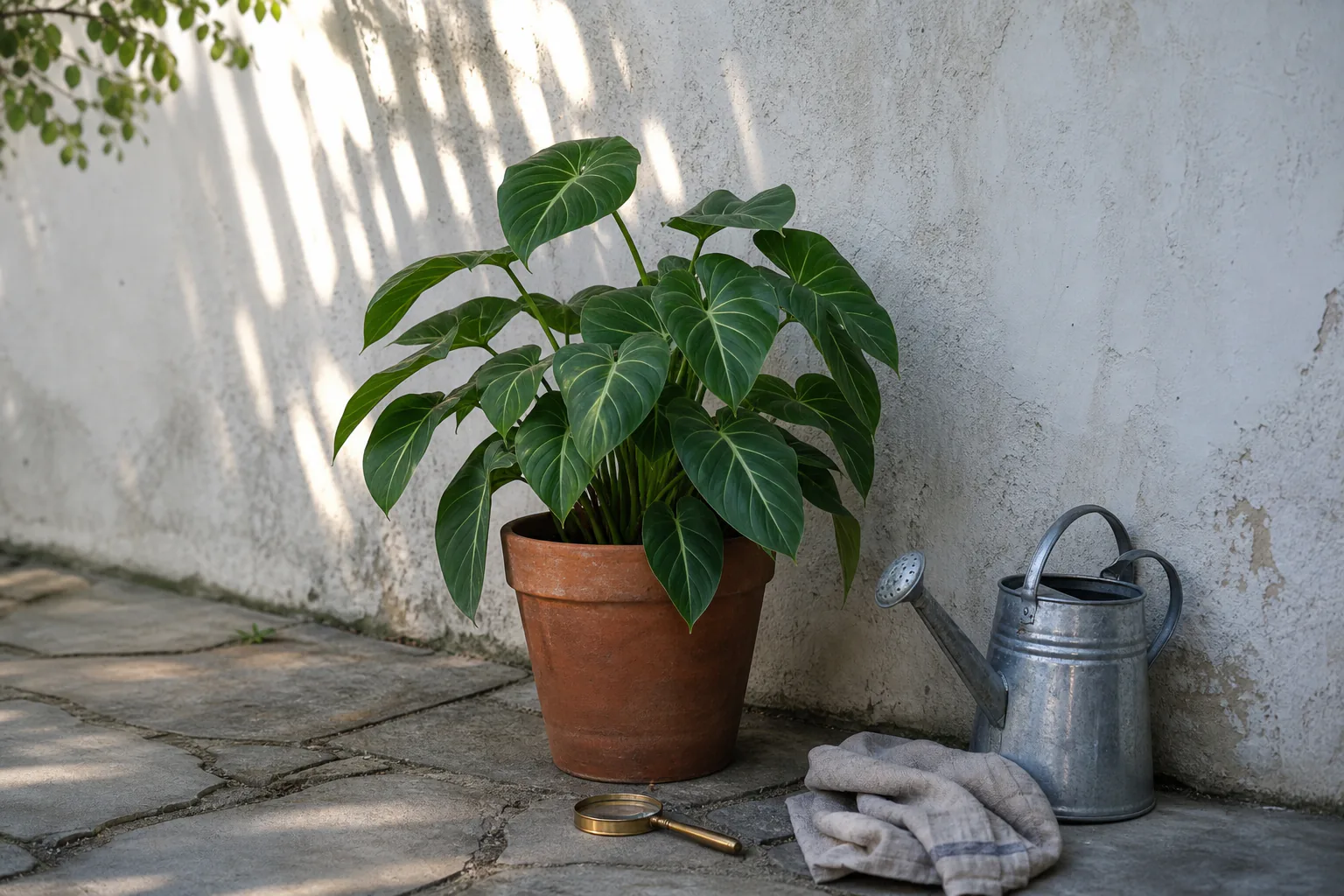
Plant care
Moving houseplants outside for the summer, without the shock
· Updated
Treat the move outside as a slow, two-week observation experiment rather than a single event. Start each plant in deep shade for an hour or two, lengthen the time before increasing the light, and check the leaves daily for bleaching, wilting, or brown edges. Bring a plant back indoors at the first sign of stress. Outdoor summer placement is optional, not a step your plant needs to stay healthy, and the right routine depends on the plant, the spot, and the local climate.
Why some indoor growers move plants outside, and why it is optional
Some people enjoy having their plants on a patio or balcony in summer, where natural light, warm air, and humidity can support a flush of new growth. Others keep their plants inside year-round with grow lights and a steady routine, and that works too. Outdoor summer placement is an option, not a step a plant needs in order to thrive. If you have a sheltered spot, room to bring plants in for cool nights, and a few minutes a day to check on them, the move can go well. If your outdoor space is mostly hot afternoon sun, your climate has short cool summers, or your routine makes daily checks hard, leaving the plants indoors is a reasonable choice rather than a missed step.
The differences your plant will actually feel
Indoor light is the baseline your plant has been living in. Even a bright window usually sits well below outdoor shade, and outdoor shade is in turn usually softer than morning sun and far softer than afternoon sun. The jump from indoors to a sunny patio can scorch leaves in a single afternoon, especially for plants that have only ever lived under bright indirect light or a low-output grow light.
Wind is the second thing your plant will feel. A breezy corner or a balcony a few stories up dries the soil faster and beats against large leaves. Consistent with extension guidance to start out of the wind, thin-leaved plants like calathea and many ferns, and large-leaved tropicals like monstera, fiddle-leaf fig, and alocasia, often show wind stress first as crisp brown edges or torn leaves.
Temperature swings are the third. Indoor rooms usually hold a fairly narrow range. Outside, a sunny afternoon followed by a cool night can swing tens of degrees within twelve hours in many temperate summers, easily spanning a 25 to 30°F range. Most tropical foliage plants tolerate that range once they are acclimated, but it is a real adjustment rather than a free upgrade.
Rain can be a help or a problem. A long, gentle rain can wash dust off leaves and water the soil for you. A heavy storm can flood a pot with limited drainage, snap brittle stems, or splash soil out of the pot. There is a practical side too: pots sitting on saucers through steady rain will stay wet for days, which is the kind of condition that ends in root rot for many houseplants.
Read the outdoor spot before you read the calendar
Most outdoor move-out guides lean on one question first: what kind of spot do you actually have. A north-facing courtyard with morning light and afternoon shade is a gentle place to start. An open south- or west-facing balcony in midsummer heat is a much harsher place to start, even if the air temperatures are similar.
Walk the spot at the time of day you plan to leave plants there. Note where the sun lands. Note whether the area is sheltered or exposed to wind. Note whether rain pools under the pots or runs off quickly. The answers shape the routine, not the other way around. If you can’t picture leaving a plant in your spot for several hours without checking on it, that is a useful signal to start smaller.
If you do not have outdoor space, or only have a hot west-facing balcony, the rest of this article still applies in compressed form. Use any open window, a shaded front step, or a sheltered patio at a friend’s place as a stepping stone rather than the plant’s summer home.
A two-week gradual transition
The cleanest approach across university extension services is a slow ramp rather than a single move-out day. Treat it as a roughly two-week experiment. If your climate, plant, or schedule demands longer, take it. If a stretch of bad weather forces you to pause, you can pause and resume without restarting.
The structure has three knobs: time spent outside, brightness of the spot, and exposure to wind. Change them in this order: length of time first, then shelter, then light.
One possible structure within the 10 to 14 day range extension services describe looks like this. Treat it as a starting structure, not a recipe; the goal is a slow ramp that fits the plant and your spot.
- Days one to three: deep shade, a couple of hours. Put each plant where it will not see direct sun at all. A north wall, under a tree canopy, behind a hedge, or under shade cloth all count. Bring the plant back in for the rest of the day.
- Days four to seven: deep shade, half a day. Lengthen the outdoor window to four to six hours. Still no direct sun on the leaves. Watch the leaf edges for the first signs of stress.
- Days eight to ten: morning sun is fine for most plants. If your spot gets gentle morning light, you can let the plant sit in it for an hour or two before moving back to shade. Skip this step if your spot only offers afternoon sun.
- Days ten to fourteen: work toward the spot you actually plan to keep the plant in for the season. If that spot is part-shade or morning sun, you can move in. If that spot is full afternoon sun, you may need to keep the plant in deeper shade for most of the summer, especially for thin- or large-leaved species.
If you only have a weekend slot, a shorter version works for some plants. A few hours on Saturday and Sunday in deep shade, extended through the weeks ahead, is better than a full day outdoors on day one.
Common leaf signals during acclimation
Reading the leaves is more useful than reading the calendar. The patterns below come up often in extension guidance. They aren’t a diagnosis. They are a cue to bring the plant back to its prior spot for a few days before pushing further.
- Sudden bleaching or whitish patches on the upper leaves: usually too much direct sun, especially after a jump from indoors to any sun exposure. Retreat to deeper shade.
- Drooping during the day even when the soil is damp: usually wind or sudden heat, sometimes the move itself. Move to a more sheltered spot and let the plant recover indoors before trying again.
- Brown, crispy leaf edges on new growth: usually low humidity combined with wind, or a dry pot. Check soil moisture before blaming the move.
- Dropping of older leaves without other signs: a common stress signal in the first days. Pause the routine and let the plant stabilize before adding more light.
- Yellowing lower leaves after a week of acclimation: often overwatering from a damp pot and an outdoor watering schedule the plant doesn’t need yet. Check the moisture in the root zone before watering.
If a plant shows more than one of these signals at once, move it back indoors for a few days before resuming. There is no award for finishing on day fourteen.
Outdoor pests, wildlife, and weather to plan around
Once a plant is outside, it can become a host for insects you don’t see indoors. Outdoor exposure can introduce pests that later affect the rest of your indoor collection. The general direction is well documented in extension guidance; the specific pests depend on your region and your yard.
The simplest routine is to look at each plant closely on the way back inside for the night. Check the undersides of leaves, the soil surface, and the stems near the soil line. A small hand lens helps. If you spot something moving, a rinse with water and a soft cloth handles many early cases. For anything that spreads fast, your local extension office or a nursery in your area can help identify it and suggest a treatment that fits your situation, your climate, and any pets or children in the home.
Weather matters too. A late-spring cold snap can damage tropical foliage even after several weeks of mild days. 40s°F is below the working overnight threshold most extension sources use for tropical foliage, so treat that forecast as a bring-them-in signal rather than a borderline call. Heavy wind or hail forecasts are a reason to keep plants in their indoor spots for the day.
When to bring a plant back inside, even mid-summer
Two situations usually mean bring the plant in now.
A cold stretch is coming. A short dip into the high 40s°F may be tolerated by some succulents and a few tougher tropicals that have been out for several weeks, but most tropical foliage is safer once nights are consistently in the 50s°F / low teens °C. A forecast of three nights in a row below the species’ working threshold is enough reason to move plants back under cover or inside. Extension and horticultural society guidance for many tropical foliage plants converges on roughly 50 to 60°F nighttime lows as a starting point, but species vary and the right number for your plant depends on what you are growing.
The plant is showing stress that has not improved after a step back. If you have retreated to deeper shade, watered appropriately, and the leaves are still declining after a week, that plant may not be a good candidate for outdoor summer placement this year. Bring it back indoors and treat it as a learning for next year rather than something to push through.
Conditions that change the answer entirely
A few situations make the standard routine hard to apply. It helps to name them so you can decide whether the advice still fits.
- Cold-sensitive species, especially alocasia, calathea, and many ferns, can be set back by a single cool night. If your nights are regularly in the low 50s°F or below, these plants do better spending summer near a humid indoor window with bright indirect light.
- Harsh sun climates. The high desert, Mediterranean, and southern U.S. summers include afternoons that can scorch leaves even after a careful two-week ramp. In those climates, deep shade and a north-facing wall are usually the realistic ceiling for most houseplants.
- Limited outdoor space or rentals. Apartment balconies may not allow heavy pots or shared ledges. A single railing planter for herbs is fine; ten large tropicals are a different matter.
If any of these describes your situation, the rest of this article still has ideas, but the center of gravity shifts back to indoor care with grow lights and a humidifier during the hottest, brightest stretch.
A short pre-move checklist
Before you carry pots outside for the first time, a quick check keeps the first afternoon from going sideways.
- Water check: the soil should be slightly moist, not bone-dry and not waterlogged.
- Pest check: look over each plant for hitchhikers before it goes out.
- Forecast check: overnight low, wind speed, storm timing.
- Placement plan: deep shade, shelter from wind, no direct afternoon sun for the first week.
- Bring-back plan: a clear path back inside, and a place to set the pots so each one can come in for the night without rearranging everything.
Once that first set of sessions has gone well, the rest of the summer is mostly about adjusting the routine to the plant, the weather, and the schedule you actually keep. Plants indoors all summer aren’t missing out. Plants that join you on a patio for a few weeks can enjoy a summer outside and a quiet, isolated return indoors once the nights get cool again.
For a sense of how to judge the light your plant is used to indoors, the journal piece on reading natural light is a useful baseline. The reverse trip, bringing plants back indoors in fall, gets its own routine and is worth planning for from the start.
Sources
- Iowa State University Extension, Moving Indoor Plants Outside for the Summer: https://yardandgarden.extension.iastate.edu/how-to/moving-indoor-plants-outside-summer
- University of Minnesota Extension, Moving Houseplants Outdoors: https://extension.umn.edu/news/moving-houseplants-outdoors
- Royal Horticultural Society, Moving houseplants outdoors for summer: https://www.rhs.org.uk/plants/types/houseplants/moving-houseplants-outdoors
- University of Nebraska 4-H Extension, Guide to Growing Houseplants: https://go.unl.edu/4hhouseplants
- University of Illinois Extension, Starting a Garden: Hardening Off Indoor Seedlings: https://extension.illinois.edu/blogs/good-growing/2020-04-06-starting-garden-hardening-indoor-seedlings