Plant care
Low-maintenance houseplants: what the label actually means
· Updated
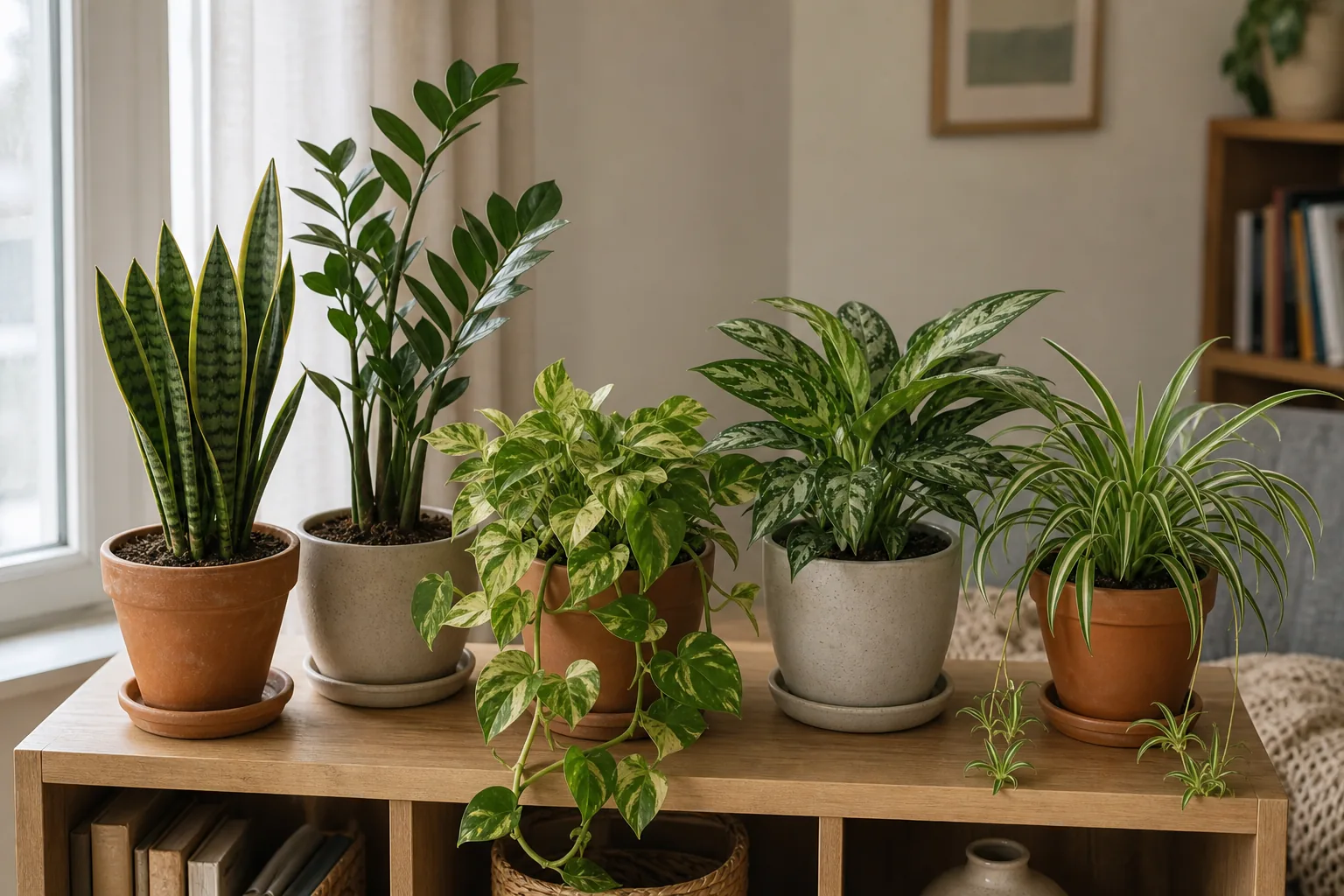
A low-maintenance houseplant is one that tolerates an irregular watering rhythm and the brightest indirect light your room actually offers. It is not a plant that needs zero observation, no water, and no thought. The honest shortlist, anchored by what university extension services consistently recommend, is snake plant, ZZ plant, pothos, Chinese evergreen, and spider plant. The single most common way these “tough” plants fail is overwatering in a pot without drainage, not neglect.
What ‘low maintenance’ actually means (and what it doesn’t)
Iowa State University Extension offers the closest thing to a working definition: a low-maintenance houseplant is one that tolerates dry soil, tolerates low indoor humidity and still looks good, stays healthy and attractive with minimal care (no constant leaf drop, no special fertilizer schedule), and blooms easily if it is grown for flowers. Those four criteria are behavioral, not marketing — they describe what the plant actually does in a real room, not what a tag on a nursery shelf promises.
The label is not “no care.” A snake plant in a dark corner still needs you to check the soil occasionally, and a spider plant in a dry apartment will still tell you, through brown leaf tips, that the air is too dry. What a low-maintenance plant offers is tolerance: a missed watering or two won’t kill it, and average indoor light is enough to keep it alive. That tolerance has limits, and the rest of this piece is mostly about knowing where those limits are.
Two terms that often get confused, and that the rest of the article will keep separate:
- Low maintenance describes tolerance for irregular care.
- Low light tolerance describes tolerance for dim conditions.
The categories overlap — snake plant and ZZ appear on both kinds of lists, and Chinese evergreen is a natural addition from the low-light-tolerant side — but they are not the same. Spider plant, for example, is consistently listed as low-maintenance by extension services, but West Virginia University Extension places it in the medium-light category. A succulent can be very low-maintenance in a bright window without being low-light-tolerant at all. The structural distinction is worth holding onto; see low-light-tolerant houseplants for the longer version.
The three conditions a low-maintenance plant has to tolerate
For a plant to genuinely earn the label in an ordinary home, three conditions have to be tolerable to it.
An irregular watering rhythm. You will forget. You will travel. The plant will sometimes go a week or two past when it “should” have been watered. A low-maintenance plant tolerates this — some because they store water in modified leaves or rhizomes (snake plant, ZZ), some because their root systems recover quickly from a dry-down (pothos, spider plant).
Average indoor light. Not bright south-facing windows, not deep interior shadow — the kind of light most rooms actually have a few feet back from a window. Penn State Extension describes low-light tolerance as adaptation rather than preference: the plant survives in dim conditions, not that it wants them. A snake plant in a windowless bathroom is surviving, not thriving, and variegation will fade in very low light over time.
Ordinary room temperature and humidity. The temperature most homes sit at year-round, with humidity that drops noticeably in winter when heating is running. Plants that need consistently high humidity and stable warmth (calathea, many ferns, fiddle leaf fig) are not low-maintenance in this sense, even when they show up on retail “easy care” lists.
Why ‘low maintenance’ is a room question before it’s a species question
The most common mistake is to start with the species and try to fit the room to it. The more useful order is the opposite: figure out what your room can actually offer, then pick a plant that fits.
A few quick checks before you choose:
- What is the brightest indirect spot in the room? The plant should be matched to that spot, not a hypothetical better one.
- Is there a cold draft from a window or a hot draft from a vent? Either one disqualifies plants that are sensitive to temperature swings.
- Is the air very dry in winter from a furnace or radiator? Dry air is the reason some “easy” plants develop brown leaf tips and crispy edges.
If the room is genuinely dim — an interior room with no window, or a north-facing window with no skylight or supplemental light — the low-light list is the relevant filter, not the low-maintenance list. In that case the realistic answer is that the plant will survive and grow slowly, not that it will thrive. The framing of low-light-tolerant houseplants handles that case more honestly.
The watering pattern that works across most low-maintenance houseplants
There is no single reliable schedule. What works is a habit: read the soil by feel, water when it is dry an inch or two down, and let the plant tell you when it is ready for the next round.
A few rules that hold up across the shortlist:
- A pot with drainage is not optional. Snake plant, ZZ, and pothos all fail more often from sitting in wet soil than from being underwatered. The root rot that kills them is usually invisible until it is advanced.
- Water less in winter. With shorter days and cooler indoor temperatures, soil stays wet longer. Iowa State Extension addresses this directly in its winter-watering FAQ: indoor plants need more water in active growth and less in winter. The same shift applies to the low-maintenance shortlist — the most drought-tolerant species in this group may go several weeks between winter waterings, depending on pot and conditions.
- Skip the calendar. A pothos or spider plant in active growth will usually want water every seven to fourteen days. The actual interval depends on pot size, soil mix, light, and humidity. The right habit is to check the soil, not the calendar.
The full method — finger an inch or two into the soil, water when dry at that depth, expect a longer interval in winter — lives in watering by feel instead of a schedule. If you are trying to figure out whether a struggling plant has had too much or too little, telling overwatered from underwatered is the more useful place to start.
An honest shortlist of plants that earn the label
Four species show up consistently on Iowa State Extension’s low-maintenance list — snake plant, ZZ, pothos, and spider plant — and Chinese evergreen is a strong fifth, identified by University of Illinois Extension as a low-light-loving houseplant. They are listed here in roughly increasing order of how much they want from you.
- Snake plant (Dracaena trifasciata). Tolerates the lowest light of the group and the longest dry-down. The most common failure is root rot from overwatering — let the soil dry completely between waterings. For species specifics, see the snake plant care in a real room guide.
- ZZ plant (Zamioculcas zamiifolia). Stores water in fleshy rhizomes under the soil, which is why it tolerates dry soil as well as snake plant does. Same rule: do not keep the roots wet. For species specifics, see the ZZ plant care guide.
- Pothos (Epipremnum aureum). Tolerates irregular watering but is more of a medium-light plant. Shows underwatering quickly (wilting), and recovers quickly after a soak. For species specifics, see the pothos care in a real room guide.
- Chinese evergreen (Aglaonema). Sits in the medium-and-lower-light range and tolerates indoor humidity reasonably well; it prefers a longer dry-down between waterings. For species specifics, see the Chinese evergreen care guide.
- Spider plant (Chlorophytum comosum). The most medium-light of the five and the most communicative — browning leaf tips usually signal tap-water sensitivity, dry air, or fertilizer buildup, which are common and rarely fatal. For species specifics, see the spider plant care guide.
What is not on this list, even though it sometimes shows up on retailer “low maintenance” pages: Boston fern, fiddle leaf fig, calathea, maidenhair fern, and most succulents placed in dim rooms. These are humidity-sensitive, light-sensitive, or both. Boston fern on a retail “low maintenance” category page is a useful example of how the label gets misapplied — extension services do not include it in their lists for ordinary indoor air.
When a forgiving plant still isn’t enough — and what to do instead
A few conditions push past what “low maintenance” can reasonably cover, and the honest move is to recognize them before you buy.
- The room has no natural light at all. A low-maintenance plant is still a plant; it needs light. If the space is genuinely windowless, the realistic options are artificial light (a simple LED grow light on a timer) or treating a low-maintenance plant as a seasonal rotation rather than a permanent resident.
- The routine is unpredictable for weeks at a time. A snake plant and a ZZ plant will tolerate a typical two-week trip; longer absences push past what dry-soil tolerance can cover without any check at all. For longer absences, group plants on a tray with pebbles and water, ask a neighbor to do a quick check, or use a simple self-watering setup — but understand that none of these are zero-maintenance answers.
- You have pets that chew on plants. Several plants on this list are toxic to cats and dogs if ingested. For a verification method that goes beyond a list, see pet-aware houseplant choices. The short version: defer to the ASPCA’s searchable database for the specific species you are considering, and treat any “pet-safe plant” list as a starting point rather than a guarantee.
If “low maintenance” still sounds like more than your routine can hold, a useful downgrade is to pick one plant and learn its rhythm rather than buying several at once. A simple weekly houseplant care routine — soil feel, light level, leaf condition — is what “low maintenance” actually looks like in practice.
And if the room, the routine, and the species all still feel uncertain, a local nursery or your state’s extension office can look at the actual conditions in your home and suggest plants that match. That kind of in-person read of the light, the drafts, and the room is more useful than any list.
Sources
- Iowa State University Extension — Easy low-maintenance houseplants
- Iowa State University Extension — How often should houseplants be watered during the winter months?
- Penn State Extension — Low light houseplants
- University of Illinois Extension — Hardcore houseplants
- West Virginia University Extension — Common houseplant care