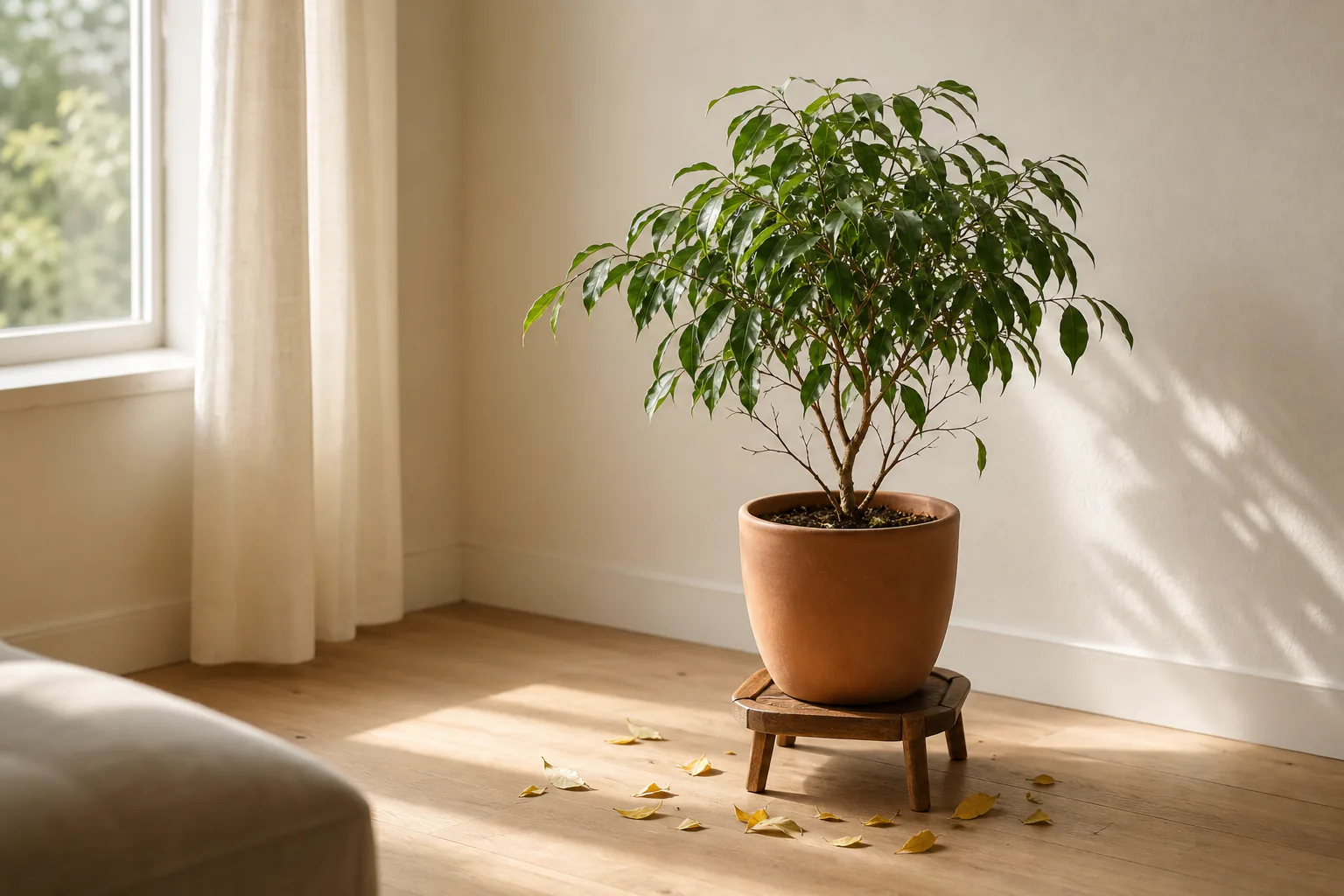
Plant care
Why your houseplant is dropping leaves after a move or change
· Updated
If your houseplant is dropping leaves after a move, delivery, repotting, or room change, the most likely explanation is stress from one or more conditions that shifted at once: light, temperature, drafts, watering rhythm, or root handling. The most useful response is to stabilize what you can control, watch the plant on a measured timeline rather than minute to minute, and avoid the reflex actions (extra water, fertilizer, another repotting) that tend to make recovery harder. Some leaf drop can be part of normal adjustment, but persistent heavy drop, soft stems, foul soil, or visible pests are signs worth taking to a local source.
That’s the short version. The rest of this article walks through what to check, what to leave alone, and where the limits of remote troubleshooting sit.
What a move or big change usually means for a houseplant
A big change in a plant’s life can be any of:
- a physical move to a new home or office
- a delivery from a mail-order nursery or a gift
- a new room, or a new spot within the same room
- a recent repotting, or an aggressive root tease during one
- a seasonal shift, such as moving a plant closer to or away from a window as the sun changes
- any combination of the above
What makes these moments confusing is that several conditions often shift at the same time. The plant may have moved from a sunny window to an interior wall, from a drafty old apartment to a building with stronger HVAC, and from a watering rhythm the reader had dialed in to new airflow and humidity that change how fast the medium dries. Asking what’s the one thing I did wrong usually produces an unsatisfying answer, because there isn’t a single thing. There are several things, layered.
Why leaf drop happens: a stress response, not always one cause
Leaf drop after a change is most often an abiotic stress response. Abiotic means non-living factors: light, temperature, water, physical handling. It is the plant reacting to conditions it didn’t have last week.
The complication is that biotic stress (living agents like pests and pathogens) can produce many of the same visible symptoms. UC ANR notes that leaf spots, defoliation, wilting, and slowed growth can be common to both categories, and the two are not mutually exclusive. University of Illinois Extension’s IPM materials make the same point: environmental and biological problems can overlap, so visible signs alone are not always definitive.
The practical version: leaf drop right after a move is more likely abiotic, but it isn’t automatically abiotic. The observation order below keeps that distinction open.
A no-panic observation order: the first hour and the first two weeks
Watching a plant drop leaves in real time tends to produce anxiety rather than information. A measured cadence of observation gives the plant time to respond and gives you better data.
In the first hour, you can check:
- Where the plant is now versus where it was, and what’s different about the new spot.
- Light at the new location: is it direct, indirect, or low? Has the duration changed?
- Temperature: is there a vent, a door, an exterior wall, or a window nearby that wasn’t in the picture before?
- Soil moisture: is the medium soggy, evenly moist, or already drying out?
- The plant itself: any visible pests, sticky residue, webbing, spots, or mushy stems?
Over the first two weeks, what you’re watching for is the direction of travel, not moment-to-moment count:
- Is the drop slowing, steady, or accelerating?
- Is any new growth appearing, even small?
- Are remaining leaves holding their posture, or are they wilting or curling?
- Has the soil moisture pattern stabilized, or is it swinging between very wet and bone dry?
A weekly check-in will tell you more than staring at the plant daily. Plants respond on their own clock.
Light: the most common silent change after a move
Light is one of the most common silent changes after a move, and the one the human eye is least equipped to judge reliably. A spot that looks bright may deliver a fraction of the light the plant was getting two rooms away, or the reverse if it has landed in front of a sunny window. Direction matters too: a north-facing window in a new apartment may give soft, even light, while the previous spot faced east and got only morning sun.
The honest fix is to re-check the new spot using the same observation method you’d use to place any plant. Houseplant Supplies walks through how to read the natural light in your room before placing a plant; the same approach works as a post-move re-check.
What you should not do is keep moving the plant from spot to spot to find the right one. Each move is another stress event. Pick the most reasonable spot based on what the plant is used to, leave it there, and let it adjust.
Temperature, drafts, and the new microclimate
Light is the silent change; temperature is the felt one. A new spot near a frequently opened door, an exterior wall with poor insulation, a single-pane window in winter, a heating vent, or a kitchen appliance can introduce temperature swings the previous location didn’t have. Plants respond to swings, not just to averages: a room that holds a steady temperature is easier on a plant than one that fluctuates noticeably across the day.
Quick checks:
- Is there a path between the plant and a door that opens to outside air?
- Is the plant sitting above or in line with a forced-air vent?
- Does the window above or beside the plant get cold at night?
- Is there a radiator, space heater, or oven nearby?
If any of these are new, consider relocating the plant once to a more stable spot, then leaving it.
Watering rhythm after a change
In new light, airflow, and temperature conditions, the same plant may dry down faster or slower than before. The watering rhythm that worked in the old room is unlikely to be exactly right for the new one.
The fix is to water based on what the medium is doing, not on a calendar. Stick a finger or a wooden chopstick into the medium an inch or two down. Water when the top portion has dried to a depth appropriate for the species; skip a watering if it still feels moist. Over the first couple of weeks you’ll start to see the new rhythm.
This is also where the overwatering trap sits. Wilting and leaf drop can be the first signs of extreme overwatering, the University of Arkansas Cooperative Extension notes, not just of under-watering. A wilting plant in damp medium is a different problem from a wilting plant in dry medium, and the two don’t have the same fix.
What not to do, and why more water or fertilizer usually makes it worse
Most leaf drop articles list causes and solutions, which encourages the compensating behavior that often makes recovery harder. The list of things to deliberately not do is short:
- Don’t repot again. Most houseplants only need repotting every three to five years, and spring, when the plant is entering active growth, is generally the best time to repot because roots re-establish into the new medium. Repotting a stressed plant again adds another shock on top of the current one.
- Don’t fertilize. A stressed plant with disturbed roots or shifted conditions doesn’t need fertilizer. It needs stability. Adding nutrients to a plant that can’t take them up efficiently adds to its stress load.
- Don’t overwater. The instinct to give it more is strong, especially when leaves are dropping. Check the medium first.
- Don’t move it again. Gradual acclimation is the standard recommendation for reducing transplant stress in outdoor horticulture; the same logic applies indoors.
- Consider holding off on heavy pruning until the plant has stabilized. The plant is already light on leaves, and the remaining foliage is doing the work of recovery.
Doing less is the intervention.
Normal adjustment signs versus warning signs worth escalating
Some adjustment is expected after a real change. Reasonable adjustment signs include:
- a modest amount of leaf drop that slows or stops within a couple of weeks
- slowed or paused growth
- leaves that look slightly dull or less turgid than usual
- a few yellowing or browning leaves at the base or tips
Signs that, taken together, suggest the situation is no longer routine adjustment include:
- heavy or accelerating leaf drop that continues over several weeks without slowing
- soft, mushy, or collapsing stems
- foul-smelling, sour, or rotting soil
- visible pests, sticky residue, webbing, or fungal growth on leaves or soil
- sudden total defoliation in a plant that previously held its leaves
These don’t always mean the worst, but they are the points where remote troubleshooting runs out and an in-person or local-expert second opinion earns its keep. A local nursery, a master gardener program, or a regional extension office can see what a written description cannot.
What this article cannot tell you
A written description, or even a photo, isn’t the same as looking at the plant in its new spot. Species, cultivar, prior health, root condition at the time of the move, the exact light and airflow in the new room, the medium in the pot, and recent care history all matter, and none of that fits in a paragraph.
If the plant is mostly holding on and the direction of travel looks stable, the stabilization approach above is usually enough. If the situation is severe, persistent, or involves any of the warning signs above, contact a local nursery or your regional extension service for an in-person look. They can see what a remote reader cannot.
Sources
- University of Arkansas Cooperative Extension Service — Repotting Houseplants
- Penn State Extension — Repotting Houseplants
- UC ANR — Distinguishing abiotic and biotic symptoms in plants
- University of Illinois Extension IPM — Distinguishing abiotic and biotic plant problems
- Purdue Extension — Transplant shock of trees and shrubs
- Cornell CALS — Avoid transplant shock