Plant care
Yellow sticky traps for fungus gnats: what they actually do
· Updated
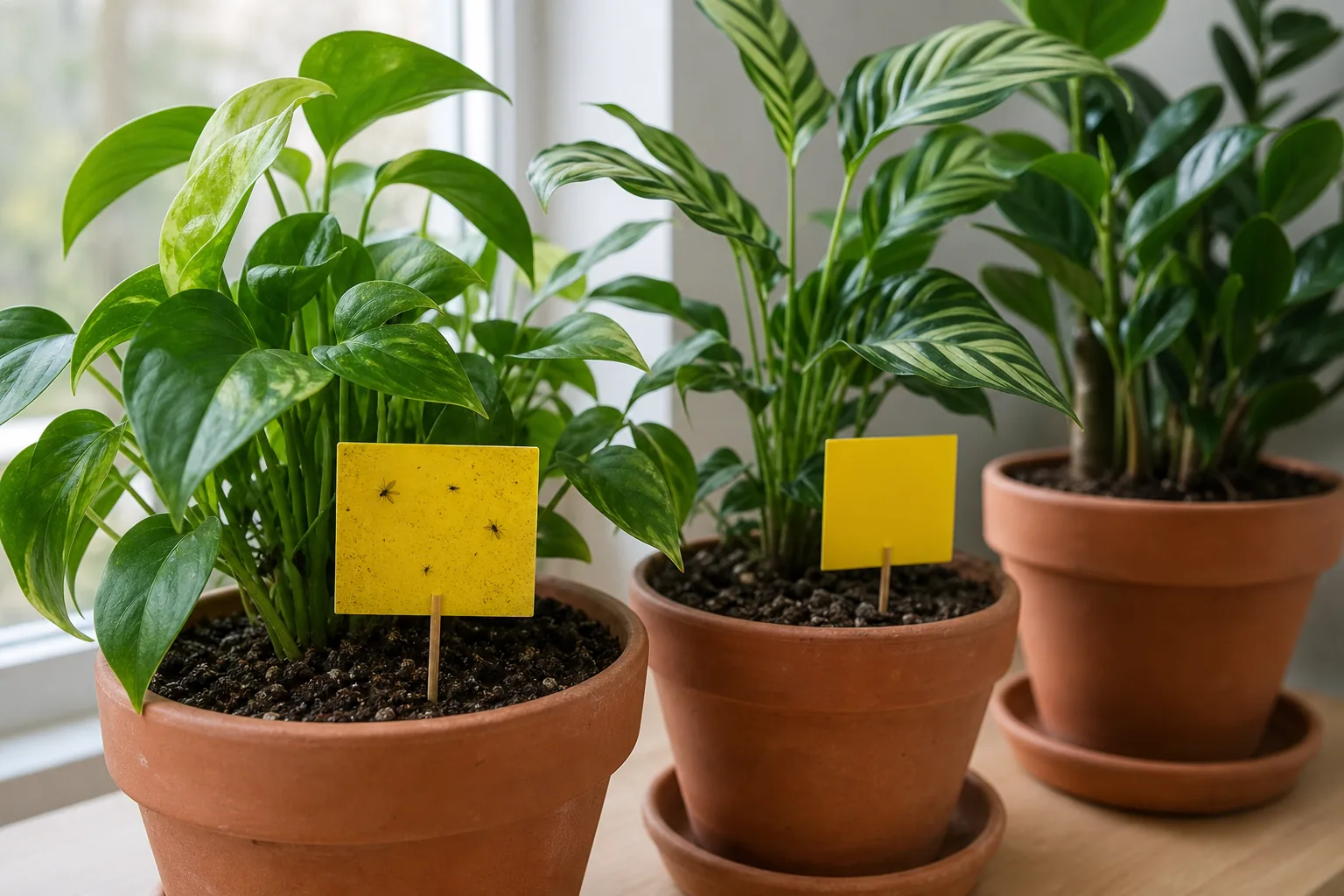
Yellow sticky traps for fungus gnats are bright yellow adhesive cards (or stake-style cards) that catch adult fungus gnats in flight. University extension services describe them as a monitoring tool first, with a modest secondary effect of reducing the number of visible adults. They do not reach larvae living in the soil, and they do not change the moist organic layer the larvae feed on. Used alone, traps rarely finish an indoor infestation. Used alongside dry-down watering and a well-drained potting mix, they give you a clear, observable signal of whether the adult population is rising, stable, or falling.
That bounded answer is the most useful thing to know before you buy a pack. The rest of this article explains how the traps work, what they can and cannot do, where to put them, and how to read what they catch.
What yellow sticky traps actually are
A typical indoor yellow sticky trap is a piece of card or thin plastic coated on one or both sides with a pressure-sensitive adhesive, dyed a strong yellow that falls in the wavelength range many flying insects respond to. Most retail indoor versions sold for houseplant use are adhesive-only and do not contain insecticide or pheromone; the color itself does the attracting. A few greenhouse or outdoor versions are sold as part of a pesticide device and may include an attractant or active ingredient, so it is worth reading the actual product label before assuming your trap is a passive adhesive card.
The adult fungus gnat (Bradysia species and close relatives) is a small, dark, delicate fly that hovers near the soil surface and is the only life stage you will see flying around. The larvae are tiny, translucent worms with dark heads, and they live entirely inside the growing medium, feeding on fungi, algae, and decaying organic matter in the top moist layer. Sticky cards can only ever interact with the flying adult stage.
What sticky traps can reliably do
Extension services describe yellow sticky cards as a monitoring tool first, with a secondary role in reducing the visible adult population. Purdue’s Vegetable Crops Hotline puts it directly: yellow sticky cards are not a management tool, but rather a very handy monitoring tool. UC IPM, Clemson, K-State, UConn, and Colorado State all describe cards as a way to detect adults and decide when to act, not as the cure itself.
Within those limits, the cards do four useful jobs for an indoor reader:
- Confirm that the small dark flies you are seeing are fungus gnats rather than something else.
- Tell you whether the population is going up, holding steady, or going down over several days.
- Point to which pot is the source, because one card will often fill up while the cards next to it stay clean.
- Modestly thin the visible adult population. Cards do not eliminate adults, but every adult a card catches is one that is not laying more eggs in the medium.
What sticky traps cannot do
The honest limits are where this comparison earns its keep, and they matter because they explain why some readers feel that sticky traps “didn’t work.”
Sticky traps cannot:
- Reach larvae in the soil. The larvae live in the upper layer of moist growing medium. No card, hung however cleverly, changes what is happening under the surface. Extension guidance often pairs cards with a separate larval detection method (potato disks or wedges pressed into the medium, then pulled up and inspected) precisely because the cards miss that stage.
- Substitute for drying out the top layer of the mix. Larvae need a moist, fungus-rich surface layer to feed and develop. Traps have no effect on moisture.
- Fix a chronically waterlogged pot, an old compacted mix that stays wet for days, or a cachepot holding standing water around an inner pot. These are the conditions that keep the larval habitat viable, and cards do nothing about them. The mix itself and the pot setup together control how long that surface stays damp.
- Replace observation-based watering. If you water on a fixed schedule regardless of how dry the medium is, the trap will keep catching adults no matter how many you hang.
- Provide a meaningful “done” signal. A card that stops catching adults can mean the population crashed, or it can mean that nearly all the adults are gone but larvae in the medium are about to emerge as a new generation. Trap counts are a trend, not a verdict.
If dry-down feels unfamiliar, watering by observation rather than a schedule walks through what to actually look for before you reach for the watering can.
Where you place a yellow sticky trap matters
Extension sources differ on exact orientation, but they agree on the principle: place the card near the soil or growing-medium surface, not high in the foliage. Adults emerge from the medium and fly close to it, so a card sitting on or just above the medium catches more than one hung at eye level.
Practical placement for an indoor plant grouping:
- Put one card per pot, or one card per small cluster of pots, so you can localize the source. A heavily spotted card next to clean ones is a strong clue.
- A stake-style card pushed into the medium, a card laid face-up on the surface, and a card clipped vertically near the pot rim are all supported by different extension sources. For an ordinary houseplant, a low-placed card or stake is usually the simplest.
- Avoid placing cards where pets, children, or curious hands can brush against them. The adhesive is not toxic, but it is a physical mess. Skip placement over food prep surfaces, and replace the card weekly before dust and water mist obscure the yellow and the catches.
- If you are quarantining a new plant, Oregon State Extension suggests adding a card and inspecting it daily as part of an early-detection routine.
Reading what the cards tell you over a few days
Absolute catch numbers are not very meaningful; the trend over a week or two is what to watch. UConn recommends checking and changing cards weekly so the picture stays clear.
A few patterns and what they tend to mean:
- Catches fall noticeably within the first week or two while the top of the mix is also drying out between waterings. This is the signal you are hoping for. The larval habitat is shrinking, fewer adults are emerging, and the rest of the plan is working.
- Catches hold steady or climb despite a drier top layer. This usually points to a hidden wet pocket. Common culprits are deep pots that drain slowly, dense or old mixes that hold water, dropped leaves or bark on the surface that stay damp, or a cachepot with standing runoff under the inner pot. The trap is telling you the problem is structural, not just a population of adults. This is also the moment to revisit how pot setup changes how long soil stays wet.
- One card fills up while nearby cards stay clean. That pot is the source. Move your attention (and any repotting or mix refresh) there first.
- A card stops catching entirely while the top of the medium still looks dark and moist. This is the most ambiguous signal. It can mean the adults are temporarily absent, or it can mean a new generation is still developing in the medium. Keep the dry-down going and watch for a second wave.
How sticky traps fit next to the rest of the plan
Think of the trap as the observation layer of the layered plan. It does not, on its own, fix the moist organic layer that larvae feed on. That work is done by the other parts of the plan: watering based on observation rather than a schedule, a coarse and well-drained potting mix, removal of damp leaf litter or top dressing, and any label-compliant biological or chemical option you decide to use. The trap is the part that tells you whether the rest of the plan is working. Without it, you are guessing at whether the adult population is shrinking. With it, you have a weekly number to read, and that number is what points you to the next concrete step described in the layered prevention plan in our fungus gnat guide.
A quick note on color: yellow is the conventional choice in extension monitoring guidance, and extension sources default to it for general flying-pest scouting. Blue cards are more often discussed in extension literature for thrips rather than for fungus gnats specifically, and head-to-head yellow-versus-blue comparison data for sciarid flies is thin. Treat yellow as the standard, well-documented choice, not as a scientifically proven optimum.
When sticky traps alone are not enough
If catches stay high over the first week or two of consistent dry-down, or if you can see small translucent worms with dark heads in the top layer of the medium, the cards have done their job of telling you that the larval side of the problem is not yet under control. That is the moment to revisit the layered prevention plan, consider whether the mix itself needs refreshing toward a mix with coarse particles and organic matter that drains predictably, and reach out to a local nursery, master gardener program, or your state’s extension service for an in-person look. Sticky traps are a precise, honest signal device; they do not replace that kind of support, and they are not meant to.
Sources
- Fungus gnats – UC IPM, University of California Agriculture and Natural Resources
- Integrated pest management strategies for fungus gnats in ornamental plant propagation – Clemson University Land-Grant Press
- Fungus gnat larvae – UConn Extension (PDF)
- Fungus gnat management in greenhouses and nurseries (MF2937) – Kansas State Research and Extension
- The utility of yellow sticky cards – Purdue Vegetable Crops Hotline