Plant care
Whiteflies on houseplants: an indoor identification guide
· Updated
What to do if you see small white insects flying up from a houseplant
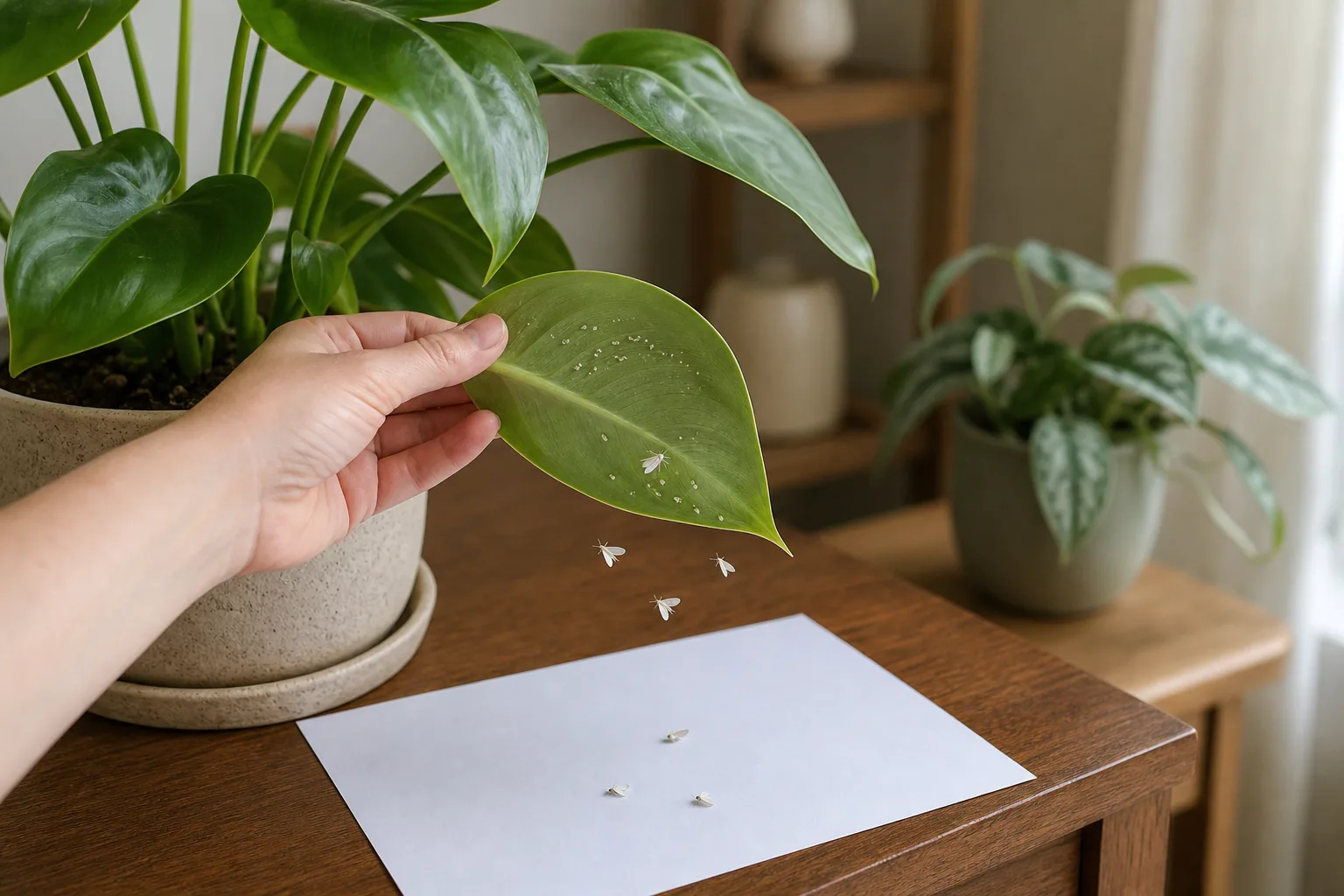
If you just tapped a leaf and a small cloud of white, moth-like insects rose briefly and then resettled on the plant, you are probably looking at whiteflies. They are tiny sap-feeding insects whose adults flutter when foliage is disturbed and whose immature stages sit, scale-like, on the undersides of leaves. If what you saw does not fly when disturbed, or if it returns to the potting soil instead of the leaves, it is probably something else, and fungus gnats are the most common confusion.
This guide is built around that diagnostic moment. It walks through how to confirm a whitefly sighting indoors, how to tell them apart from the small insects they are usually mistaken for, and what a calm, label-respecting response looks like in an ordinary home.
What whiteflies actually are on a houseplant
Whiteflies are tiny soft-bodied insects covered in a powdery white wax that makes them look like miniature moths at rest. They are roughly 1/16 to 1/10 inch long (about 1.5–3 mm), and at rest they hold their wings in a triangular, roof-like profile over their bodies. Adults are winged. The immature stages, called nymphs and pupae, stay put on the leaf and look like small, pale, translucent scales rather than like insects.
They are sap-feeders, in the same broad group as aphids, mealybugs, and scale insects. That shared feeding habit is why several of these pests produce the same secondary signs you may have already noticed on the plant or the surface beneath it.
The diagnostic moment: disturb a leaf and watch
The single most useful observation you can make indoors is also the simplest. Hold a sheet of white paper or a light-colored tray under a suspect leaf, then tap or gently shake the stem and foliage. A small cloud of white, moth-like insects that flutter up briefly and resettle on the plant is the strongest behavioral signal for whiteflies.
Their flight is weak and short-range. Whiteflies are not strong fliers that vanish across the room. If anything you have seen in your home flies in a straight line toward a window, lands on fruit, or hovers near a drain, you are looking at a different insect.
Where to look on the plant
Even after the adults resettle, the physical evidence stays. Turn the newer leaves over with a flashlight, and a magnifier if you have one, and look for:
- tiny pale eggs, often arranged in a small arc or circle on the underside of a younger leaf
- small, oval, translucent or pale scales that are the nymphs and pupae; they do not move
- small white shell-like remnants on the leaf surface where earlier stages were attached
Stem joints, leaf axils, and the soil surface are usually not where whiteflies live. The undersides of leaves are where the colony actually sits, which is why a casual glance at the top of the plant often misses the problem entirely.
Whiteflies versus common lookalikes
Most “is this a whitefly?” questions are really questions about one of four other small white or flying insects. The differences come down to where they sit and what they do when disturbed.
Whiteflies vs. fungus gnats. Fungus gnats are dark, mosquito-like adults that return to moist potting soil after flying. They do not sit on leaf undersides and they are not powdery white. If your insects return to the soil, the fungus gnats and houseplants guide is the better starting point.
Whiteflies vs. mealybugs. Mealybugs are wingless, sedentary, and coated in cottony white wax that clumps in leaf axils and along stems. They do not fly and do not produce a moth-like cloud when disturbed. Our guide to mealybugs on houseplants walks through how to recognize them specifically, including their tendency to settle in stem joints and leaf crevices rather than on leaf undersides.
Whiteflies vs. woolly aphids. Woolly aphids are slow-moving and produce a waxy white coating, but they live on stems and new growth rather than leaf undersides, and they do not flutter up in a cloud.
Whiteflies vs. thrips. Thrips are slender, fast-moving, and usually tan to dark, with narrow fringed wings rather than broad powdery ones. Their damage tends to look like silvery streaks or stippling, not the honeydew-and-sooty-mold pattern of whiteflies.
Whiteflies vs. small leafhoppers. Small pale leafhoppers are wedge-shaped and jump off the leaf when disturbed, rather than drifting up in a soft cloud.
Honeydew, sooty mold, and other secondary clues
Whiteflies feed by piercing leaves and sucking sap. They excrete a sugary liquid called honeydew that lands on the leaves below and on whatever surface sits beneath the plant. If you have noticed stickiness on the upper surfaces of leaves, on a windowsill, or on a shelf, that is a strong secondary signal that a sap-feeder (whitefly, aphid, mealybug, or soft scale) has been present for some time. Sooty mold can then grow on that honeydew as a dark, wipeable film. Sooty mold itself is not a leaf disease, even when it looks like one. Our guide to honeydew and sticky residue on houseplant leaves walks through what honeydew can and cannot tell you.
These signs are not specific to whiteflies. They point you toward a sap-feeding insect; the underside and behavior observations point you to which one.
How whiteflies typically get indoors
Indoor introductions are usually quiet and not anyone’s fault. The most common entry paths are:
- new plants brought in from a garden center or delivery, even ones that looked clean at purchase
- cut flowers and greenery, especially in warm months
- open windows and doors during warm weather
- houseplants that spent the summer outside and were moved back in for the cooler months
Warm indoor temperatures accelerate whitefly reproduction. Generation time is strongly temperature-dependent: roughly three to four weeks at warm indoor temperatures (around 70–86°F / 21–30°C), and noticeably longer in a cool room, with extension sources citing as long as several months near 50°F / 10°C. That is why a small initial population can become a noticeable one within a season, and why outdoor-to-indoor transitions in late summer often coincide with the first sightings.
A short, label-respecting response in an ordinary home
Indoor whitefly management is a calm, repeated routine rather than a single decisive treatment. The aim is to reduce the population while the plant recovers, not to promise eradication on a fixed schedule.
A reasonable sequence:
- Isolate the affected plant from its neighbors. Whiteflies are weak fliers but they do move plant to plant over short distances, and isolation is the cheapest step that actually limits spread. Our post on how to isolate a new houseplant covers what isolation can and cannot do indoors.
- Remove the most heavily infested leaves and bag them rather than composting them in the open. This cuts the load of eggs and sessile nymphs.
- Use a gentle shower, a sink rinse, or a soft brush on the undersides of remaining leaves to dislodge adults and crawlers. A handheld vacuum used carefully on the underside of foliage can also pick up adults.
- Monitor weekly with a simple leaf-underside check, and repeat the rinse or vacuum step. Because eggs and pupae remain on the leaf while only adults are mobile, populations recover without repeated monitoring.
If you decide a product is appropriate, the two categories that university extension and IPM sources most consistently support for whiteflies on indoor ornamentals are insecticidal soaps and horticultural oils, used as the current product label directs for indoor ornamentals. Concentrations, mix ratios, and application intervals are determined by the label, not by this article, and ventilation plus the sensitivities of people, pets, or plants in the home are part of that decision. For label reading and product choice in general, defer to the product itself.
Realistic expectations matter here. Most university and botanical-garden sources describe whitefly management indoors as a process of population reduction across several weeks, with continued monitoring rather than a one-shot fix. A small, recently arrived infestation is much easier to bring down than a multi-plant one that has been building all summer.
When to ask a local nursery or extension service
Escalation is reasonable when:
- the infestation is on multiple plants in the same room
- the affected plant is a valued specimen you would rather not lose
- the identification is still unclear after the tap test and underside check
- you are weighing a product and want a second opinion specific to your region and plant
Local independent nursery staff and your county extension office (often reachable through a Master Gardener hotline or plant clinic) are the right next step. They can confirm what you are seeing, suggest a species-appropriate response for your area, and flag any regional pesticide regulations that matter for indoor use.
A short checklist before you close the post
- Confirm the flight response by tapping a leaf over a light-colored surface.
- Look at the undersides of newer leaves for pale eggs and scale-like nymphs.
- Isolate the affected plant and check its neighbors.
- Remove heavily infested leaves, rinse or vacuum the rest, and repeat weekly.
- Treat any product step as label-first, and ask a local expert if the population persists or spreads.