Plant care
Rubber plant dropping leaves: a calm, observation-first guide
· Updated
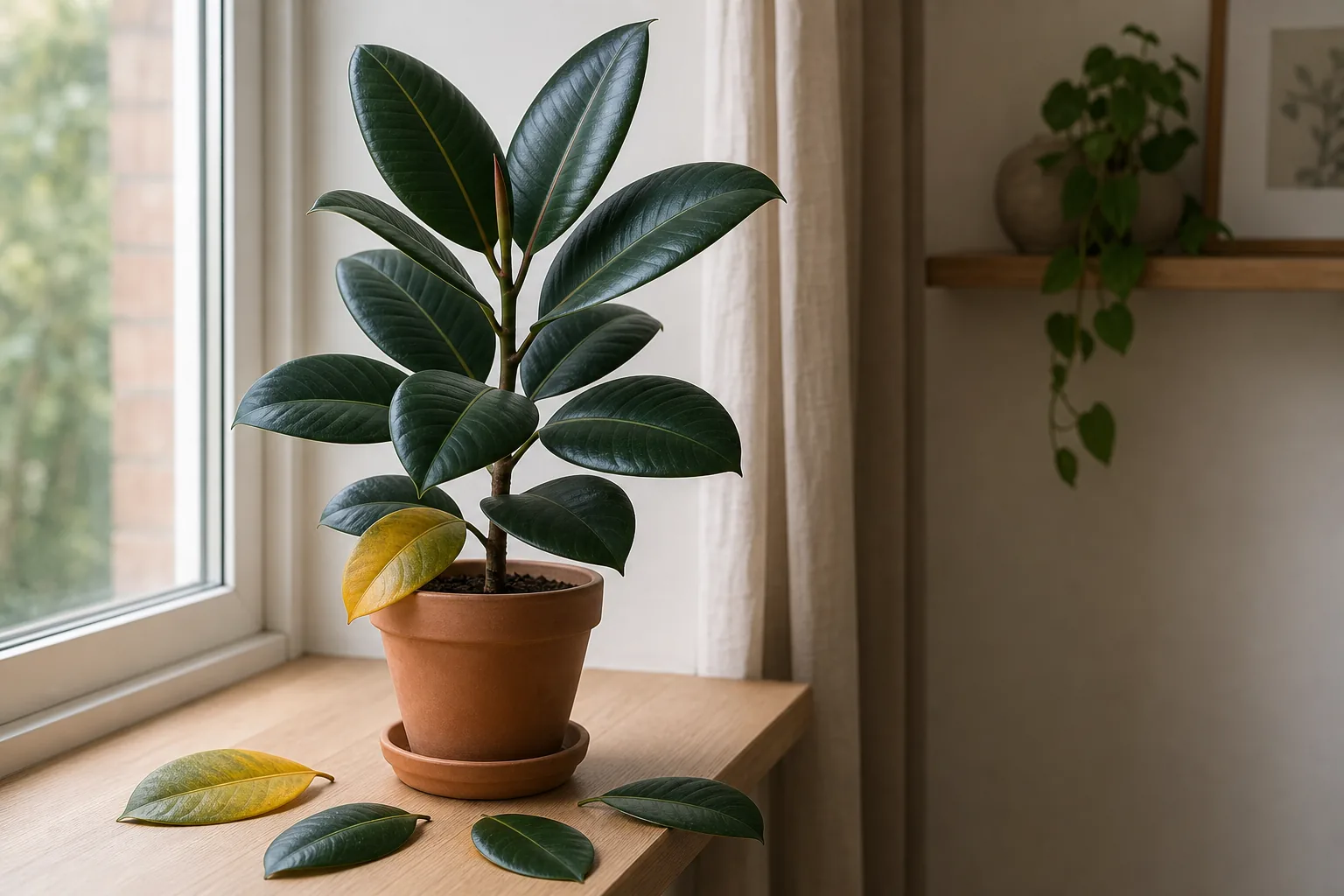
A rubber plant losing leaves indoors is usually a stress protest, not a death sentence. Ficus elastica is widely described in extension publications as a species that drops leaves readily when conditions shift, including light, watering rhythm, temperature, drafts, or physical location. The right first move is observation, not action. Read which leaves are dropping, how fast, and what changed in the last two to six weeks. Then stabilize one spot, one watering rhythm, and one temperature range, and wait two to four weeks before deciding on bigger moves like repotting or relocating. For steady-state care of a healthy plant, the main rubber plant care guide is the reference; this piece focuses on what to do during an active drop.
Why rubber plants drop leaves more visibly than many other houseplants
Clemson University’s Home and Garden Information Center describes the rubber plant as easy to grow and tolerant of a range of indoor conditions. That framing is accurate for steady-state care. It also means the plant is not fragile in any dramatic sense; it simply communicates stress by dropping leaves rather than wilting. NC State Extension lists overwatering and temperature drops or cold drafts as direct causes of leaf loss in Ficus elastica, and notes that some yellowing and drop of the oldest bottom leaves is normal aging on a healthy plant.
A broader pattern comes through in extension literature on figs more generally. The University of Arkansas Cooperative Extension notes that most figs are sensitive to sudden changes in their environment, and that sudden leaf drop, especially on weeping fig, can be a natural response to changing light levels across seasons. For an indoor rubber plant, the same sensitivity shows up when a new spot, a new pot, a new watering habit, or a new draft source enters the picture. Recognizing the pattern as a stress signal rather than a verdict is the first practical shift.
Read the pattern first: which leaves, how fast, when it started
Before changing anything, spend a minute looking at the plant with these questions in mind. The answers narrow down what is actually happening, and they keep you from changing three things at once in the wrong order.
Which leaves are dropping. Bottom, older leaves turning yellow before they fall is a common pattern on a healthy Ficus elastica and is named as such by NC State Extension. Scattered leaves dropping from across the canopy, with or without yellowing, is more often a stress signal. If only the newest, smallest leaves are dropping, look at recent light and watering changes first.
How fast the leaves are dropping. One older leaf per week on an otherwise stable plant is a different situation from many leaves dropping in a few days. The rate tells you whether the plant is gradually rebalancing or actively protesting.
What color the leaves were before they fell. Yellow first, then drop, often points to watering rhythm or light. Brown, crispy edges before drop point to dry air, direct sun, or chronic underwatering. Green leaves dropping with no color change can show up during a stress event, and a recent shift in light, temperature, or location is one of the first triggers worth checking.
What changed in the last two to six weeks. This is the question that catches most causes. A new room, a new pot, a repotting, a new window, a season change, a new heating or cooling pattern, a new watering habit, even a piece of furniture moved near the plant can all count. If nothing obvious comes to mind, list subtle changes too: longer days, a draft from a window you started opening, a vent that started running, a move across the room. For broader move-and-change framing, our piece on leaf drop after a move or change covers the same pattern across species. If the plant is recent, our guide to acclimating a new houseplant sets expectations for the first few weeks at home.
The four most common indoor triggers for rubber plant leaf drop
Once the pattern is clear, most indoor leaf drop episodes trace back to one of four triggers. They are listed in order of how often they show up in the surveyed extension and horticultural sources.
Light change
NC State Extension describes Ficus elastica as preferring bright indirect light or partial shade, with protection from harsh afternoon sun. The University of Arkansas Cooperative Extension publication on houseplant problems names sudden light change as a trigger for sudden leaf drop on figs. Consumer horticulture sources also report that moving a rubber plant from a bright area to a dimmer room can result in leaf drop. Light is also the trigger most readers miss when nothing else seems to have changed, because seasonal shifts in window light are easy to overlook.
The stabilization move is to pick one spot with bright, indirect light for at least several weeks and leave the plant there. If you are not sure the spot is bright enough, see our guide to reading the natural light in a room for a way to gauge it without buying a meter.
Watering inconsistency
NC State Extension names overwatering as a cause of leaf drop in Ficus elastica, and chronic underwatering can produce a similar stress pattern in practice. Overwatering is the more dangerous of the two because it can lead to root issues, but a thirsty plant will drop leaves too. The problem is rarely a single bad watering; it is rhythm. A reader who waters lightly and often, then forgets for two weeks, then floods the pot, is creating swings the roots cannot follow.
The stabilization move is to switch to checking the plant rather than the calendar. Lift the pot to feel its weight when it has just been watered and again when the top inch or two of soil feels dry. Water thoroughly when the pot has lightened and the surface is dry, and let excess drain away. Our guide to watering without a schedule walks through the observation method in more detail.
Temperature, drafts, and cold glass
NC State Extension names temperature drops and cold drafts as causes of leaf loss. The Society for Growing Australian Plants advises keeping Ficus elastica away from heaters and central heating vents indoors, because heating sources reduce humidity around the plant. Cold window glass in winter and hot afternoon sun through glass in summer can both expose the plant to temperature swings a rubber plant does not appreciate, and air from a frequently opened door or window can be enough to set off drop.
The stabilization move is to keep the plant in a spot where the temperature is reasonably steady across the day and the night, away from heating and cooling vents, and out of the path of door drafts. Our placement guide for drafts, vents, and sun-heated glass covers the patterns worth checking if you are not sure where the swings are coming from.
Recent physical disturbance
Repotting, moving the plant from one room to another, or even frequent rotation of the pot can all register as disturbance to a change-sensitive Ficus. Extension publications describe fig species as sensitive to sudden environmental changes, and that includes being moved. If the leaf drop started within a week or two of a move, a new pot, or even a new shelf, this is the most likely trigger.
The stabilization move is to leave the plant in its current spot. Resist the urge to move it again to fix the light. The same spot that may not be ideal long-term is the right spot for the next several weeks.
Stabilize one thing at a time
Stabilization is the opposite of trying everything at once. Pick a spot, a watering rhythm, and a temperature range, then hold those three things steady. If light, watering, and temperature all shift in the same week, the plant has no way to know which one to blame, and it will keep dropping leaves until something feels stable. For a reader whose plant is in active drop, this is the most useful single sentence in this article: one spot, one rhythm, one range, then wait.
What not to change while the plant is dropping leaves
The instinct during active leaf drop is to do something. Most of the obvious somethings make things worse, especially when stacked on top of each other.
- Do not repot. Repotting during active drop is an additional stressor. The plant is already adjusting; a new pot of fresh soil is a second adjustment at the same time.
- Do not fertilize. A stressed plant is not a hungry plant in the way the instinct suggests. Fertilizing during active drop can push new growth the plant is not ready to support.
- Do not move the plant to a new spot to fix the light. Pick one spot and stay there.
- Do not overcorrect watering. If you suspect underwatering, water thoroughly and let the pot drain. Do not water again the next day to be safe.
- Do not mist as a treatment. Misting is not a treatment for leaf drop, and added moisture that does not dry quickly is not what the plant needs in this window.
- Do not prune heavily. Light tidying is fine; a hard prune during active drop removes leaves the plant may still be relying on.
If a move, repotting, or fertilizer application has already happened in the last few weeks, that does not mean the plant is lost. It means the stabilization window is now more important than the diagnostic step.
A realistic recovery timeline and what new growth tells you
Dropped leaves do not come back on the same stem. Consumer horticulture sources note that rubber plants will not regrow leaves where previous ones have dropped; new growth emerges from the apex of the plant or from lateral nodes along the stem. That is why the most useful signal during recovery is not the leaves that fell, but the new leaves that emerge.
Under steady conditions, a healthy Ficus elastica typically begins to put out new growth from the apex or along the stem over a span of weeks, with fuller canopy recovery over months rather than days. The exact rate depends on light, pot size, season, and the plant’s overall condition. There is no reliable week count. What is reliable is the direction: stopped or slowing drop, plus visible new growth at the top or sides, plus steady stem firmness, is a good sign. Continued drop for several weeks with no new growth, or stems that go soft, is not.
When to ask a local source
A local independent nursery or your regional cooperative extension office can look at the plant in person, which is something an article cannot. Reach out when any of the following apply:
- Active drop continues for more than four to six weeks with no new growth
- Stems feel soft or mushy rather than firm
- The soil smells sour or stays wet for many days
- You see sticky residue, cottony spots, webbing, or visible insects on the undersides of leaves or at the stem joints
- The plant is also showing spots, lesions, or unusual discoloration
If the soil is staying wet and the plant is wilting rather than drooping from thirst, our guide to wilting in wet soil walks through the next observation step before adding water. The University of Florida IFAS publication on ornamental Ficus diseases is a useful reference for what ficus diseases can look like, and a local extension agent or nursery professional can help confirm whether what you are seeing is environmental, pest-related, or disease-related, and what the appropriate next step is in your region.
Sources
- NC State University Plant Toolbox, Ficus elastica
- University of Arkansas Cooperative Extension, Houseplant problems and solutions
- Clemson University HGIC, Rubber plant
- Society for Growing Australian Plants, Ficus elastica (Rubber plant)
- University of Florida IFAS, Ornamental Ficus diseases: identification and control