Plant care
Plant saucers and pot feet: a practical guide to sizing, depth, and emptying
· Updated
A plant saucer is a catch-tray for water that has already drained through the pot’s hole and the potting mix. It does not improve drainage, and it should not hold standing water against the drainage hole for long. The practical setup is a saucer slightly wider than the pot base, shallow enough to empty quickly, optionally lifted on pot feet when water would otherwise pool, paired with a short post-watering check rather than a separate chore.
A cachepot with an inner pot is a related but different setup — the inner pot drains into the space between the two pots, and that space plays the same role as a deeper saucer. The companion piece on pot drainage and cachepots walks through that configuration in more detail.
The rest of this piece is about how to make the saucer-and-pot-feet choices from observation rather than from product marketing.
What a saucer is actually for
The drainage of an indoor pot happens in the pot itself, through the hole in the bottom and through the potting mix that surrounds the roots. A saucer sits below all of that and does one job: catch whatever drains out.
This sounds obvious written down, but the language around saucers often blurs the line. A saucer does not help the pot drain faster, does not pull air into the root zone, and does not regulate moisture on its own. Anything it does beyond catching water is a side effect of where you put it and how often you empty it.
If you keep that frame in mind, the rest of the choices follow fairly naturally.
Sizing a saucer to the pot
The most useful rule is to pick a saucer slightly wider than the pot base, with a small visible lip all the way around. Manufacturer guidance often lands around one to two inches wider than the pot diameter, which is a reasonable starting point. The visible rim is the practical test: if you can see the saucer edge peeking out under the pot from every angle, water that drains quickly has somewhere to land without running onto the floor.
A saucer that is too small spills onto the surface the moment you overwater or set the pot down wet. A saucer that is much larger than the pot is not a problem for the plant, but it uses up space, hides how much water has collected, and can collect dust and grit around the edge. Width matters more than style, and the wider saucer should still be shallow.
Depth matters more than people expect
Depth is the more important variable, and it is the one most often gotten wrong. A shallow saucer holds a thin film of water that dries quickly and is easy to lift or slide out for emptying. A deep saucer can hold a meaningful reservoir against the bottom of the pot. When water stays in contact with the drainage hole for an extended period, it can re-enter the mix through the same opening it came out of — which is why extension guidance treats this as a problem to prevent by emptying, not by making the saucer deeper.
The result reads in the soil, not in the saucer: the lower part of the mix stays wet long after the surface looks dry, and the plant shows the same signs covered in why wet soil for too long is the underlying problem. A shallower saucer makes that situation harder to create in the first place.
A practical way to think about depth: if you can easily tip the saucer to drain it without moving the plant, depth is probably fine. If the saucer holds more than a thin puddle and you tend to forget it, the saucer is doing more work than it should.
When pot feet or risers actually help
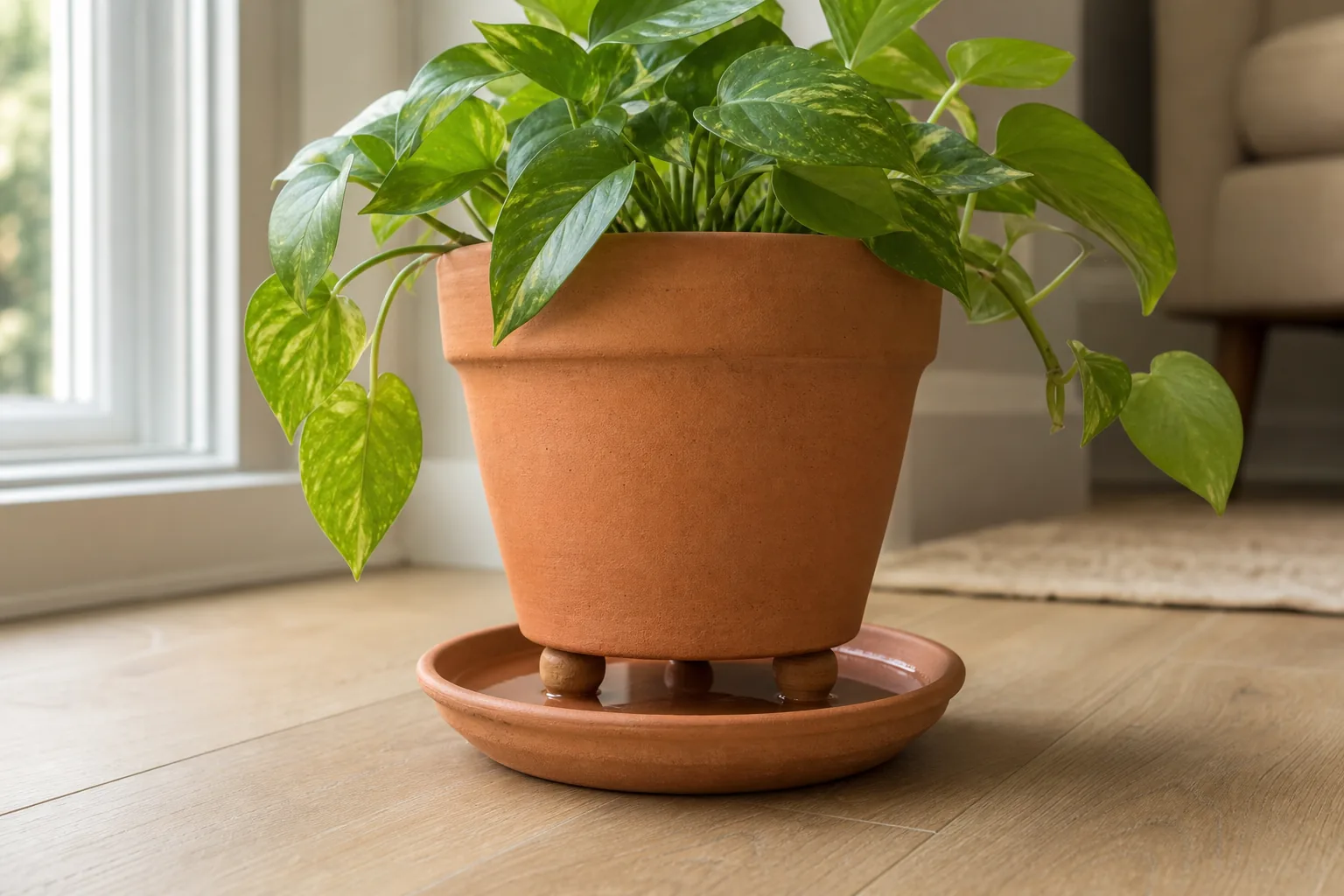
Pot feet are small lifts placed between the pot and the saucer. They do three observable things: they create a visible gap, they keep the drainage hole above any water that has collected in the saucer, and they let a wet saucer dry from underneath rather than against the pot.
They matter most in three situations. The saucer tends to hold water, either because it is deep, because the plant is in a spot where you forget it, or because the potting mix drains a lot at once. The pot has a flat, smooth base that would otherwise seal against a wet saucer and stay damp. The floor surface under the pot benefits from airflow, such as a wood floor, a sealed shelf, or any finish that shows water marks.
If the pot already has a slight foot or ridge built into its base, separate pot feet are usually redundant. If the saucer is shallow and you empty it promptly, the case for pot feet is mostly cosmetic. Trade publications describe pot feet as a way to lift the drainage hole and protect the surface underneath; they are a useful tool, not a required accessory for every setup.
The emptying routine that prevents most problems
Several university extensions give the same instruction in slightly different words: dump the excess water that collects in the saucer and never let the plant sit in water. The University of Missouri Extension gives the most specific time frame in the materials I worked from, which is to discard water that remains beneath the pot about one hour after watering.
The exact window matters less than the habit. The most useful post-watering check is to come back to the plant within the time it takes to do something nearby, such as tidying the kitchen, putting away the watering can, or moving on to the next plant, and tip the saucer before moving on. The watering-by-feel approach already asks you to look at the pot after you water; the saucer check slots into that same moment.
What goes into the saucer tells you something about the mix as well. A lot of runoff within a minute of watering usually means a coarse, fast-draining mix; almost no runoff after a thorough watering can mean the mix is dry and tight or that the pot has very little drainage. This is an observation-based cue rather than a tested rule, and it sits alongside pot weight and surface feel as one of several signals worth weighing together.
Surface protection: what the saucer can and cannot do
A saucer helps with drips, small spills, and the brief contact between a wet pot base and the surface beneath it. It does not, by itself, protect a wood floor or shelf from long-term moisture under a heavy pot, and it does not stop mineral deposits from forming where water evaporates.
A few honest limits are worth naming. A saucer that is left wet for hours can leave a ring of its own on the surface beneath, especially on finishes that mark easily. In some setups, unglazed terracotta saucers can wick moisture through their walls, leaving the outside of the saucer damp. Smooth plastic saucers can condense on the underside and slide on a finished surface, which is its own small problem. A very heavy pot concentrates load in a small area, and a saucer does not change that load distribution.
For most indoor setups, a shallow saucer emptied promptly on a flat and stable surface is enough. Where the surface is precious or the plant is large, a wider saucer paired with pot feet and an awareness of floor finish goes further than any single material choice.
Common setups and what to watch for
A few situations show up often enough to mention directly, not as a buying guide but as a place to look. Small pots on shelves are mostly a tipping risk, not a drainage risk. A wider, shallow saucer gives a more stable base than a narrow, deep one, and pot feet are usually unnecessary if the saucer is shallow and the shelf is level. Large pots on the floor are mostly a forgetting risk. A heavy pot is hard to lift for emptying, so a saucer you can slide or tip in place is the practical choice, and pot feet help when the saucer regularly holds water.
Plants near heating vents or in bright windows dry the mix faster, which means more frequent watering and more frequent saucer emptying rather than a different saucer. Plants on carpet need a saucer, and a pot with a built-in foot or with separate pot feet keeps the carpet from staying damp under the pot.
The common thread is that the saucer and the pot feet are part of the same setup, and the setup is shaped more by how you water than by what the saucer is made of. For more on how mix choice affects what ends up in the saucer, see how to choose a potting mix for houseplants.
A short checklist before you buy
A few observation-based checks tend to make the rest easier. Measure the base of the pot at its widest point, including any rim, and pick a saucer that shows a visible lip all the way around. Choose a saucer you can empty without lifting the plant, either by tipping or by sliding it out. Decide on pot feet only if the saucer regularly holds water, the pot has a flat smooth base, or the floor needs airflow. Plan the emptying check before the watering, not after, so the habit is set when the plant is still in front of you.
The goal is a setup you forget about, in the good sense. A correctly sized, shallow saucer under a pot that you empty on the same rhythm you water is the kind of supply choice that quietly does its job and stays out of the way.
Sources
- University of Maryland Extension, Watering indoor plants: https://extension.umd.edu/resource/watering-indoor-plants
- University of Missouri Extension, Caring for houseplants (G6510): https://extension.missouri.edu/publications/g6510
- UF/IFAS Gardening Solutions, Caring for houseplants: https://gardeningsolutions.ifas.ufl.edu/plants/houseplants/houseplant-care/
- Illinois Extension, Container drainage options: https://extension.illinois.edu/container-gardens/container-drainage-options
- Ten Thousand Pots, How big should a saucer be under a planter?: https://tenthousandpots.com/blogs/ten-thousand-pots-blog/how-big-should-a-saucer-be-under-a-planter