Plant care
Phalaenopsis orchid aerial roots: what they are and what to do
· Updated
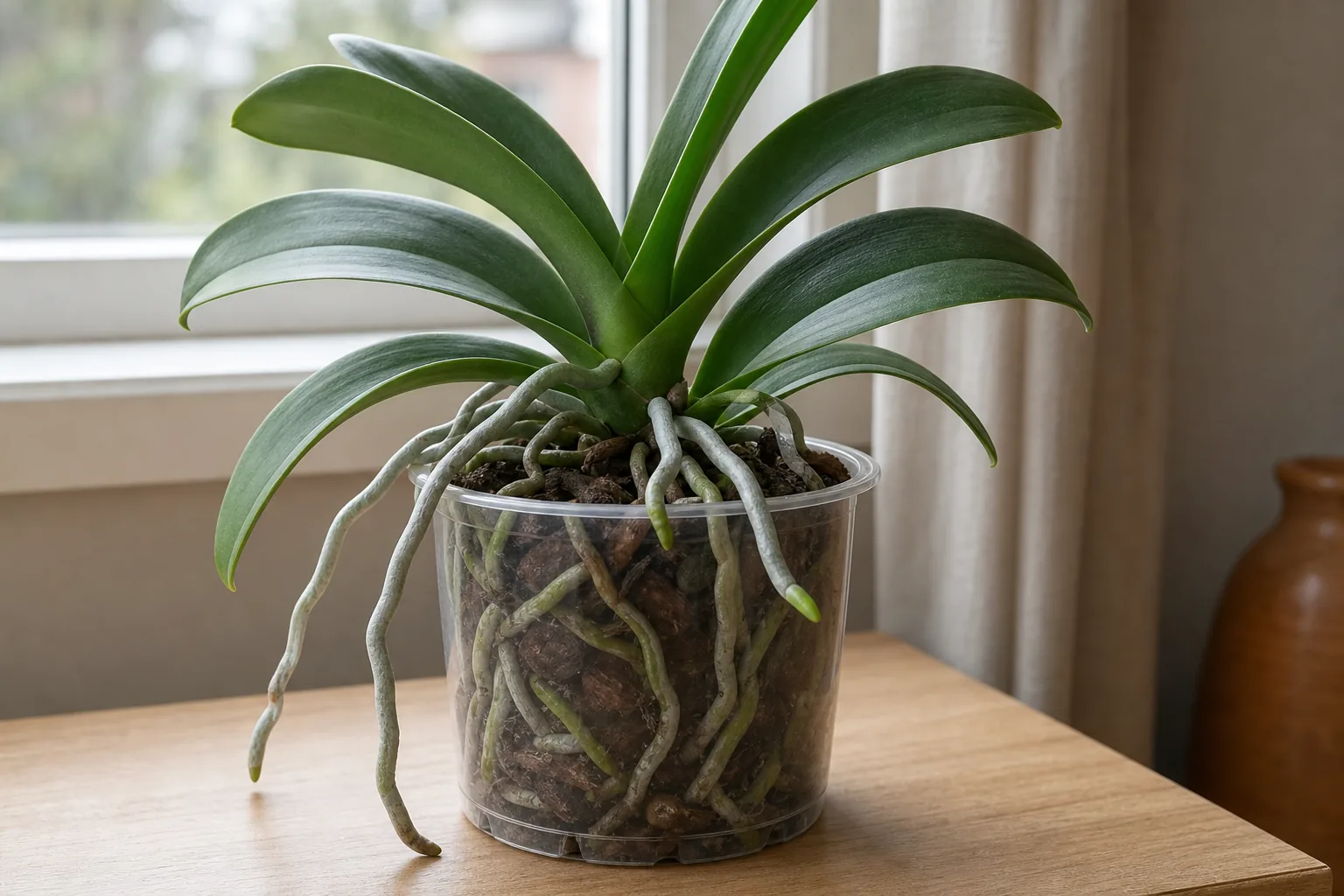
If your Phalaenopsis orchid is sending roots up over the rim of the pot, down the outside of the pot, or wandering off into the air, the short answer is this: that’s normal. Aerial roots are not a sign of disease, not a sign the orchid hates its pot, and not a problem you need to fix. They are a feature of how this plant grows.
Phalaenopsis orchids are epiphytes. In their native range they live on tree branches, anchoring themselves to bark with roots that are exposed to the air instead of buried in soil. Producing roots above the medium is what they do. The right response in an ordinary home is almost always observation, not intervention. The rest of this article is about how to read what you’re seeing so you can feel confident leaving them alone.
What orchid aerial roots actually are
Aerial roots are the same roots a Phalaenopsis would put out in the wild, just growing above the potting medium instead of inside it. They serve two quiet jobs: anchoring the plant to a surface, and absorbing moisture and nutrients from the air around them. They are not a sign that the orchid has run out of room, and they are not a sign that something has gone wrong.
This is also why the usual houseplant instinct, tuck the root back into the pot or trim it off, often backfires. Aerial roots evolved to be in the air. Forcing them into the medium can damage them, and cutting live tissue opens a wound the plant then has to manage. Both the broader Phalaenopsis care routine and the way aerial roots actually function are easier to work with once you accept that their default state is “out and exposed.”
A few things follow from this:
- Mature, healthy Phalaenopsis almost always produce some aerial roots. A plant with several is not stressed; it is being itself.
- Aerial roots and in-pot roots are the same kind of root, just in different environments. They respond to the same overall care.
- The potting medium inside the pot is still where most of the plant’s water uptake happens. Aerial roots are a small, secondary contribution, not the main supply line.
What healthy aerial roots look like
The most useful diagnostic is touch, not color. A healthy aerial root feels firm and slightly springy when you gently squeeze it, the way a fresh green bean feels rather than a dried one. It is plump rather than shriveled, and the surface is smooth or slightly velvety. If you run a finger along it, you should not feel accordion-style ridges or papery patches.
Color is the second clue, and it is more variable than most readers expect. A healthy aerial root can be silvery-white, silvery-grey, pale green, or bright green, sometimes all on the same plant. The shift happens because orchid roots are wrapped in a spongy outer layer called velamen. When velamen is dry, it looks silvery or off-white. When it absorbs moisture, it turns green. Both states are normal. A root that has been silvery for a long time and never greens up at all, even right after watering, is a root to look at more closely, but silver on its own is not a problem.
The growing tip is worth a separate look. An actively growing aerial root has a small green, yellow-green, or reddish point at the very end. That tip is the part of the root that is doing new work. If you can see a firm green tip, the root is functional. If the tip is brown, black, or dry and there is no green tissue anywhere along the length, that root is no longer contributing and can be treated as spent.
A few practical reference points:
- Firm and plump, any shade of silver or green: healthy.
- Firm, plump, with a small green or reddish tip: healthy and actively growing.
- Papery, accordion-pleated, and dry: the root is dehydrated. This is a whole-plant signal, not just a root problem.
- Mushy, brown, black, hollow, or smelly: the root is rotting. Again, this is usually a whole-plant signal about water and air flow, not a single bad root.
When aerial roots are signaling a problem
Aerial roots are most useful as a signal when you read them together with the rest of the plant. A single silver root poking out of the pot is not a diagnosis. A consistent pattern across roots, leaves, and the potting medium is.
Shriveled, papery aerial roots alongside a bone-dry medium, limp leaves, and a pot that feels light when you lift it point toward underwatering or very dry indoor air. The fix is not to mist the shriveled roots. It is to look at your watering rhythm and the medium itself, because the in-pot roots are doing most of the work.
Mushy, brown, hollow, or smelly aerial roots alongside a medium that stays wet for a long time, yellowing lower leaves, and a pot that feels heavy days after watering point toward overwatering or poor drainage. Aerial roots can rot for the same reasons in-pot roots do: the medium holds too much water and not enough air reaches the root. Treating the individual rotted root does not help if the conditions that caused it are still in place.
Long stretches of aerial roots that have died back to dry strings, with no firm green tissue near the base, suggest those particular roots are no longer functional. This is normal over time as the plant reorganizes its root system. It becomes worth attention only if it is happening to most of the roots at once, in which case the broader care picture is the real issue.
The pattern to watch for is consistency. If aerial roots, in-pot roots, and leaves are all telling the same story, that story is real. If only one aerial root looks off and the rest of the plant is fine, that root is probably just at the end of its life.
What to do with aerial roots in a normal home
The default action is also the simplest: leave them alone. Aerial roots are not bothering the plant, and most of the common “fixes” create new problems.
If you want to do something, here are the realistic options in order of how often they make sense.
Leave them alone
This is the right answer for most aerial roots in most homes. They are functional, they are exposed to the air, and the plant is using them as designed. No action is required.
Mist lightly, only if the air is genuinely dry
In a room with very dry winter air from indoor heating, a light mist every now and then can briefly green up the velamen on aerial roots. It is a small, optional boost, not a primary water source, and it does not replace watering the medium. If your indoor air is already on the humid side, misting adds little. Two cautions worth keeping in mind: misting does not substitute for watering, and water that sits in the crown of the plant (the center where the leaves meet) can encourage rot, so a gentle, brief pass is better than a heavy soak.
For a fuller picture of what humidity actually does in an ordinary home, the Houseplant Supplies article on humidity goes into more depth.
Guide them gently, do not force them
If an aerial root is heading somewhere awkward, you can very gently redirect it back over the rim of the pot or along the outside of the pot. Think of it as nudging, not stuffing. The root will often settle into the new position on its own. Forcing an aerial root deep into the medium is a different action and is not a standard recommendation; it can damage a root that evolved to be in the air.
Trim only clearly dead tissue
Cutting live aerial roots is generally discouraged in orchid-care guidance. Live roots are functional tissue, and a clean cut is still an open wound that the plant has to seal. Trimming is reserved for roots that are clearly dead: papery, hollow, dry, and brown all the way through, with no firm green section anywhere.
If you do trim, use clean, sharp tools and cut back to firm tissue. Wipe the blades with rubbing alcohol before and after. Do not treat the cut with cinnamon, hydrogen peroxide, or fungicide as a default; those are situational interventions, not routine ones, and any product should be used according to its label.
Aerial roots and the rest of the orchid
Aerial roots are one signal among several. They are exposed to drier air than in-pot roots, so it is normal for them to look silvery while the in-pot roots look green. What matters is that the overall picture is consistent.
A calm way to read your orchid is to look at four things in order: the leaves (firm and slightly upright, or limp and wrinkled), the medium (dry at the right time, not staying wet for a week), the in-pot roots (visible through a clear nursery pot, mostly green when recently watered and silvery as they dry), and the aerial roots (firm, plump, shifting between silver and green). When three or four of those are telling the same story, you have a real signal. When one is off and the others are fine, it is usually just that one root’s life cycle.
For the full picture of watering by feel and pot weight, the article on reading when a houseplant actually needs water is a useful companion read alongside the broader Phalaenopsis care routine.
When aerial roots relate to repotting (and when they do not)
Aerial roots alone are not a reason to repot. Plenty of mature, healthy Phalaenopsis have a thick mane of aerial roots simply because they are epiphytes producing roots in the way they evolved to. Repotting because of the aerial roots, without any other reason, is one of the more common unnecessary interventions.
Repotting makes sense when there is an observable problem tied to the pot or the medium, not to the aerial roots themselves. Watch for the medium breaking down (compacting into chunks, staying wet too long, smelling sour), a significant loss of in-pot roots when you lift the plant, or the orchid becoming physically unstable in its container. Those are the signals that a new pot and fresh medium will actually help.
If you do end up repotting, the article on when a houseplant actually needs a new pot covers the realistic signals, and the piece on what to do after repotting walks through the days and weeks that follow so you know what normal post-repot behavior looks like.
A short way to think about it
Aerial roots on a Phalaenopsis are not a problem to solve. They are a feature of how the plant grows. Read them by touch first and color second, leave them alone by default, mist lightly only when the air is very dry, and trim only what is clearly dead. If the rest of the plant is healthy, the aerial roots are probably doing exactly what they are supposed to.
Sources
- Chicago Botanic Garden — Test your orchid IQ: how do orchid roots work? chicagobotanic.org
- New York Botanical Garden — How to be a Phalaenopsis pro nybg.org
- American Orchid Society — Orchid roots aos.org
- Peer-reviewed review: The orchid velamen (PMC) pmc.ncbi.nlm.nih.gov
- The Spruce — What orchid roots are trying to tell you thespruce.com