Plant care
Do moisture meters work for houseplants?
· Updated
A short, honest answer
A basic probe-type moisture meter can be a useful extra signal in your watering routine, but it is not a direct measurement of water, and it is easily skewed by the chemistry of your soil. Treat the meter as a prompt to check the plant, not as a verdict on it. When the dial, your finger, the weight of the pot, and the plant itself disagree, the plant is the tiebreaker.
How a basic moisture meter actually works
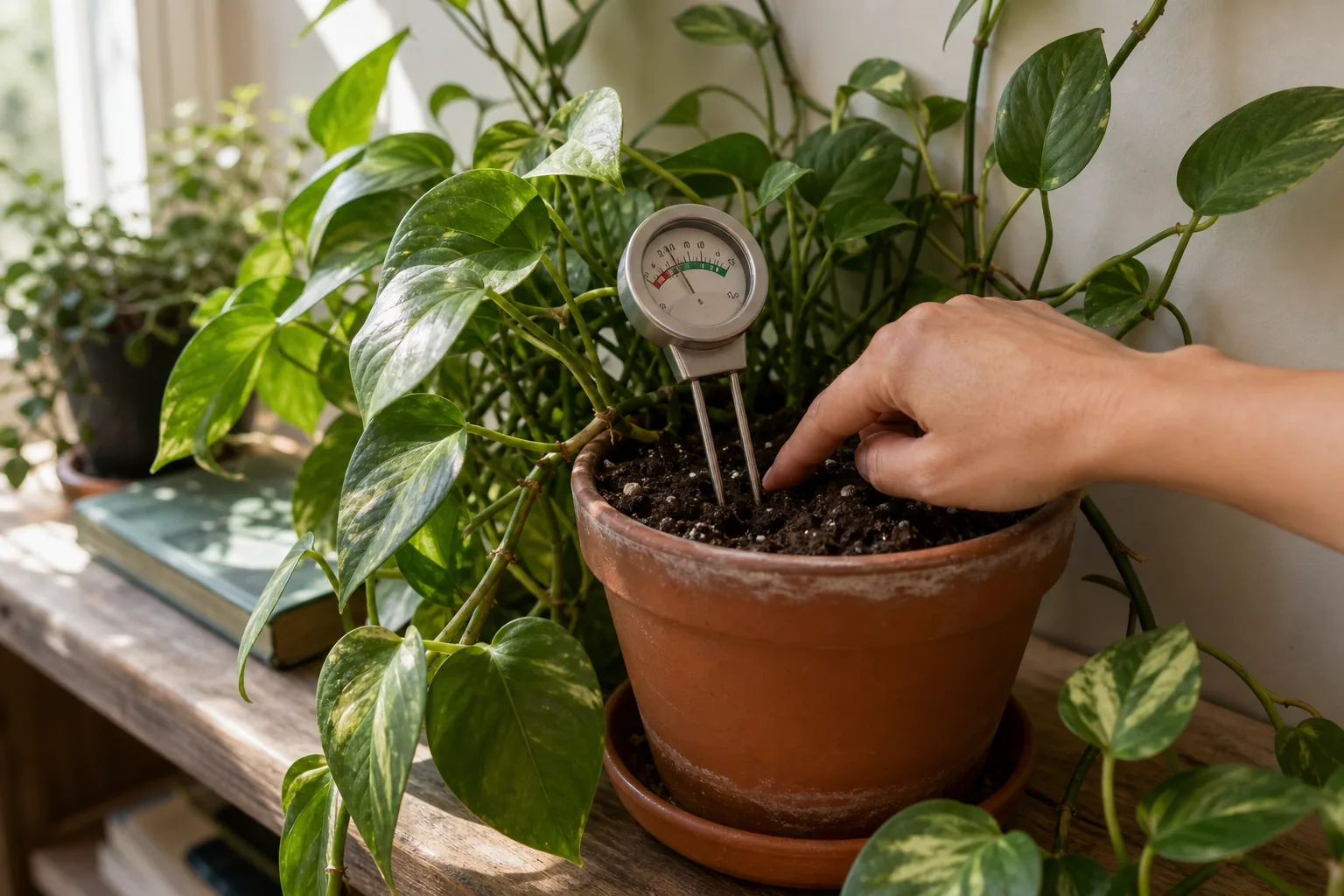
Most moisture meters sold for houseplants are two-probe resistive meters. You insert the two metal probes into the soil, and the meter passes a small electrical current between them. It then infers moisture from how easily that current flows, which is a property called electrical conductivity (and its inverse, electrical resistance).
Wetter soil conducts electricity more easily than drier soil, so the meter translates that conductivity into a relative reading, usually a dial marked 1 to 10 or a wet-to-dry scale. This is the key point: the meter is not measuring water. It is measuring how well electricity moves through a thin slice of soil between the two probes, and water is only one of several things that affect that flow. University extension publications on soil moisture sensors describe the same principle, calling these tools indirect sensors that estimate water content from electrical properties rather than measuring water directly.
Cheaper digital probe meters sold for houseplants use the same conductivity or resistance principle. They tend to give a number on a screen instead of a needle, and they often bundle in a light meter or a pH reading. Research-grade sensors (called capacitance, TDR, or FDR sensors) work differently and are more accurate, but those are not the hand-held meters you find at a garden center for ten or twenty dollars. In everyday houseplant use, switching from an analog dial to a cheap digital probe gives you easier-to-read numbers, not a fundamentally more accurate measurement.
What changes the reading, and why that matters
Because the meter is sensing electricity, anything that affects conductivity in that slice of soil will move the dial. Four variables matter most in practice.
Probe depth and location. The reading only reflects the soil between the two probes, in the spot where you happened to stick them. A probe inserted only at the top centimeter of the pot is reading the part of the soil that dries first and is often dry even when the root zone below is still damp. A probe pushed all the way to the bottom of a deep nursery pot is reading the wettest part of the pot, which will read wet long after the upper roots are ready for water. A practical compromise is to insert the probe roughly one-third to halfway down the pot, slightly off-center and away from the main root ball, and to take more than one reading in different spots.
Soluble salts. One of the most consistent reasons a cheap meter stubbornly reads “wet” while the plant is clearly thirsty and the pot feels light is soluble salt buildup. Soluble salts come from synthetic fertilizer, from mineral deposits in hard tap water, and from sodium in softened water. Dissolved ions carry electrical charge, so they make the thin film of water around soil particles a much better conductor of electricity than it would otherwise be. The meter sees that extra conductivity and reports a wetter reading than the actual water content suggests. If you see a white crust forming on the soil or on the rim of the pot, that is a visible flag that salts have built up, and the meter’s reading is likely to be biased wet until you flush the pot thoroughly. Our guide to recognizing that white crust and what to do about it walks through what buildup looks like and the simplest way to leach it out.
Soil mix composition. Peat- and coco-coir-based mixes hold water relatively uniformly and stay conductive for longer, so the meter can read “wet” past the point where the plant actually needs to dry out. Bark- and perlite-heavy mixes, the kind often used for aroids like philodendrons and monsteras, hold less water overall and dry unevenly. In those mixes the meter reading depends heavily on where the probe lands: it can read “dry” in an air pocket and “wet” in a damp pocket only an inch away. The same dial number means different things in different mixes, and a meter number is not a portable “soil moisture percentage” you can carry from one plant to the next. It helps to understand how a mix is built, and how it holds and releases water, before you trust a meter reading inside it.
Roots. The roots themselves conduct electricity differently than the air gaps in dry soil or the water films around soil particles. A dense, root-bound root mass changes the reading in ways that are hard to predict. If the probes happen to press against a thick root, the reading may shift in either direction depending on the meter. If your plants have been in the same pot for a long time and the meter keeps giving you strange numbers, our guide to signs a plant is overdue for a new pot can help you tell whether the root mass itself is part of what you are seeing.
Where a meter can genuinely help your routine
A probe meter is at its most useful in a few specific situations. It adds a useful data point when you are working with deep nursery pots where the root zone is far below where a finger can reach, and with large floor plants whose soil surface dries out faster than the root ball underneath, so a surface check gives a false alarm. It is helpful for beginners who are still learning each plant’s rhythm and want a second signal alongside touch and weight. And it is helpful across a varied collection where you are juggling many pots and want a quick check on which ones are clearly wet versus clearly dry.
In each of these, the meter is best used to track a trend on a single plant over time: how the dial moves after you water, how long it takes to fall back toward “dry,” and how that pattern shifts with the seasons and with new growth. That trend is more useful than the absolute number on any given day.
Where a meter is likely to mislead you
A moisture meter is more likely to mislead you when there is heavy salt or fertilizer buildup, especially if you see a white crust on the soil or pot rim; the reading will tend to be biased wet. It is more likely to mislead you in a very small pot, where the probes either hit the side wall or sit against a dense root ball and the reading reflects that small geometry rather than the whole pot. It is more likely to mislead you in a very coarse mix with lots of bark or perlite, where the meter can swing quickly between wet and dry depending on where it lands. It is more likely to mislead you in a freshly repotted plant sitting in dry mix that has not been thoroughly watered, or in hydrophobic peat that has pulled away from the probes. And it is more likely to mislead you when you treat the dial as the answer. Any time the meter, the finger test, and the plant all disagree, the meter is the one to question.
A simple three-step way to verify any meter reading
Use this routine whenever the meter says something that surprises you, or once a month on plants you want to double-check. The full loop, with the meter folded into it rather than driving it, is described in our observation-first guide to knowing when to water.
Step 1: insert the probe at the right depth. About one-third to halfway down the pot, slightly off-center and away from the main root ball. Take two or three readings in different spots. If the meter sits in an air pocket or against the side of the pot, the reading is meaningless.
Step 2: cross-check with touch and weight. Push a finger or a clean wooden chopstick into the soil at the same depth as the probe. If the soil at that depth feels damp and the pot feels heavy for its size, the meter reading is probably reasonable. If the soil feels dry and the pot feels light but the meter says “wet,” suspect salt buildup, an air pocket, or a probe sitting against the side of the pot.
Step 3: look at the plant. Turgor, leaf color, recent growth, and the weight of the whole plant are the final cross-check. If the meter says “dry” and the plant is firm and perky, the plant wins. If the meter says “wet” and the plant is wilting in wet soil, the plant wins again, and you are probably looking at a different problem, like a root issue or hydrophobic soil that has stopped absorbing water. Our guide to what to do when a houseplant wilts in wet soil walks through that case in detail, and the calm inspection order for over- vs underwatered plants is a useful next read whenever the meter, the touch test, and the plant are all telling you different things.
Caring for the meter, and when to retire it
Wipe the probes clean between plants. Do not leave the probes inserted in the soil between readings; the metal will corrode faster and the reading will drift. Do not force the probes through dense or root-bound soil; that bends them and changes how they sit in future readings.
When the probes show visible corrosion, the dial needle sticks, or the readings start to feel inconsistent with what you see in the pot, it is time to replace the meter rather than try to recalibrate it. Basic probe meters are not precision instruments, and the cost of a new one is small compared to the cost of repeatedly misreading a plant.
A moisture meter is a small, cheap tool that can give you one more data point in the loop you already use: touch, weight, and the plant itself. Used that way, it earns its place on the shelf.
Sources
- University of Minnesota Extension, Soil moisture sensors for irrigation scheduling
- University of Wyoming Extension, Methods and techniques for soil moisture monitoring (B-1331)
- UMass Extension Greenhouse Crops and Floriculture, Soluble salts and electrical conductivity (EC) for greenhouse crops
- University of Florida IFAS, Soil and container media electrical conductivity interpretations (SS117)
- California Agriculture journal (Hanson et al.), Soil type affects accuracy of dielectric moisture sensors