Plant care
Can houseplants grow under office lights?
· Updated
Yes - most common houseplants can survive for months or even years under typical office lighting alone, especially the foliage species that university extension publications repeatedly name as low-light tolerant. Whether a specific plant actually puts on visible new growth depends on three separate variables rather than on the label “office lighting”: how intense the overhead fixture is, how many hours a day the lights stay on, and how close the plant sits to the bulb.
That is the honest starting point, and the rest of this article is a way to estimate those three numbers in your specific space, then choose species and placements that match what your office actually delivers.
What counts as office lighting, and why the label hides real differences
“Office lighting” describes a category, not a single thing. A newer office with bright overhead LED panels that run ten hours a day is a very different environment from a darker older office with aging T8 fluorescent tubes that only switch on when someone walks past. Both qualify as office lighting in casual conversation, but they sit at opposite ends of the practical range for a houseplant.
The illumination levels set for office work are driven by what humans need to read and use screens, not what plants need for photosynthesis. Industry summaries of office lighting standards put general task areas in the rough range of 20 to 30 foot-candles (around 200 to 300 lux), with reading and detail zones climbing to 30 to 50 foot-candles (around 300 to 500 lux). Those numbers are reasonable for human comfort on paper, and they are also much lower than the brightness a plant receives a few inches from a sunny windowsill. So “bright to my eyes” is not the same measurement as “enough for a plant,” and that gap is where most office-plant confusion lives.
The three variables that decide if a plant grows under office lights
A useful way to think about any office light scenario is as a small equation: intensity times hours per day times proximity. If any one of those is small, the total usable light the plant receives is small, even when the other two seem generous.
Intensity is what most people mean when they say an office looks bright. A new LED panel and an old magnetic-ballast fluorescent with yellowed tubes can look similar to human eyes while delivering meaningfully different amounts of light in the wavelengths plants use. Fixture type matters more than the room name.
Hours per day is the easiest variable to underestimate. In a conventional occupied office, overhead lights run roughly eight to twelve hours on a workday. In motion-sensor or zone-controlled offices, fixtures only come on when someone is in the space, and a frequently empty desk may receive a fraction of those hours. Field studies reviewed by the U.S. Department of Energy estimate that sensor-controlled offices save roughly twenty to thirty percent on lighting energy compared with always-on schedules, and for a plant that translates into noticeably fewer minutes of usable light each week.
Distance is the variable that is hardest to see from across the room. Light intensity drops off sharply with distance from the fixture. The exact pattern depends on whether the fixture is a point source, a panel, or a row of tubes, but the practical observation is the same: a plant directly under a ceiling panel sees a lot more light than the same species on the same desk a few feet to the side, and a floor plant several feet below the fixture sees much less than a hanging plant inches below it. Extension research on seedlings found that for active seedling-grade growth, plants often needed to sit only a few inches from the source - an extreme case that illustrates just how steep distance falloff really is, even for a mature houseplant sitting farther below an office fixture.
How to judge your own office without a meter
A few plain observations can give a working estimate of all three variables at once.
Hold your hand flat a foot or two below the overhead fixture and look at the shadow it casts on the desk. A sharp, well-defined shadow suggests the fixture is delivering reasonably bright output at that spot. A faint, soft, or barely visible shadow means the useful light at that distance is modest, even if the fixture looks bright from across the room.
Note how long the lights actually stay on during a typical day and on weekends. An always-on office that runs the lights twelve hours a day is a different scenario from a sensor-controlled office where the desk is dark half the evening and all weekend.
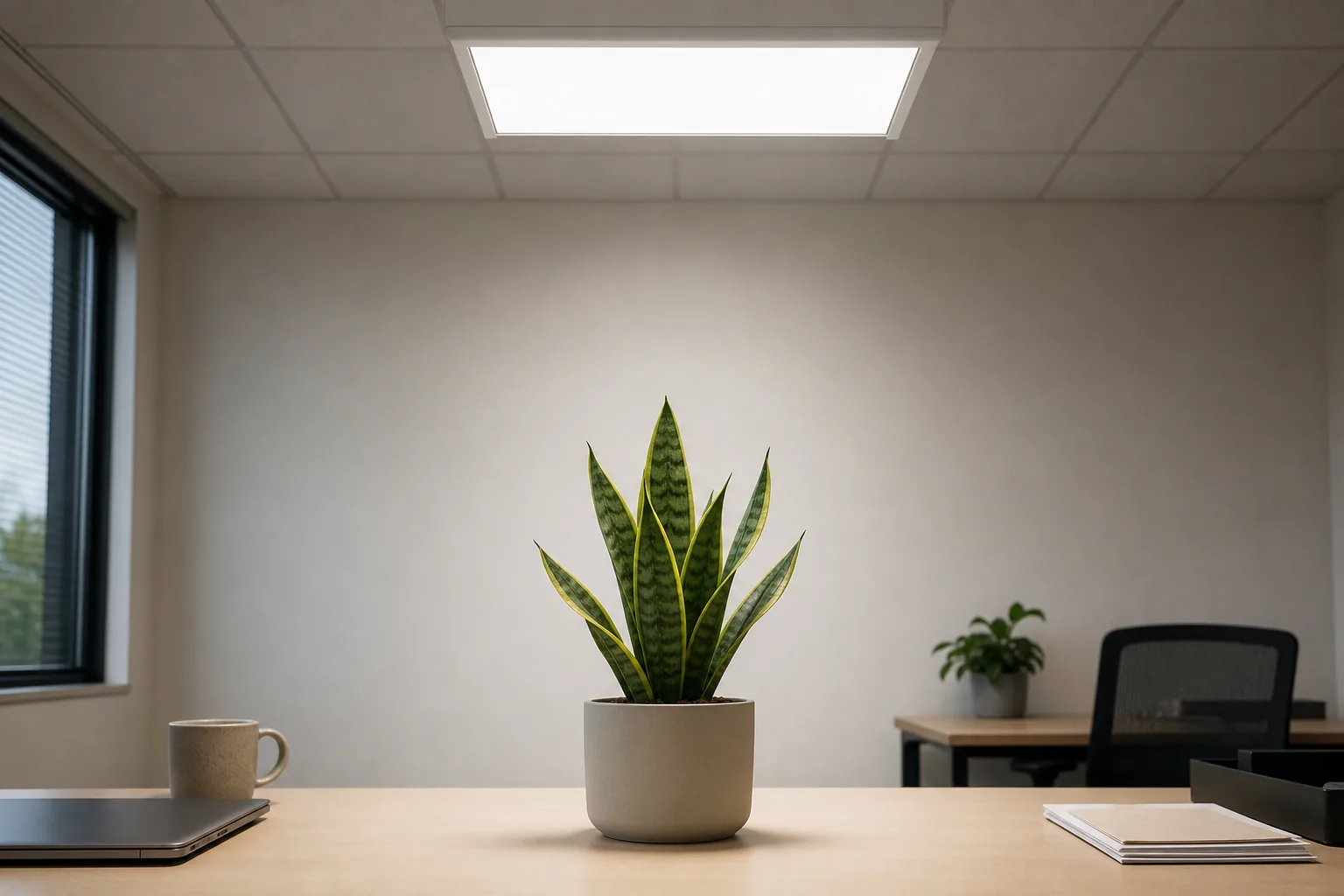
Look at where the plant would actually sit in relation to the fixture. A small plant centered on the desk directly below an overhead panel is the best case in that office. A floor plant tucked into a far corner is the worst case, because distance falloff compounds with whatever the fixture delivers.
If there is a window anywhere in the office, use it as a reference. You can already use a familiar window spot to judge your room, and an office light can be compared to that same baseline rather than treated as a separate world.
Where the light actually falls: overhead fixtures, desk lamps, and the spaces between
Most of the plant-relevant light in an office comes from the ceiling fixtures, not from desk lamps. A typical desk lamp is positioned to illuminate paper or a keyboard, sits at an angle, and is rarely close enough to the plant to act as its main light source for long. It can help, but it is not the place to plan around.
Overhead panels and tubes, by contrast, can deliver a meaningful slice of usable light if the plant sits directly below them. Modern LED panels usually run cooler than older fluorescent tubes, which lets a small plant sit a few inches closer without scorching. An older fluorescent tube still deserves a few inches of clearance, and any bulb that is hot to the touch is too close for foliage pressed against it.
The practical implication is geometry. Within a foot or two under the fixture, light is reasonably strong. Three to four feet to the side of a panel, or several feet below it on the floor, light is meaningfully weaker. Two plants in the same office can live in genuinely different light environments for that reason alone.
Office lights compared to a sunny window, in terms the reader can picture
A bright indirect east-facing window a few feet from a plant will, in most offices and most windows, deliver more usable light in a single morning than the same plant receives under an office panel all day. Even a north-facing window typically gives a steady, if low, dose of usable light across the working hours. Offices rarely match that for plants, because most office fixtures are tuned for the human eye rather than for the photosynthesis curve.
The newer the office’s LED retrofit, the closer the ceiling fixture gets to being a reasonable environment for foliage plants, especially species already adapted to low light. Older fluorescent installations, particularly aging T8 or T12 tubes with visible yellowing, are usually a step further from a window in plant-relevant terms. They can still support a tolerant plant for a long time. They just are not equivalent to a window, and treating them as if they were is how mismatched species end up under office lights in the first place.
Houseplants that genuinely grow under office lighting as their only source
The species to reach for in an office-only setting are the foliage plants that university extension publications consistently describe as tolerant of low to medium indoor light. Across several extension sources, including the University of Minnesota, University of Missouri, West Virginia University, and Maryland extension lists, the repeatedly named species are snake plant, pothos, philodendron, ZZ plant, peace lily, cast iron plant, spider plant, and Chinese evergreen.
These plants can persist for months or years under office lighting alone. Growth is typically slower than it would be near a window, and the gardener should expect that. New leaves may emerge a touch smaller than they did when the plant arrived, and the soil may stay wet for longer because the plant is using less water. That is normal office-light behavior for a tolerant plant, not a sign of failure.
Species that need more light, such as monstera, rubber plant, and ferns, are reasonable only in the brighter corners of an office, particularly newer LED offices with several hours of consistent illumination, and even then their growth will usually be slower than it would be in a window. A pothos or philodendron is a more honest match for an average office than a young monstera, and choosing the more tolerant species up front is much easier than nursing a brighter-light plant through an unsuitable space.
Worth noting that tolerant is not the same as indestructible. A snake plant in a windowless corner that never sees the overhead fixture directly will still struggle over months, and the framing of low-light tolerance often hides how much placement under the fixture actually matters. For a closer look at what “low light tolerance” means in real rooms rather than in marketing copy, the snake plant is a useful example to walk through.
Plants that survive under office lights but should not be asked to grow much
Plants grown for their flowers or fruit are a different case. Most flowering houseplants do not bloom reliably under typical office lighting alone. Industry interiorscape sources describe the bright indirect light from a window as what most flowering houseplants need to set buds, and they treat bromeliads and peace lilies as partial exceptions in office fluorescent environments. In practice, a commonly sold flowering houseplant such as an African violet, begonia, or hibiscus, or a fruiting plant such as dwarf citrus, will often stay alive and produce leaves on an office desk for a while, but it should not be expected to flower or set fruit on a reliable schedule there. Setting that expectation early avoids the disappointment of a perfectly green plant that simply never blooms.
Variegated foliage is a quieter version of the same problem. Snake plants and pothos with strong variegation often lose some of their patterning under office-only light and may push out greener, less striped new growth when light is on the edge of enough. That is one of the easier on-the-plant signals that office light is borderline for the plant, and it shows up before the plant looks obviously unhappy.
The honest survive-versus-thrive expectation
Most office-plant disappointment comes from the gap between these two words. Survive means the plant holds its foliage, drinks a reasonable amount of water, and looks roughly the same month to month. Thrive means visible new growth, fuller shape, strong variegation, and for some species, occasional flowers or offsets.
In a typical office, especially one with consistent overhead hours and a reasonably bright fixture, a tolerant foliage plant will survive and may even put on a little slow growth. In a dim, motion-sensor-controlled space, the realistic expectation is survival with very little new growth, and the wisest move is to pick species that genuinely tolerate that, rather than hoping a brighter-light plant will struggle through it. It is worth being honest about what slow-growing, dim-tolerant houseplants actually do in that second scenario, because the answer is usually quieter than the marketing suggests: longer gaps between new leaves, a plant that holds its shape without visibly declining, and very little fanfare.
What to adjust when the light is on the edge
If the office is borderline rather than clearly bad, four adjustments usually cover most of what can be changed without rebuilding the lighting.
Move the plant directly under the fixture. Sharp falloff with distance means that even a few feet of closer placement can change the picture. Small desktop plants benefit most from this, because they can sit almost directly below the panel.
Swap the species before swapping the light. If the office is dim, a snake plant or ZZ will hold its shape much longer than a pothos, and a pothos will hold its shape much longer than a monstera. Choosing the more tolerant species is a smaller decision than adding new equipment, and it stays useful even if the office changes.
Slow the watering rhythm. A plant that is using less energy uses less water. The first sign that office light is genuinely limiting is often a pot that stays damp for a week or more, not a plant that is wilting. Watering on the same schedule used near a window can quietly rot the roots in a dim office.
Watch for leggy growth over the next several weeks. New leaves emerging on longer, thinner stems than the older growth is the classic on-the-plant sign that office light is not quite enough, and it usually appears over weeks to a couple of months. That stretched, reaching look means the plant is asking for either more light or a less demanding spot, and it is a clear signal worth acting on rather than waiting out.
When the signs say the office really is too dim
Even tolerant plants have a floor. Slowed or absent new growth, smaller new leaves than the plant had when it arrived, lower leaves yellowing or dropping while the upper leaves stay green, and a tendency for the soil to dry very slowly are the recurring signals that the office is at the dim end of the plant’s comfort zone.
In that case, the practical responses are to move the plant to a brighter spot in the office if one exists, to swap in a more tolerant species that matches the space, or to add a small dedicated grow light for the desk or shelf where the plant sits. A grow light is not a magic fix. It is a way to give the plant the wavelengths and intensity that the overhead fixture was never designed to deliver, and it lets a tolerant plant actually use its low-light tolerances rather than merely survive them.
There is no urgency in any of these decisions. A houseplant that is holding its foliage under office-only light is not in crisis. It is living within the limits of the space, and reading the office first is how a reader chooses a plant and a placement that fit those limits from the start, rather than watching a brighter-light plant slowly decline because the lighting never matched what it actually needed.
Sources
- University of Minnesota Extension — Lighting for indoor plants and starting seeds: https://extension.umn.edu/planting-and-growing-guides/lighting-indoor-plants
- University of Missouri Extension — Lighting Indoor Houseplants (G6515): https://extension.missouri.edu/publications/g6515
- West Virginia University Extension — Common Houseplant Care: https://extension.wvu.edu/lawn-gardening-pests/indoor-plants/common-houseplant-care
- Maryland Grows (University of Maryland Extension) — Houseplants for Low Light Conditions: https://marylandgrows.umd.edu/2017/10/25/houseplants-for-low-light-conditions/
- University of Florida / IFAS Gardening Solutions — Light for Houseplants: https://gardeningsolutions.ifas.ufl.edu/plants/houseplants/light-for-houseplants/
- Vegetable Crops Hotline (Purdue / Indiana) — How distance from light fixtures influences light level: https://vegcropshotline.org/article/how-distance-from-light-fixtures-influences-light-level-for-seedlings/
- Planterra — 8 Best Office Plants for Fluorescent Lighting: https://planterra.com/blogposts/the-best-plants-for-offices-with-florescent-lighting/