Plant care
Holes in houseplant leaves
· Updated
Holes on houseplant leaves: the short answer for indoor plants
Most holes on indoor houseplant leaves are not caused by pests. They are usually mechanical (a tear from shipping, brushing against a window, a pet or person bumping the leaf) or part of normal development (Monstera deliciosa fenestrations and the tears that happen as a new leaf unfurls). Chewing pests do occur indoors but are uncommon for typical indoor-only plants, and most of the routine indoor pests that show up on houseplant leaves do not eat clean holes through the tissue at all. The right next step depends on what the rest of the plant and the room are telling you, not on the hole alone.
This article walks through how to describe a hole, then through the three cause categories, then through an inspection order you can use any time a leaf looks wrong.
What kind of hole is it? Edge tears, interior holes, and fenestrations
Before deciding what caused a hole, it helps to describe what you actually see. A few descriptors carry most of the diagnostic weight:
- Location: edge of the leaf, somewhere in the interior of the blade, or at the tip.
- Symmetry: a single opening roughly between two veins, or an irregular patch on one side.
- Edges: clean and dry, brown and callused, or ragged and greenish-moist.
- Pattern: one hole on one leaf, or several holes on several leaves.
None of these descriptors by themselves prove a cause. Together they narrow the next question, which is whether the cause is mechanical (something that touched the leaf), developmental (the leaf grew that way), or biological (something is feeding on the plant).
Mechanical damage: one of the most common causes indoors
Mechanical damage is one of the most common causes of holes on an indoor houseplant leaf, and the simplest to confirm or rule out by looking at the room. It covers tears from shipping, a leaf getting caught in a closing door, a shelf edge or window latch scraping the blade, a child or pet batting at the plant, or a recent move or repotting where a leaf was bent or pinched.
Mechanical wounds usually look like this:
- A single tear or hole, often on a leaf that has had contact with something recently.
- Brown, dry, sometimes papery edges — a useful observation rule of thumb is that the wound has callused over.
- No other signs on the rest of the plant.
- Often on a leaf that is older, more exposed, or near a traffic path in the room.
If this matches what you see, the plant is most likely fine. Old tears do not heal, but a callused edge means the wound is closed and the leaf is still functional. The read of the room matters as much as the read of the leaf: did the plant just come home in a sleeve, sit in a moving box, or get slid past a bookshelf edge?
If the plant was just bought, look at the leaves before you do anything else. Pre-existing tears are common on retail plants in our experience, with that framing being general horticulture observation rather than a specific extension citation. If you can see tears at the store you can pick a cleaner specimen — our pre-purchase inspection guide walks through what to look at.
Pests that can chew holes on indoor houseplants
Chewing pests that produce actual holes through a leaf are uncommon indoors, and the most commonly listed indoor houseplant pests — aphids, mealybugs, scales, thrips, spider mites, and whiteflies — generally do not eat clean holes at all. Across university extension services, these pests are described as sap-feeders, and the damage they produce usually looks like stippling, scarring, distortion, or sticky residue rather than missing tissue.
University of Alaska Fairbanks Cooperative Extension describes caterpillars, leafhoppers, beetles, and leaf miners as “occasionally encountered” indoors — possible, but not routine. Clemson HGIC notes that these chewing pests and root-ball pests like pillbugs, millipedes, and slugs most often arrive indoors on houseplants that spent the summer outside. So the highest-risk window for chewing damage on an indoor plant is during or just after an outdoor-to-indoor move.
If chewing damage is happening, you can usually expect other signs alongside the holes:
- Fresh, ragged, greenish or moist edges at the wound — a useful observation rule of thumb that the damage is recent rather than callused.
- Dark specks or small pellets (frass) on the leaf below the damage.
- Visible insects themselves — a caterpillar tucked against a stem, beetles on the lower leaves, or a slow-moving larva on the underside.
- Multiple leaves affected, sometimes across more than one plant in the room.
A few pests that readers often lump in with “holes” actually produce different symptoms, and it helps to keep those symptom classes separate:
- Spider mites cause fine pale stippling and sometimes webbing, not holes. Our spider mite guide walks through what that looks like in more detail.
- Thrips cause silvery scarring and small black specks of frass.
- Leaf miners feed between the upper and lower surfaces of the leaf and leave serpentine trails or blotchy mines, not open holes.
- Fungus gnats are a soil and moisture issue, not a leaf-feeding insect.
If what you see is stippling, scarring, webbing, or wandering trails inside the leaf, this is not the right starting point. For pest identification it can help to compare what you are seeing against our mealybug guide or your local extension office rather than guessing from a single leaf.
Normal leaf development: fenestrations and unfurling tears
Two development-related causes produce holes or splits that have nothing to do with damage, and they are the easiest to misread as pest damage.
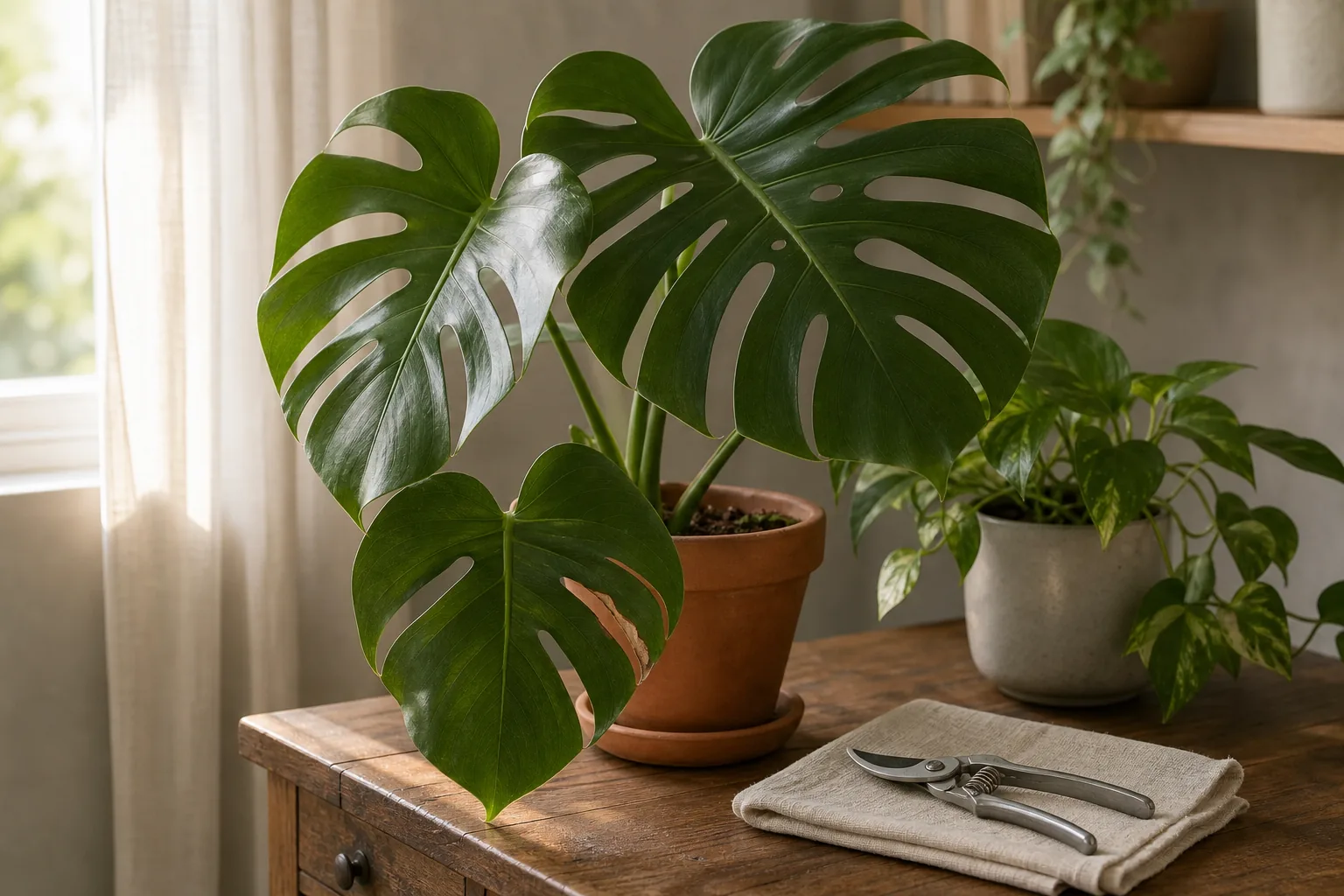
Fenestrations on a maturing Monstera deliciosa. As the plant matures, new leaves typically begin to show internal slits between the veins, and later the leaf margins themselves cut inward. The openings are usually symmetric, sit between the veins, and line up with the architecture of the rest of the leaf. Timing varies widely with cultivar and growing conditions, so there is no fixed leaf number or year at which fenestrations appear — what you can rely on is the pattern. If the holes respect the veins and the rest of the leaf, they are very likely fenestrations. Our Monstera care guide covers this in more detail.
Tears from unfurling. New leaves emerge tightly rolled inside a protective sheath, the cataphyll. If the new leaf catches on the sheath, on the petiole of an older leaf, or on the edge of the pot while it is unfurling, it can tear. Low indoor humidity is one documented contributing factor, with extension entries linking dry indoor air to puckering and tear-prone new leaves on tropicals. These tears typically run along one side of a new leaf and may be paired with a stuck sheath. They are mechanical in origin, but they are not the same as a leaf that tore from a knock against the wall, and they are not chewing damage.
A calm inspection order: leaf, plant, room, neighbors
When a hole looks unfamiliar, the same observation-first triage order that works for spots and other leaf symptoms works here too. Look, describe, then decide. For a parallel example with a different symptom class, our spots triage guide walks through the same leaf, plant, room, neighbors habit.
Start with the leaf. Where is the hole, what are the edges like, is the damage old or new. A single old tear with brown dry edges is mechanical until you have evidence otherwise.
Then look at the rest of the plant. Are other leaves affected. Are there stippled leaves, sticky residue, cottony tufts, webbing, small flies around the soil, or visible insects on the undersides of leaves or along the stems. The presence or absence of these signs moves the case toward or away from pests.
Then look at the room. Did the plant just arrive, just get moved, just get repotted, or just come back in from outdoors. Are pets, kids, or heavy curtains in contact with the leaves. Is a window or door catching the leaf when it is opened or closed. Has a humidifier been off for a while during a dry heating season. Several of these changes often show up at once, and our guide on leaf drop after a move covers how a recent change tends to produce multiple leaf symptoms together.
Then look at the neighbors. If only one plant out of a collection shows holes, the cause is more likely local to that plant — one past contact, or a pest that arrived on that plant. If several plants show new holes, broaden the search to recent changes in the room or to pests that may have arrived together.
What to do based on what you see
The next step depends on which category the leaf and the room fall into, and the goal is to avoid acting before you have read the plant.
Old mechanical damage. If the wound is callused, the rest of the plant looks healthy, and there is no recent change to investigate, do nothing to the leaf. The plant is fine, and the leaf is still doing its job. You can trim a torn section for tidiness, but leave the green tissue in place. If the leaf is heavily torn and mostly brown, you can remove it at the petiole, but there is no rush.
Unfurling tears or fenestrations. Same answer — leave the plant alone. For unfurling tears during dry seasons, gently loosening a stuck cataphyll with clean, slightly moist fingers is generally safe and may help a new leaf unfurl cleanly next time; running a humidifier near the plant for a few weeks may also reduce recurring tears. These are general horticultural practices rather than treatments drawn from a specific extension publication.
Possible chewing-pest signs. If you find fresh ragged holes plus frass plus visible insects on more than one leaf, isolate the plant away from your other plants and watch it for a week before deciding on next steps. New arrivals with holes deserve isolation regardless, and our guide on how to inspect and isolate a new houseplant walks through that workflow. If you see chewing damage and a creature you can identify, our mealybug guide can help you compare what you are looking at against cottony or fluffy-looking pests, which can sometimes be confused with chewing damage at a glance.
Mixed or unclear symptoms. If the leaf shows mixed signs (brown edges plus fine stippling, or one chewed leaf plus sticky residue on another), the safest path is to stop, take a clear photo, and ask a local source.
When to ask a local nursery or extension office
This article cannot tell from a photo or a description exactly what is happening on your plant — that is a job for you, your eyes, and ideally a local expert who can see the plant. Reach out when:
- You see damage on more than one plant in the room and you cannot identify the cause.
- You see chewing damage plus visible insects and you are not sure which insect it is.
- The plant is declining quickly — new damage plus leaf drop plus a generally wilted look.
- You are not sure whether a leaf feature is normal development (especially on a Monstera or similar species) or damage.
A local independent nursery, a county or state cooperative extension office, or a university plant clinic are the right next stops. Bringing a fresh sample of an affected leaf in a sealed bag can speed up identification. As a rule of thumb across the cited extension sources, indoor houseplant problems tend to be environmental or care-related before they are pest-related — so if you cannot find a pest, look at the room before reaching for a treatment. For readers with cats, dogs, or curious children, mechanical damage from pets and people is one of the more common non-pest causes, and our pet-aware houseplant choices post covers how to think about that branch of the problem.
Sources
- UC IPM — Houseplant problems: https://ipm.ucanr.edu/home-and-landscape/houseplant-problems/
- Colorado State University — Houseplant pests: https://agsci.colostate.edu/agbio/ipm-pests/houseplant-pests/
- University of Alaska Fairbanks Cooperative Extension — Houseplant pests and control: https://www.uaf.edu/ces/publications/database/insects-pests/houseplant-pests.php
- Clemson HGIC — Common houseplant insects and related pests: https://hgic.clemson.edu/factsheet/common-houseplant-insects-related-pests/
- Ask Extension — What is causing my houseplant to have holes in the leaves: https://ask.extension.org/kb/faq.php?id=273760