Plant care
Air conditioning and houseplants: how to read the room before you move anything
· Updated
Air conditioning is not automatically bad for houseplants. Most tropical foliage plants tolerate a cooled room just fine, as long as they are not sitting in the direct path of cold air from a vent or window unit, and as long as the room does not become extremely dry while the AC runs. The plant problems that show up in summer usually come down to one of three things: a cold draft blowing onto the same plant for hours, a room that has gotten meaningfully drier than it was, or a watering rhythm that no longer matches how fast the soil is actually drying. The right response is to look at the actual room and the actual plant in front of you, then make small placement and watering adjustments. There is no single safe minimum temperature for “houseplants,” because tolerance varies by species, by how long the cold exposure lasts, and by what the rest of the room is doing. This pairs naturally with the same-season adjustments in our summer houseplant care guide, since stronger sun and faster dry-down often arrive at the same time the AC does.
If you are trying to figure out whether the AC is the reason a specific plant is sulking, this article walks through the three mechanisms, the on-plant signals that point to each one, and a small set of placement and watering adjustments that fit a normal apartment or home.
What air conditioning actually does to the air in a room
A refrigerant-based air conditioner cools air by passing it over a cold evaporator coil. As a side effect of that cooling, water vapor from the room condenses on the cold coil and drains out of the unit. The air that comes back into the room is therefore cooler and drier than it was before.
In a sealed, well-cooled room that has been running for several hours, indoor relative humidity often settles noticeably lower than the reader might assume. As a rough, room-specific reference rather than a universal rule, that working range frequently lands somewhere around 30 to 45 percent, well below the roughly 50 to 60 percent range that many tropical foliage plants tend to prefer in their native understories. The actual number depends on outdoor humidity, room size, how often the doors and windows are open, and how long the unit runs. The point is not the number. The point is that the room you cooled is also a drier room, and the soil in that room will behave differently than it did before the AC turned on.
How an AC unit is different from a window or a supply vent
The same ideas of drafts and supply registers covered in our guide to drafts, vents, and sun-heated glass apply here, but air conditioning adds a layer. Cooling is happening at a single point, and cold air is being pushed out of that point into the room. The geometry of that cold plume depends on the kind of AC you have.
A window unit or a portable unit typically blows a narrow, concentrated stream of cold air in one direction. The air is noticeably colder than the rest of the room, and a single shelf of plants can sit directly in its path. A mini-split head blows air along the wall or ceiling and is usually easy to redirect, so the cold plume is more spread out and easier to aim away from a plant. A central supply register discharges air only a few degrees below the room setpoint and spreads it across a wider area, so the cold path is less intense, but if a register on one wall points straight across the room at a plant on the opposite wall, that plant is sitting in a continuous cool current.
The fix depends on which type you have, which is why “just move it away from the vent” is less useful than it sounds.
The three ways an AC can affect a houseplant
Cold draft from the discharge
When a plant sits in the path of the cold plume for many hours, the leaves on that side of the plant can be several degrees cooler than the rest of the room. Cold leaves are thought to move water less efficiently, and the cells in those leaves are exposed to a sustained temperature difference the rest of the plant is not. The result is usually one-sided damage. Leaves facing the vent curl, droop suddenly, or develop dark or water-soaked patches. Sometimes the plant drops leaves on the cold side first, while the leaves on the sheltered side still look fine.
Lower humidity in the room
A drier room pulls moisture out of leaves faster than a humid room does, and out of the soil surface faster too. The plant has to keep up with that loss through its roots, and tropical foliage plants that evolved in stable, humid understories are not built for it. The signals here are different from the draft signals. They are usually gradual, bilateral on both sides of the plant rather than one, and they build over weeks. New growth may come in thinner than older growth, leaf edges turn brown a little at a time, and the top of the soil dries out much faster than it used to.
A watering rhythm that no longer fits
A plant in the cold-air path can hold wet soil for longer than the rest of the room, because cold roots take up water more slowly. A plant in the dry-air part of the same room can dry out faster than it did in spring. The watering schedule that worked in April may not fit August at all. This is the part that is easiest to miss, because the symptom, like yellowing lower leaves with soggy soil in one pot and wilting with bone-dry soil in the next, looks like a watering mistake rather than an AC effect.
On-plant signals that point toward AC stress
The patterns overlap, but a rough diagnostic order helps. Look at which leaves are affected and how the damage showed up. If the brown edges and tips you are seeing could come from the AC, the draft, the watering, or a build-up of minerals in the soil, our guide to brown tips and crispy edges walks through a calm diagnostic order that puts AC stress in context rather than treating it as the only possible cause. For the deeper question of how dry a room actually is, the framing in our article on humidity in real homes is also useful.
Cold-draft signals tend to be one-sided and acute. Curling, sudden droop, or dark patches on the leaves facing the vent, leaf drop within a few days of turning the AC on, damage concentrated on one side of the plant, and a plant that looks fine except for the leaves in the cold plume all point to a draft rather than to a whole-room issue.
Low-humidity signals tend to be gradual and bilateral. Brown edges and tips that progress over weeks, both sides of the plant affected rather than just one, thinner and smaller new growth than older leaves, and a top of the soil that dries out much faster than it used to all suggest the room is drier than the plant prefers.
Watering-rhythm signals look different again. Yellowing lower leaves and soft stems with soil that is still damp a week after watering, or wilting with bone-dry soil in a plant that was on a normal schedule a few weeks ago, suggest that the rhythm needs to be reset rather than the room being fixed. A mix of those two across different plants in the same room is a strong hint that the AC changed the conditions more than the routine caught up with.
Where to put a houseplant when the AC is running
A few practical placement moves cover most of the problems without touching the equipment. Remember that moving a plant can also change the light it receives, so it helps to glance at our guide to reading natural light in a room before settling on a new spot.
Move the plant a few feet out of the direct discharge path. With a window unit, a couple of feet sideways is often enough. With a central register, the question is whether the register is aimed straight at the plant across the room, in which case rotating the register or shifting the plant one seat over can break the line of cold air.
Put a tall piece of furniture, a bookshelf, or a room divider between the unit and the plant. This softens the cold plume without blocking the vent.
Group plants together. A cluster of plants holds a small pocket of more humid air around their leaves, which buffers them against the drier room.
Rotate the plant a quarter turn every week or so, so the same face is not always pointing at the vent. This evens out the cold exposure across the canopy.
Avoid putting a plant directly in front of a supply register that is aimed across the room at it, even if the vent itself is several feet away. The cold plume can travel further across a room than it feels from where you sit.
The reason to think about placement rather than about equipment is that the air is going to keep coming out of the unit. The plant is the movable part.
Adjusting watering and humidity without overcorrecting
The same three things are usually the practical levers: watering by feel rather than by calendar, raising local humidity in a steady way, and not chasing the dryness with daily misting.
For watering, check the actual soil two days after a normal drink while the AC is running. If the surface dries much faster than it did before AC season, the room is meaningfully drier and the plant is using more water. If the soil in the cold-air path is still damp a week after watering, the roots are cold and taking up less, and the plant would rather wait.
For humidity, grouping plants and setting them on a shallow tray of pebbles and water, with the pot above the waterline and not sitting in it, raises the local humidity gently. A small humidifier in the room is more consistent than misting. Misting raises humidity only briefly, and leaves that stay wet for hours can encourage fungal issues, especially where the room’s air movement is uneven rather than steady.
For temperature, the goal is stability rather than a specific number. Most tropical foliage plants tolerate the typical 22 to 26 °C (72 to 78 °F) setpoint that humans find comfortable. The stress is usually in the cold plume, not in the room’s average temperature.
Species to watch more closely, and species that usually shrug it off
Species differ in how they handle a cool, dry, drafty air-conditioned room, and a few are useful illustrations rather than a complete list.
Calathea, prayer plant (Maranta), and some philodendrons are often more sensitive to cold drafts and to sustained cool indoor temperatures. They make useful early-warning plants. If a calathea starts curling and crisping the same week you turn the AC on, the AC is the most likely suspect.
Snake plant (Dracaena trifasciata), ZZ plant (Zamioculcas zamiifolia), jade plant (Crassula ovata), and ponytail palm (Beaucarnea recurvata) are usually more tolerant of cool, dry, air-conditioned interiors, as long as they are not in a direct cold blast.
A pothos or a peace lily can sit anywhere in this range, depending on the cultivar, the light, the watering history, and how close it is to the vent. The species examples are signals, not guarantees for any specific plant in any specific home.
A short observation checklist for the first week after turning the AC on
A few simple tests tell you most of what you need to know about your specific room.
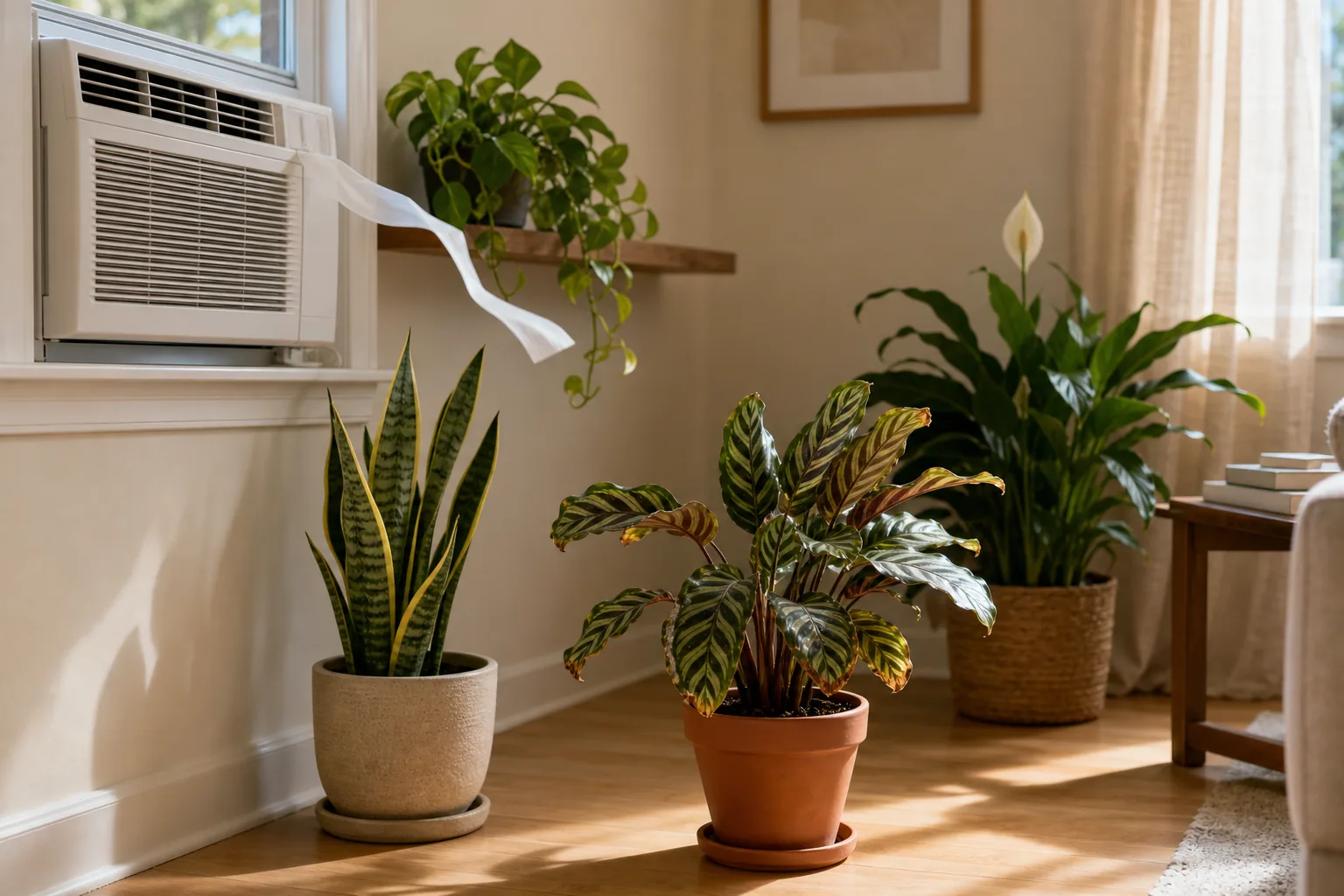
Hold a thin tissue, a piece of ribbon, or your hand at the plant while the AC is running. If it moves toward the plant steadily, the plant is in a draft path.
Stand under each supply register and trace where the air is aimed. A register pointed at a plant on the opposite wall is the most common chronic-stress setup.
Check the soil two days after a normal watering. If the top dries out much faster than it did before AC season, the room is drier and the plant is using more water.
Compare the leaves facing the vent with the leaves on the sheltered side. One-sided damage points to a draft, while damage on both sides that builds over weeks points to low humidity.
Photograph the plant once a week during AC season and compare. Slow cumulative changes are easier to see in images than in daily observation.
If those tests suggest a draft, move the plant or block the path. If they suggest a drier room, raise local humidity and adjust watering by feel. If they suggest that the watering rhythm is off, change what you do to the plant rather than overhauling the schedule. The AC is not the enemy of the plant. A cold plume aimed at the same leaves for eight hours a day is one of the three problems, a room that has become much drier than the plant is used to is another, and a watering rhythm that has quietly drifted out of sync is the third. All three are fixable with placement, observation, and a willingness to adjust by feel rather than by calendar.
Sources
The material in this article is supported by commercial and regional horticultural sources, since university extension and botanical garden publications on air conditioning and houseplants specifically were not available at the time of writing. Use these as starting points and cross-check against a local nursery or extension service when a plant’s symptoms are unusual or persistent.